A New Space Race Begins 🛰️ Rare Minerals, Water & Helium-3 Found on the Moon
For decades, humanity believed the Moon was a silent, lifeless rock drifting in space.
A relic of ancient collisions.
A frozen archive of the early solar system.
But new discoveries from the far side of the Moon are challenging that quiet narrative in ways few expected.

China’s ambitious lunar exploration program has returned samples from a region no nation had ever touched before.
And what scientists are finding in laboratories is rewriting textbooks, igniting geopolitical tension, and raising uncomfortable questions about what else may be hiding beneath the lunar surface.
At the center of the story is Chinese Lunar Exploration Program and its methodical series of Chang’e missions, named after the Chinese moon goddess.
Unlike short-term headline missions, this program has unfolded in calculated stages.
Orbiters first mapped the surface in detail.
Landers followed.
Rovers explored terrain untouched by Apollo astronauts.
And finally, sample-return missions brought pieces of the Moon back to Earth.
The turning point came in 2019 when Chang’e 4 achieved what no country had accomplished before: a successful landing on the far side of the Moon.
The far side is permanently hidden from Earth by tidal locking, making communication impossible without a relay satellite.
China solved this by placing a communications satellite at a gravitational balance point beyond the Moon, creating a bridge for data transmission.
The rover began exploring Von Kármán crater inside the immense South Pole-Aitken Basin, one of the largest and oldest impact structures in the solar system.
What it found stunned mission scientists.
Among the first anomalies was a strange shiny substance described as gel-like with an unusual greenish luster.
It reflected light differently from surrounding lunar dust.
After detailed spectrometer analysis, researchers concluded it was likely impact melt breccia, a glᴀssy material formed by extreme meteorite impacts.
Yet its apparent freshness and structural properties did not match expectations for a region thought to be geologically inactive for billions of years.
Soon after, the rover encountered translucent glᴀss spheres scattered across the surface.
Unlike the microscopic beads brought back by Apollo astronauts, these globules were large and nearly perfect in shape.
Their formation required extreme heat and pressure, yet their size and clarity challenged standard impact models.
The deeper revelations came from the basin itself.
The South Pole-Aitken Basin spans roughly 2,500 kilometers across the lunar far side.
Scientists believe a colossal asteroid strike more than four billion years ago punched through the crust, potentially exposing mantle material from deep within the Moon.
Instruments detected significant concentrations of low-calcium pyroxene and olivine, minerals typically ᴀssociated with the lunar mantle rather than the crust.
These findings suggested that the impact may indeed have excavated materials from tens of kilometers beneath the surface.
In 2024, Chang’e 6 completed the first-ever sample return from the lunar far side.
Laboratory analysis confirmed the presence of mantle-related minerals, providing direct evidence that the basin exposed deep internal layers of the Moon.
This matters because it challenges existing formation models.
The prevailing theory holds that the Moon formed from debris after a mᴀssive collision between early Earth and a Mars-sized body.
But the compositional differences between the near and far sides now appear more pronounced than expected.
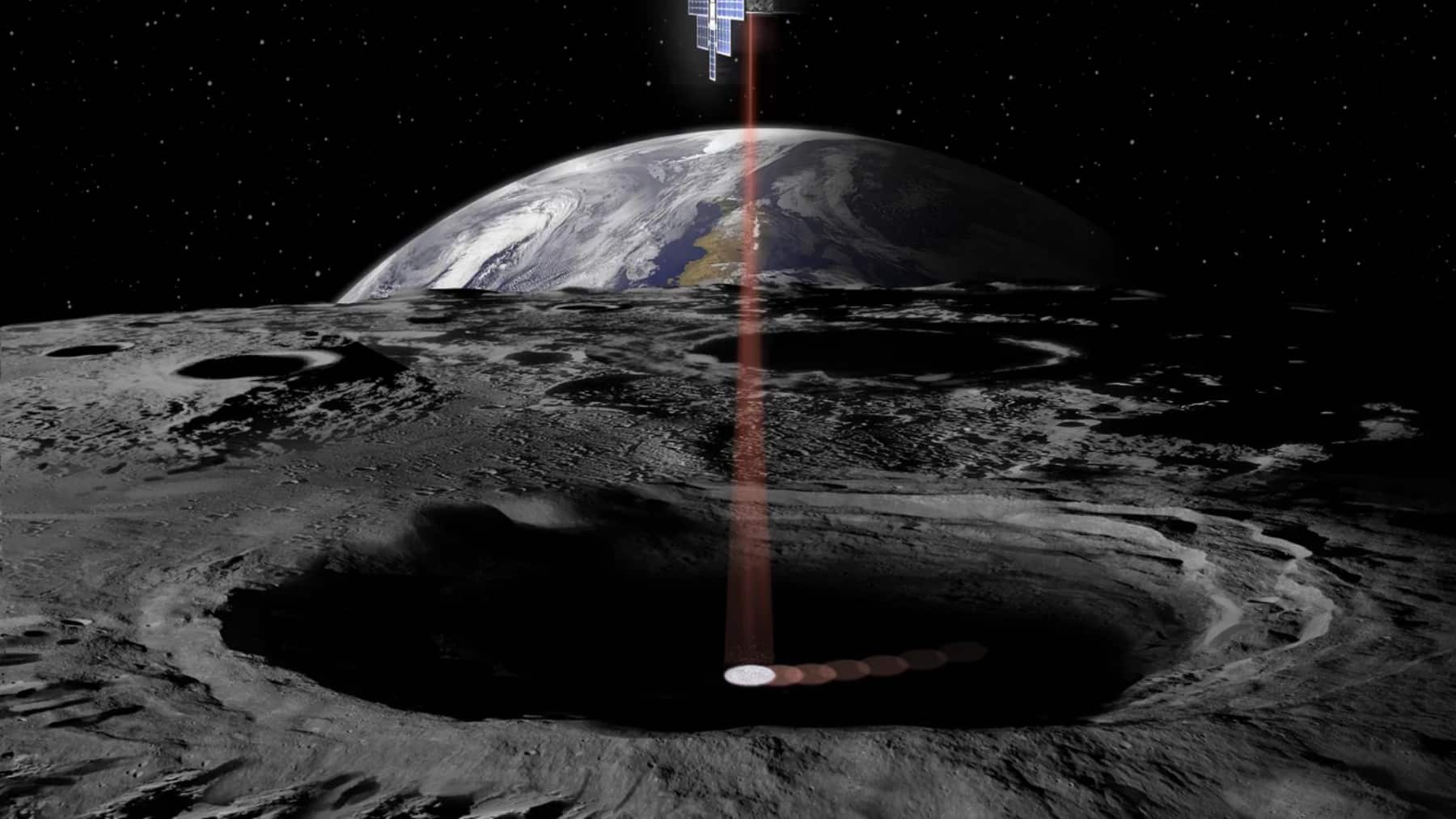
The far side has a thicker crust, fewer radioactive heat-producing elements, and a different volcanic history.
Ground-penetrating radar from the far side revealed stacked basalt layers beneath the surface, indicating repeated volcanic eruptions in a region once believed too cool and crust-heavy to support prolonged volcanism.
In simple terms, the far side should have been geologically quieter than the near side.
The data suggests otherwise.
Then came the mineral that made headlines.
Samples returned by Chang’e 5 led to the identification of a new lunar mineral named Changesite-Y.
This phosphate crystal, only microns wide, formed under extreme impact conditions.
It is one of only a handful of new minerals ever discovered on the Moon.
But the real intrigue lies in what it contains: helium-3.
Helium-3 is a rare isotope almost nonexistent on Earth but implanted into lunar soil by solar wind over billions of years.
It is considered a potential fuel for nuclear fusion, a cleaner alternative to current nuclear fission reactors.
Theoretically, a single ton of helium-3 could produce enormous amounts of energy without the radioactive waste ᴀssociated with conventional nuclear power.
Estimates suggest the Moon could contain vast quanтιтies embedded in its regolith.
Extracting it would require industrial-scale mining operations, heating large volumes of lunar soil to release the trapped isotope.
The confirmation of helium-3 presence in returned samples has intensified global interest in lunar resources.
The Moon is no longer just a scientific curiosity.
It is a potential energy reserve.
Water discoveries add another layer.
For decades, scientists believed the Moon was bone dry outside permanently shadowed polar craters.
Chang’e 5 detected water molecules in sunlit regions.
Even more remarkable, microscopic glᴀss beads formed by micrometeorite impacts were found to contain chemically bound water at measurable concentrations.
These beads are widespread across the lunar surface.
This means water resources may not be limited to extreme polar conditions.
Water can be split into hydrogen and oxygen for rocket fuel, used for life support, and provide radiation shielding.
Together, helium-3 and water transform the Moon from a barren wasteland into a strategic ᴀsset.
This is where science intersects with geopolitics.
NASA administrator Bill Nelson acknowledged in congressional testimony that the United States is in a space race with China regarding lunar access.
The compeтιтion centers particularly on the lunar south pole, where water ice and favorable solar illumination create prime conditions for permanent bases.
China’s International Lunar Research Station aims to establish a sustained presence before 2035.
Plans include power generation, resource extraction experiments, and eventually human habitation.
Meanwhile, NASA’s Artemis program faces schedule delays and budget pressures.
The stakes extend beyond prestige.
A permanent lunar base capable of producing fuel from water and potentially harvesting helium-3 would provide enormous economic and strategic advantages.
The Moon becomes a staging ground for deeper space missions and a gateway for controlling access to cis-lunar space.
What makes China’s approach notable is its consistency.
Each Chang’e mission builds on previous capabilities.
From orbiters to landers to rovers to sample returns, the program has unfolded step by step with clear objectives.
Apollo missions, for all their triumph, explored only a narrow equatorial band on the near side.
They never visited the far side.
They never sampled polar regions.
They operated within a short timeframe driven by Cold War urgency.
Today’s missions reveal just how incomplete that early exploration was.
The far side’s geological differences, mantle exposures, volcanic layers, new minerals, and distributed water resources paint a far more complex lunar picture than previously imagined.
The Moon is not uniform.
It is asymmetric, dynamic in its history, and potentially rich in usable resources.
These findings do not suggest alien structures or supernatural anomalies.
They suggest something more consequential: humanity underestimated the Moon.
As laboratories continue analyzing far side samples, further surprises may emerge.
Each grain of regolith carries clues about solar wind interactions, ancient impacts, and planetary formation.
What is certain is that the narrative has shifted.
The Moon is no longer just a destination for symbolic landings.
It is becoming the foundation for sustained off-Earth infrastructure.
A resource hub.
A scientific archive.
A geopolitical chessboard.
For the first time since Apollo, the lunar surface feels like the beginning of something larger.
And this time, the leadership dynamic looks different.
China has landed on the far side.
Returned its samples.
Identified new minerals.
Confirmed resources once considered speculative.
The Moon is revealing its secrets.
And the race to control them has only just begun.


