🔬 Supercomputer Analysis Reveals Mysterious Energy Pattern in Ancient Cloth
For centuries, the Shroud of Turin has stood at the center of one of the world’s most intense religious and scientific debates.
The long strip of ancient linen, measuring more than fourteen feet, bears the faint image of a man who appears to have suffered wounds consistent with crucifixion.
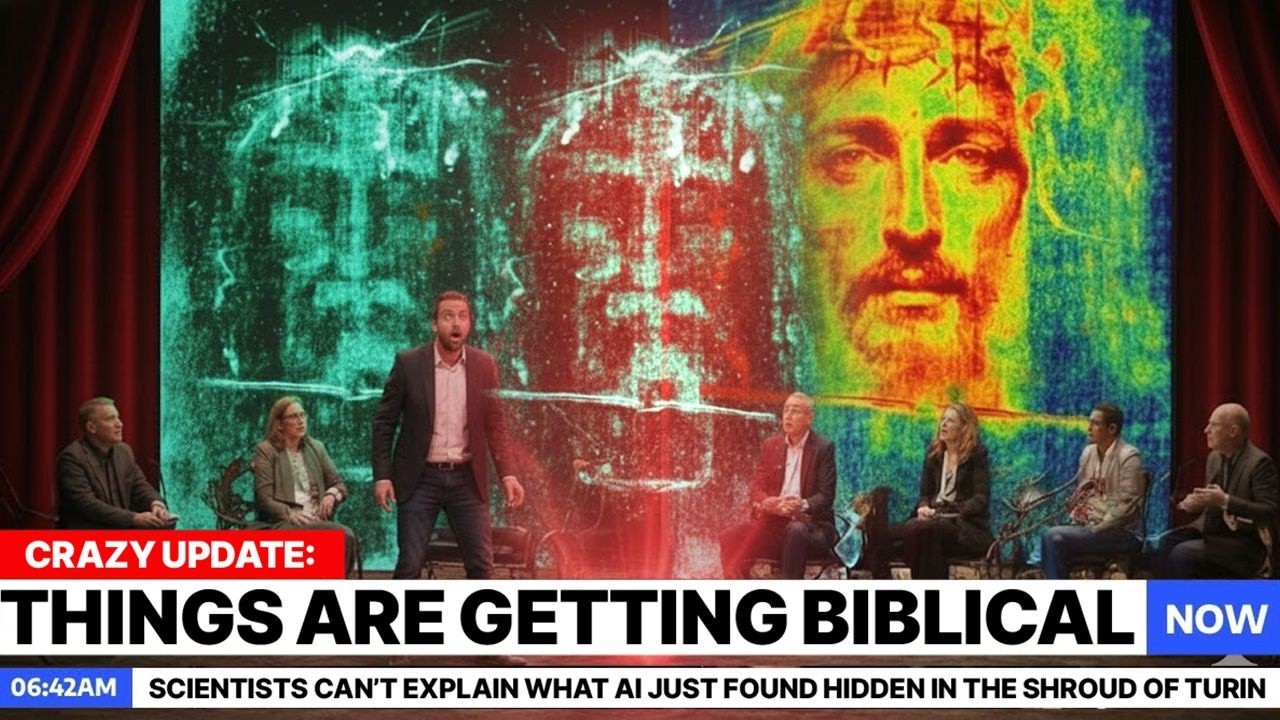
Many believers see it as the burial cloth of Jesus.
Many skeptics see it as a medieval forgery.
The arguments have lasted for generations, fueled by new tests, new claims, and new discoveries.
Now, a new wave of attention has emerged, this time driven by artificial intelligence.
According to recent reports, a powerful computer system equipped with advanced AI tools was used to analyze high-resolution scans of the cloth.
The system, described as using neural networks similar to those employed in space-signal processing, examined the microscopic fibers of the fabric in unprecedented detail.
The goal was not to prove or disprove its authenticity, but to analyze the structure of the imag
What the system reportedly found has sparked fresh debate.
Instead of identifying traditional artistic techniques, such as brushstrokes, pigments, or dyes, the AI analysis suggested that the image may contain what some researchers describe as a mathematically consistent signal embedded within the uppermost layers of the fibers.
This signal appeared to contain three-dimensional information, almost like a topographic map encoded into the cloth.
The idea is not entirely new.
In the 1970s, scientists working with early image-processing technology discovered that the shading on the Shroud seemed to correspond to distance.
When the image was processed using a special device, it produced a three-dimensional representation of a human form.
This was unlike typical paintings, where shading is determined by artistic choices rather than physical distance.
But the latest analysis claims to go further.
According to the reports, the AI detected patterns in the microfibers that suggest the image may have been formed by an extremely brief burst of energy.
The proposed explanation involves vacuum ultraviolet radiation, a form of energy that exists in a very short wavelength range.
The theory suggests that the image could have been created by a burst of energy lasting less than a fraction of a second.
Some estimates mentioned in the reports describe a burst of power in the range of tens of trillions of watts, concentrated over a tiny time window.
To put this into perspective, such levels of energy are comparable to what modern high-energy excimer lasers can produce under controlled laboratory conditions.
Researchers who support the theory argue that no known medieval technology could have produced such an effect.
They suggest that if the calculations are accurate, the image may have been formed by a process that is still not fully understood.
However, many scientists urge caution.
The Shroud of Turin has been studied for decades, and previous analyses have produced conflicting results.
One of the most famous tests, conducted in 1988, used radiocarbon dating to estimate the age of the cloth.
The results suggested that the fabric dated back to the medieval period, between the years 1260 and 1390.
This finding led many to conclude that the Shroud was not from the time of Jesus.
Yet the carbon dating itself has been questioned over the years.
Some researchers argue that the sample used for testing may have come from a repaired section of the cloth rather than the original material.
Others point to contamination from smoke, bacteria, or handling over centuries.
The new AI-based analysis adds another layer to this already complex debate.
Supporters of the findings believe the technology offers a fresh perspective.
Instead of focusing only on the age of the fabric, they argue, researchers can examine how the image was formed.
If the image truly contains three-dimensional information and was created by a burst of energy, it would challenge conventional explanations.
Traditional painting techniques would not produce such patterns, and chemical processes alone might not account for the precision described in the reports.
Still, critics note that extraordinary claims require extraordinary evidence.
The idea of a mᴀssive energy burst encoded into ancient cloth raises questions about methodology, data sources, and interpretation.
Without peer-reviewed studies and independent verification, many experts remain skeptical.
Artificial intelligence, while powerful, is not infallible.

It depends heavily on the data it receives and the algorithms used to interpret that data.
Patterns detected by AI systems must still be confirmed through traditional scientific methods.
There is also the broader issue of interpretation.
Even if the image on the Shroud contains unusual properties, that does not automatically confirm a specific historical or religious explanation.
Science can analyze materials, structures, and energy patterns, but questions of faith and meaning often go beyond measurable data.
The Shroud has always existed at the intersection of science and belief.
For some, it is a sacred relic that confirms the events described in the Gospels.
For others, it is a fascinating historical artifact, regardless of its origin.
And for many scientists, it remains an unsolved puzzle.
The new claims about AI analysis have reignited public interest, especially among those who see the Shroud as a possible physical record of an extraordinary event.
The idea that advanced technology might uncover hidden details in the cloth adds a modern twist to a centuries-old mystery.
Whether these findings will stand up to scientific scrutiny remains to be seen.
Researchers will likely continue to examine the data, repeat the analyses, and test the claims.
As with previous discoveries related to the Shroud, the debate is unlikely to end quickly.
What is clear is that the Shroud of Turin continues to captivate the world.
From medieval pilgrims to modern scientists, people have been drawn to the cloth’s mysterious image.
Each new test, each new theory, adds another chapter to its long and complicated history.
Now, with artificial intelligence entering the picture, the conversation has taken a new turn.
The possibility that hidden patterns exist within the fibers of the cloth suggests that even after centuries of study, the Shroud may still hold secrets waiting to be uncovered.
Whether those secrets point to a natural process, an unknown technique, or something more mysterious, the story of the Shroud remains one of the most intriguing intersections of faith, science, and history.


