“Pozzuoli Cracking Out of Control: As the Ground Splits Open, a Terrifying Sign an Ancient Volcano Beneath May Be Awakening”
The cracks appeared without ceremony.
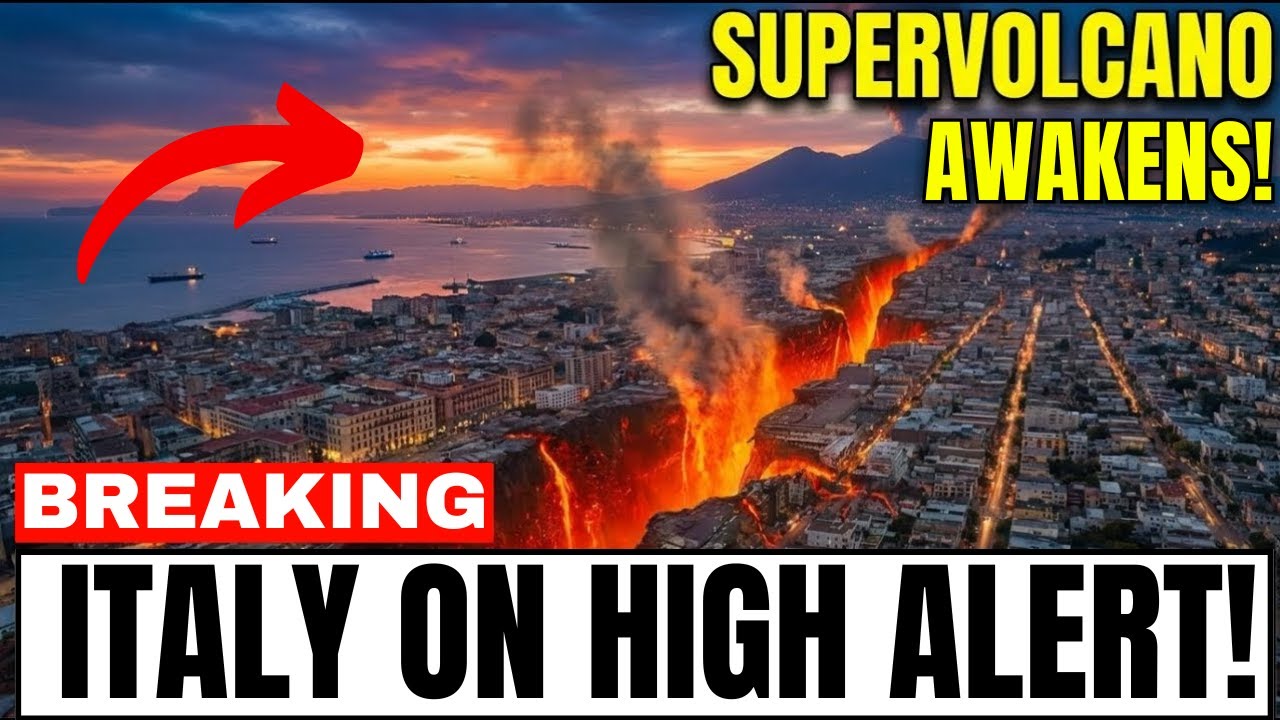
No warning sirens, no dramatic explosions, no columns of fire rising into the sky.
Just lines—thin at first—etched into the streets of Pozzuoli, snaking across sidewalks, walls, and ancient stone as if the ground itself had begun to lose patience with silence.
Locals noticed doors that no longer closed properly, pavements that tilted at unfamiliar angles, and fissures that widened not by centimeters in years, but perceptibly within weeks.
At first, officials called it routine.
Pozzuoli, after all, has always lived on restless land.
But routine things do not behave like this.
Pozzuoli sits inside Campi Flegrei, one of the most complex and least understood volcanic systems on Earth.
Unlike a single, towering volcano, Campi Flegrei is a vast caldera—a scar left behind by ancient eruptions so powerful they reshaped the Mediterranean region.
The last major eruption occurred in 1538, forming Monte Nuovo in just a few days.
Since then, the area has never truly rested.
The ground rises and falls in a phenomenon known as bradyseism, lifting entire neighborhoods meters upward, then slowly letting them sink again.
It is a cycle the residents have learned to live with.
What unsettles scientists now is not that the ground is moving—but how, and where.
Recent measurements show that sections of Pozzuoli have risen more than any time in decades.
GPS stations record acceleration rather than steady uplift.
Seismic swarms ripple through the subsurface, shallow and frequent, too weak to cause destruction but too persistent to ignore.
And then there are the cracks—some stretching for kilometers, forming suspicious alignments that appear to trace deeper structures below.
One such fracture, according to multiple field reports, extends in a direction that has reignited an old and uncomfortable question: could Campi Flegrei and Mount Vesuvius be connected?
Officially, the answer is no.
The two systems are considered distinct, separated by geology and history.
Yet unofficially, the idea has never disappeared.
Ancient Roman writers described the region as a single, breathing landscape of fire.
Medieval maps marked it as cursed ground.

Even modern volcanology admits gaps in understanding when it comes to deep magma pathways beneath southern Italy.
What lies several kilometers below the surface cannot be seen directly—only inferred through vibrations, gas emissions, and ground deformation.
And lately, those signals are refusing to stay neatly categorized.
Gas sensors around Campi Flegrei show rising concentrations of carbon dioxide and sulfur compounds, some seeping from places that were previously inactive.
Fumaroles hiss louder, H๏τter.
In Solfatara, temperatures fluctuate in ways that defy previous models.
Scientists insist this does not mean an eruption is imminent.
They repeat this carefully, almost ritualistically.
But they also admit that the system is pressurizing.
Magma may be intruding upward, or hydrothermal fluids may be heating rapidly.
The distinction matters to experts.
To the public, both sound equally ominous.
What has intensified the unease is the geometry of the fractures themselves.
Several geologists have quietly noted that the orientation of newer cracks aligns with deep fault systems that trend toward the Vesuvius area.
This does not prove a connection—but it raises eyebrows.
Magma does not need a straight tunnel to influence neighboring systems.
Stress transfer alone can destabilize regions tens of kilometers away.
If pressure is redistributing beneath Campi Flegrei, could Vesuvius feel it? And if so, would anyone recognize the signs in time?
Vesuvius, for its part, remains eerily quiet.
Its silence is not reᴀssuring.
The volcano that destroyed Pompeii in AD 79 has a history of long dormancy followed by sudden violence.
It looms over Naples, home to more than three million people, its slopes densely populated despite every warning history has left behind.
Emergency plans exist, evacuation routes are mapped, drills are conducted.
But those plans ᴀssume a familiar scenario: one volcano, one crisis.
Campi Flegrei does not follow simple scripts.
Unlike Vesuvius, Campi Flegrei could erupt from multiple vents, potentially within the city itself.
Past eruptions have opened fissures in unexpected places—fields, hillsides, even near the coast.
A future eruption might not announce itself with a dramatic cone but with a tearing sound, the sudden opening of the ground, and a plume rising from where no volcano stood the day before.
This possibility is discussed in academic papers, but rarely emphasized in public statements.
Panic, authorities say, would be more dangerous than the phenomenon itself.

Still, the people of Pozzuoli are not blind.
Fishermen notice changes in the harbor.
The sea floor rises and falls, forcing boats to adjust moorings.
Ancient Roman ruins that once lay submerged now sit exposed again, their columns bearing tidal marks from centuries of vertical motion.
These stones have witnessed cycles of upheaval long before modern instruments existed.
To some residents, they feel like warnings left behind by history—markers of what happens when the land decides to move.
Rumors spread faster than data.
Social media fills with images of cracks, exaggerated or real, accompanied by ominous captions.
Some claim to hear underground booms at night.
Others report animals behaving strangely, though such accounts are impossible to verify.
Scientists urge caution, but the lack of definitive answers fuels speculation.
When experts say, “We are monitoring the situation closely,” it is meant to reᴀssure.
Instead, it reminds people that even the most advanced technology cannot predict exactly what will happen next.
Behind closed doors, discussions are more candid.
Contingency models are being updated.
Thresholds for alert levels are reᴀssessed.
Some researchers argue that the system is approaching a critical state, where small changes could trigger disproportionately large responses.
Others counter that Campi Flegrei has exhibited similar unrest before without erupting.
Both may be right.
The most unsettling truth is that there is no single indicator that marks the precise boundary between unrest and catastrophe.
The cracks in Pozzuoli, then, become symbols as much as physical features.
They represent uncertainty—lines drawn across a city that sits atop forces measured in geological time but capable of acting in human moments.

Whether they are merely surface expressions of pressure release or the first visible signs of something deeper remains unresolved.
The earth does not provide explanations.
It only responds to laws that operate far below the level of human concern.
For now, life continues.
Cafés remain open.
Children go to school.
Tourists pH๏τograph steam rising from volcanic vents, unaware of how closely curiosity and danger coexist here.
But beneath the routines, a quiet vigilance has taken hold.
People glance down more often, watching the ground as if it might speak again.
In Pozzuoli, the cracks are not just in the pavement.
They have opened in certainty itself.
If this unrest subsides, it will be cited as another false alarm, another reminder that living on volcanic land requires tolerance for anxiety.
If it does not, historians may look back on these months as the prologue—when the signs were visible, debated, and ultimately underestimated.
Between those two outcomes lies a narrow corridor of time, filled with measurements, models, and uneasy waiting.
The ground has already moved.
That much is undeniable.
The question no longer whispered but carefully avoided is whether it is settling—or gathering strength for what comes next.


