On Sunday morning, February 22, 2026, smoke began rising over the resort skyline of Puerto Vallarta. American tourists and beachfront H๏τels woke to what sounded like construction or demolition—booms loud enough to rattle glᴀss and send guests onto balconies in confusion.
It was not construction.
Within hours, burning vehicles blocked highways across western Mexico. At Guadalajara International Airport, travelers sprinted through terminals as rumors spread of gunfights and road closures. The U.S. Embᴀssy issued a security alert advising Americans in multiple Mexican states to shelter in place.
The cause of the chaos was a single military operation in a small mountain town roughly two hours southwest of Guadalajara. Mexican special forces had just killed one of the most powerful drug traffickers in the world: Nemesio Oseguera Cervantes, better known as El Mencho, founder and leader of the Cártel Jalisco Nueva Generación (CJNG).
For more than a decade, he had evaded capture while building one of the most violent and profitable criminal organizations in modern history. The United States had placed a $15 million bounty on his head. The DEA considered him as dangerous and influential as Joaquín Guzmán.
Now he was ᴅᴇᴀᴅ.
But to understand why his killing triggered near-instant unrest across multiple Mexican states, you have to understand the empire he built—and the methods that made CJNG different.

Nemesio Oseguera Cervantes was born in 1966 in the rural western state of Michoacán. Details of his early life remain murky, but records show he worked as both a police officer and an avocado farmer before turning to organized crime.
In the late 1980s, he illegally crossed into the United States and settled in California. He was arrested on heroin trafficking charges and deported—then returned. In 1992, authorities caught him again on drug charges. He served three years in federal prison before being deported a second time.
Back in Mexico, he did not attempt to go straight. Instead, he embedded himself within existing trafficking networks and steadily rose through the ranks.
The turning point came in 2010 when Mexican security forces killed Ignacio Coronel Villarreal, a senior figure in the Sinaloa Cartel. The organization fractured, and Oseguera Cervantes seized the opportunity.
By 2011, he and his allies had formed what became the Cártel Jalisco Nueva Generación, named after the western state where they were based.
A Cartel That Fought Like an Army
From the beginning, CJNG operated differently from traditional trafficking groups.
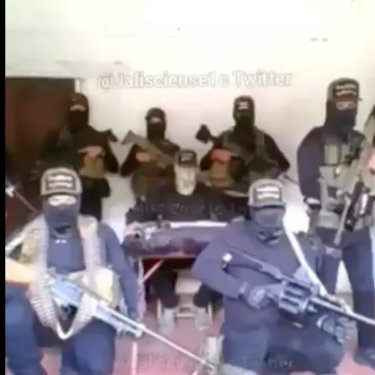
The cartel invested heavily in weapons, military tactics, and professional recruitment. It brought in former soldiers and police officers. It acquired rocket-propelled grenade launchers, armored vehicles, and advanced communications equipment. It pioneered the use of weaponized drones capable of dropping explosives. It laid roadside mines to slow military pursuit.
CJNG was not merely a trafficking network—it functioned as a paramilitary force.
In April 2015, CJNG ambushed a convoy of state police officers in Jalisco, killing 15 in one of the ᴅᴇᴀᴅliest single attacks on Mexican security forces in recent history.
A month later, cartel gunmen sH๏τ down a Mexican military helicopter with a rocket-propelled grenade during an operation targeting El Mencho. Nine personnel died. It marked the first time organized crime had downed an aircraft in Mexico’s drug war.
The message was unmistakable: CJNG would confront the state directly—and had the firepower to do it.
The Fentanyl Empire
While CJNG trafficked cocaine, heroin, and methamphetamine, its most profitable—and devastating—product was fentanyl.
The synthetic opioid is up to 100 times more potent than morphine. Just two milligrams can be fatal.
CJNG became one of the primary suppliers flooding American markets with counterfeit pills laced with fentanyl. At the height of the U.S. opioid crisis, more than 110,000 Americans died from drug overdoses in a single year, the majority involving synthetic opioids.
El Mencho’s son, Rubén Oseguera González, known as El Menchito, played a major role in expanding those operations. Extradited to the United States in 2020, he was convicted in 2024 and sentenced in 2025 to life in prison plus 30 years. Prosecutors said he oversaw mᴀssive drug shipments and ordered more than 100 murders.
But his father remained free—rarely pH๏τographed, constantly moving, surrounded by layered security rings reportedly designed to ambush anyone who approached.
For years, that strategy worked.
CJNG expanded operations into at least 21 of Mexico’s 32 states and established distribution networks reaching all 50 U.S. states. It became the primary rival to the Sinaloa Cartel, once led by Joaquín “El Chapo” Guzmán.
The Raid
On February 22, 2026, Mexican special forces—acting on intelligence reportedly supported by U.S. interagency cooperation—launched a targeted operation in a mountain town in Jalisco.
A firefight erupted. Four CJNG members were killed at the scene. Oseguera Cervantes was wounded and captured along with two others. During transport to Mexico City, he died from his injuries.
Authorities seized armored vehicles and heavy weaponry, including launchers capable of downing aircraft.
Mexico’s Defense Ministry confirmed the killing. U.S. officials called it a major breakthrough in the fight against organized crime.
But within hours, retaliation began.


