In an age defined by constant alerts, endless commentary, and a relentless demand for attention, there exists a place that has chosen a radically different path.
Far from the digital noise of modern life, on a narrow peninsula in northern Greece, stands Mount Athos.
Known for centuries as the Holy Mountain, it has no interest in trends, publicity, or relevance.
Its purpose is singular and unwavering.
For more than a thousand years, Mount Athos has been devoted to one pursuit alone, the continuous search for God through prayer, silence, and discipline.
Mount Athos is not holy because of its height or dramatic geography.
Its holiness is rooted in intention.
The mountain is home to a self governing monastic republic made up of twenty active monasteries.
These are not historic exhibits or preserved ruins.

They are living communities where monks continue ancient rhythms of worship that predate the modern world.
Life on the mountain is intentionally stripped of distraction.
There are no crowds, no entertainment venues, and no personal branding.
The absence of modern noise is not accidental.
It is essential.
One of the most widely known aspects of Mount Athos is the ancient rule that no women may enter the territory.
This tradition, known as the avaton, has been observed for more than a millennium.
According to Orthodox tradition, the Virgin Mary once visited the peninsula, blessed it, and claimed it as her spiritual garden.
From that moment, the land was dedicated entirely to monastic life.
The restriction is not framed by the monks as rejection of the world, but as an act of consecration.
The mountain exists to support a specific calling, a life fully oriented toward prayer.
Each day on Mount Athos begins long before sunrise.
Many monks rise as early as three in the morning.
Instead of reaching for a device or scanning headlines, they begin with liturgy.
Hours are spent chanting psalms, reading sacred texts, and standing in stillness.
Their daily schedule follows a rhythm shaped centuries ago, untouched by modern efficiency or productivity standards.
Time is not measured by ᴅᴇᴀᴅlines but by prayer.
This deliberate resistance to change is one of the most striking features of Mount Athos.
While the surrounding world constantly reinvents itself, the Holy Mountain remains anchored in memory and purpose.
This is not stubbornness for its own sake.
It is a conviction that some truths do not improve with revision.
In a culture consumed by self expression and visibility, the monks practice disappearance.
Their goal is not recognition, but faithfulness.
Over the centuries, Mount Athos has drawn visitors from all walks of life, including artists, scholars, and public figures.
Among them was filmmaker Mel Gibson, who visited the mountain quietly before beginning work on The Pᴀssion of the Christ.
He returned years later, again without attention or ceremony.
Such visits highlight a recurring pattern.
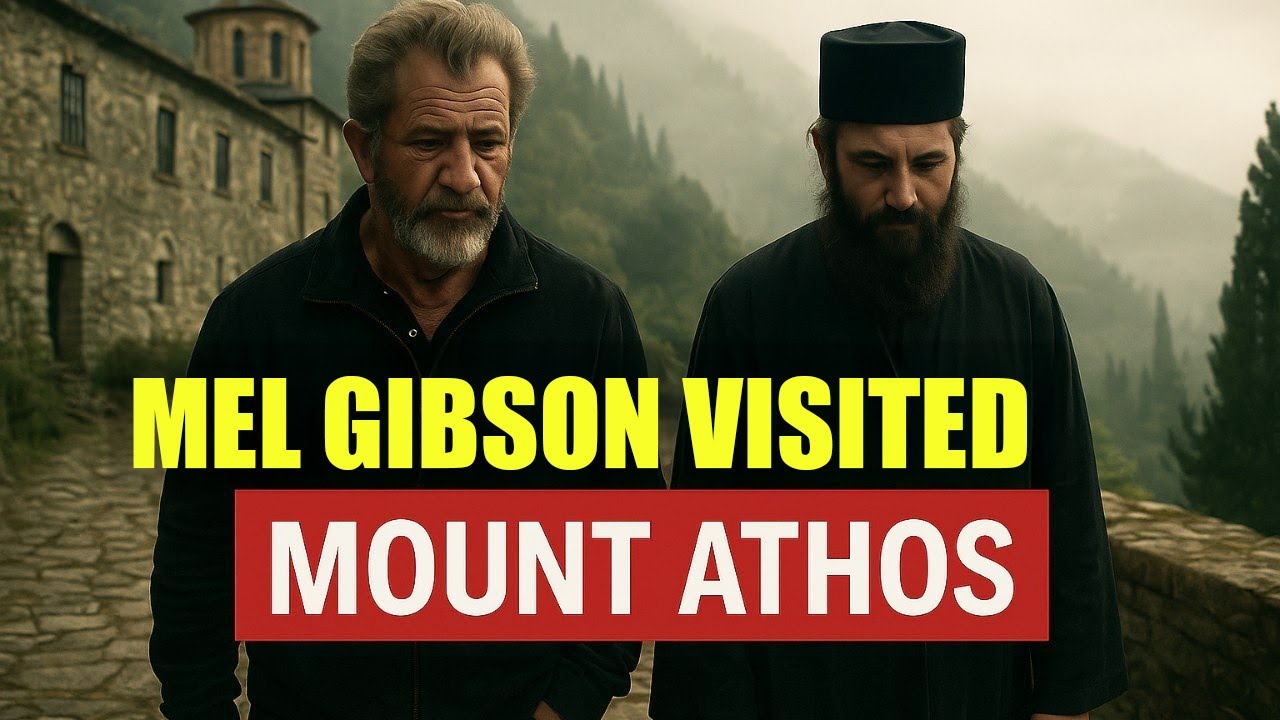
Even those who have experienced fame and success often arrive at Athos seeking something that achievement could not provide.
The silence of the mountain does not entertain.
It confronts.
It exposes the inner noise that many carry without realizing it.
To understand Mount Athos fully, one must look deep into its past.
The peninsula appears in ancient Greek writings as early as the fifth century before the common era.
In those texts, it was ᴀssociated with myth and legend.
Over time, as Christianity spread across the Roman world, the idenтιтy of the mountain transformed.
By the fourth century after Christ, men seeking a life of ascetic devotion began settling there.
These early monks were inspired by the desert fathers, believers who withdrew into solitude to practice fasting, prayer, and self discipline.
For these early ascetics, solitude was not escape.
It was formation.
Caves became places of worship.
Forest paths became corridors of meditation.
The natural environment itself became part of their spiritual training.
In the year 963, a defining moment occurred when Saint Athanasius the Athonite founded the Great Lavra, the first major monastery on the mountain.
This event marked the formal beginning of organized monastic life on Athos.
From that foundation, monastic communities multiplied.
Rulers and emperors recognized the significance of what was happening on the peninsula.
They offered protection, resources, and recognition.
Yet the monks remained focused on their calling.
While empires rose and fell, while wars reshaped borders and societies fractured, Mount Athos endured.
Its stability did not come from political power but from spiritual resolve.
At its height, the monastic population of Mount Athos reached more than twenty thousand.
Today, the number is closer to one thousand.
Despite the decrease, the influence of the mountain has not diminished.
The monasteries still house priceless icons, handwritten manuscripts, and sacred relics.
These items are not treated as artifacts for display but as living witnesses to faith practiced over centuries.
Visitors often describe the silence of Athos as overwhelming.
It is a silence that penetrates beyond sound, forcing reflection.
Without constant stimulation, inner restlessness becomes visible.
For many, this experience is unsettling at first.
Yet it is within this quiet that many discover clarity.
Silence on Mount Athos is not emptiness.
It is an invitation.
The architecture of the monasteries reflects this philosophy.
There are no stages or dramatic lighting.
Worship is led by untrained voices chanting ancient prayers.
The words are simple and repeated, emphasizing humility and dependence rather than eloquence.
Prayer here begins not with confidence, but with need.
It would be easy to dismiss Mount Athos as irrelevant to modern life, a relic disconnected from contemporary concerns.
Yet that ᴀssumption misses its deeper significance.
Athos is not anchored in the past.
It is anchored in eternity.
While society pursues relevance, the mountain preserves reverence.
In doing so, it poses a quiet challenge.
What is lost when stillness disappears.
What happens when prayer becomes secondary to performance.
To those who understand spiritual life, Mount Athos is not a retreat from conflict.
It is a front line.
The monks view their vocation as spiritual watchfulness.
Their prayers are offered not only for themselves, but for the world beyond the peninsula.
Their fasting and discipline are acts of resistance against despair, pride, and distraction.
This work is entirely hidden.
There are no broadcasts or updates.
Faithfulness on Athos is measured by consistency, not visibility.
A monk who spends his life preparing candles and opening the chapel before dawn may never be known outside the mountain.
Yet his offering is considered no less valuable than any public ministry.
The monks believe that prayer has real impact.
Ancient Christian teaching holds that sincere prayer carries power beyond what can be measured.
Many Orthodox believers repeat a saying that if prayer ever ceased on Mount Athos, the world itself would falter.
Whether taken literally or symbolically, the message is clear.
Hidden faithfulness matters.
In a culture obsessed with recognition, Mount Athos practices anonymity.
The goal is not to be remembered, but to be faithful.
Monks often renounce their former idenтιтies entirely, even their family names.
In doing so, they reject the need to be known and choose instead to be transformed.
Stories from visitors reinforce this impact.
Many arrive exhausted, skeptical, or disillusioned.
Few leave unchanged.
Transformation on Athos is rarely dramatic.
There are no spectacles or promises.
Change happens quietly, often through a single realization.
The recognition of inner emptiness.
The relief of surrender.
Mount Athos stands today as a living contradiction to modern ᴀssumptions.
It insists that silence can be stronger than noise.
That humility can outlast ambition.
That prayer, when practiced faithfully, still holds power.
The mountain does not ask others to imitate its lifestyle completely.
Few are called to monastic life.
But it does offer a reminder.
Space for silence is not optional.
Attention shapes the soul.
What one listens to eventually defines what one becomes.
Mount Athos has survived because it refuses to forget this truth.
When the noise fades and the structures of the world shift, what remains are those rooted in something deeper than trend or applause.
Mount Athos quietly bears witness to that reality.
It does not shout its message.
It lives it.


