Authorities in Las Vegas have released new details surrounding a complex investigation into a suspected illegal biological laboratory discovered inside a residential property in the northeast part of the city.
The update was provided by senior officials from the Las Vegas Metropolitan Police Department, the Federal Bureau of Investigation, and the Clark County Fire Department, outlining how the investigation began, the precautions taken, and the current status of the case.
The investigation began slightly more than one week ago when the Las Vegas Metropolitan Police Department received limited but concerning information suggesting that laboratory style equipment and potentially hazardous materials were being stored inside a private residence.
The property was located in a quiet neighborhood on Sugar Springs Drive, an area not previously ᴀssociated with industrial or scientific activity.

Due to the unclear nature of the materials involved, authorities immediately initiated a preliminary ᴀssessment.
As investigators examined property records and ownership history, they identified a significant connection.
The home was owned by an individual previously linked to an illegal biological laboratory discovered in Reedley, California in 2023.
That earlier case raised national concern after officials uncovered unregulated biological materials believed to be ᴀssociated with infectious illnsses, including hepaтιтis, Cvid, HIV, malaria, and other potentially dangerous agents.
Although it was not yet confirmed whether similar substances were present in the Las Vegas home, the connection alone prompted heightened concern.
Given the seriousness of the Reedley case, law enforcement leaders determined that the Las Vegas situation required extreme caution.
The possibility of exposure to unidentified biological or chemical substances led the Las Vegas Metropolitan Police Department counterterrorism section and its all hazard response units to partner immediately with the FBI.
Together, they launched a joint investigation and began planning a highly controlled operation.
Preparations for the operation were extensive.
Resources were mobilized from across Clark County and the City of Las Vegas, with ᴀssistance from state and federal partners.
Additional expertise was brought in from outside the region to ensure the safety of officers, residents, and the surrounding community.
Officials emphasized that the goal was not speed, but precision and safety.
During the early stages of the investigation, authorities identified Ari Solomon as the primary suspect arrested in the Las Vegas case.
Solomon, age 55, was taken into custody on charges related to the disposal and discharge of hazardous waste.
Investigators believe Solomon served as the property manager for multiple residences, including homes on Sugar Springs Drive and Temple View.
The owner of the Sugar Springs property, meanwhile, remains in federal custody in connection with the earlier Reedley investigation.
The first operational phase began early Saturday morning.
At approximately 5:51 a.m., a Las Vegas Metropolitan Police Department SWAT team executed a search warrant at the Sugar Springs Drive residence.
Inside the home were three individuals who had each rented a room independently from the property owner.
Authorities safely removed all three occupants and confirmed that they were not involved in the investigation.
Investigators believed that the locked garage attached to the residence was the primary area of concern.
:max_bytes(150000):strip_icc():focal(749x0:751x2)/las-vegas-biological-lab-4-020426-1dc2fccbf48e49a88a86c9e6439690a2.jpg)
Intelligence suggested that the garage contained the laboratory equipment and unknown substances referenced in the initial tip.
Because of this, the search warrant was authored by the counterterrorism section, and a multi agency response was activated.
To minimize risk, authorities relied heavily on technology.
Police drones were deployed at the outset of the operation to provide real time aerial views and situational awareness.
Commanders monitored live drone feeds remotely, allowing them to evaluate conditions, adjust strategies, and reduce direct exposure for personnel on the ground.
A tactical robotic unit, commonly referred to as a robot dog, was also used.
Before any human entry into the garage area, the robot was sent inside to conduct an initial ᴀssessment.
The device was capable of opening doors, navigating тιԍнт spaces, and transmitting live video back to the command center.
It also performed preliminary air sampling to detect potential hazards.
Once the residence interior was deemed stable, the Las Vegas Metropolitan Police Department all hazard response unit, known as ARMOR, entered the scene.
This multi agency team specializes in chemical, biological, radiological, nuclear, and explosive response.
Wearing protective suits and respirators, the team drilled a small access point into the interior garage door to insert air sampling probes and a pinhole camera.
The camera transmitted live video feeds to the on site command post and to the Fusion Watch operations center at police headquarters.
Almost immediately, investigators observed multiple refrigerators, a freezer, and various pieces of laboratory style equipment.
Numerous jugs and bottles containing unknown liquid substances were visible.
Officials noted that the visual appearance of these items closely matched those documented in the Reedley laboratory case.
Following the initial ᴀssessment, ARMOR personnel escorted FBI scientists and a specialized evidence collection team into the garage.
One refrigerator was found partially sealed with household plastic wrap, while a freezer remained plugged in and operational.
When opened, both units contained a significant volume of stored materials, including vials and containers holding liquids of varying colors and consistencies.
Additional containers were discovered throughout the garage alongside laboratory tools and specialized devices.
Some items appeared consistent with biological and chemical storage methods, further increasing concern.
Because none of the materials were immediately identifiable, investigators treated the entire environment as potentially hazardous.
The complexity of the scene required multiple controlled entries into the garage over several days.
Each entry followed strict safety protocols, including full protective gear and extensive decontamination procedures upon exit.
All equipment used during the operation also underwent repeated decontamination to prevent cross contamination.
Due to these precautions, the operation progressed slowly and methodically.
Officials stated that this approach was necessary to ensure both safety and accuracy.
Large scale evidence collection primarily took place during daylight hours on Sunday, while planning and coordination continued overnight.
Evidence collection concluded at approximately 6:30 p.m.on Sunday.
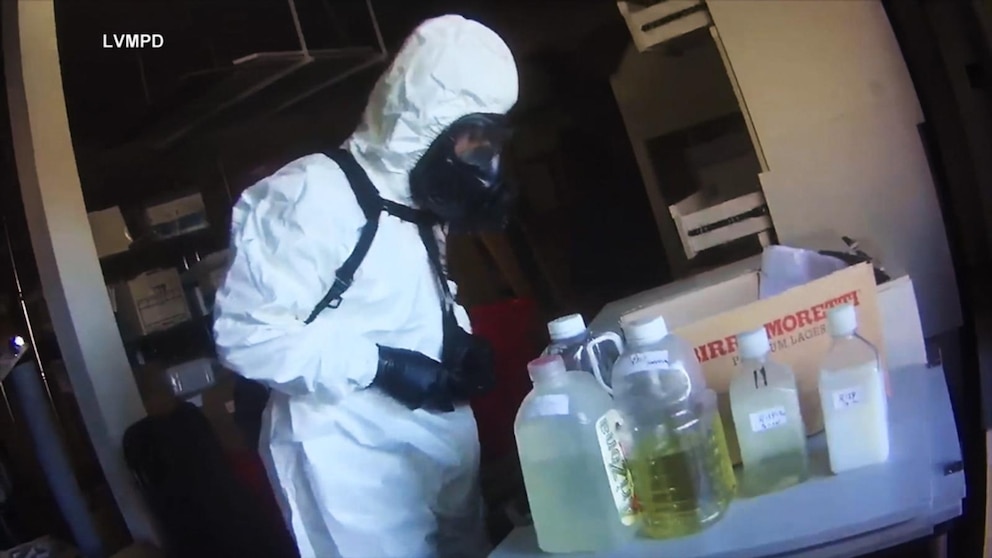
All collected materials were transported under controlled conditions to a Southern Nevada Health District facility, where they were placed in temperature regulated storage.
Authorities emphasized that this step was temporary and designed to preserve the integrity of the materials until further testing.
The final phase of the operation focused on remediation of the property.
A professional remediation team was contracted to decontaminate the residence and ensure that no hazardous materials remained.
This process was completed at approximately 2:30 a.m.
Following remediation, final inspections were conducted, and all units were demobilized.
The scene was officially cleared shortly thereafter.
On the following morning, all secured evidence was transferred to an FBI laboratory for detailed analysis.
Testing will determine the exact nature of the substances recovered and whether they pose any long term public health concerns.
Investigators have not yet released a timeline for test results.
Officials reiterated that there is currently no known threat to the public.
Throughout the operation, no exposure incidents were reported among officers, residents, or first responders.
Authorities stressed that the extensive precautions taken were preventative and not indicative of confirmed danger.
The investigation remains ongoing, with federal and local agencies continuing to examine evidence and trace potential connections to other locations or individuals.
The case has renewed calls for stronger oversight of private laboratory activities and clearer regulatory frameworks to prevent similar situations in the future.
As the investigation moves forward, officials say transparency and public safety will remain top priorities.
Further updates are expected once laboratory testing is completed and additional findings are confirmed.


