A Message Written in Light? 🕊️ The Turin Enigma That Won’t Go Away
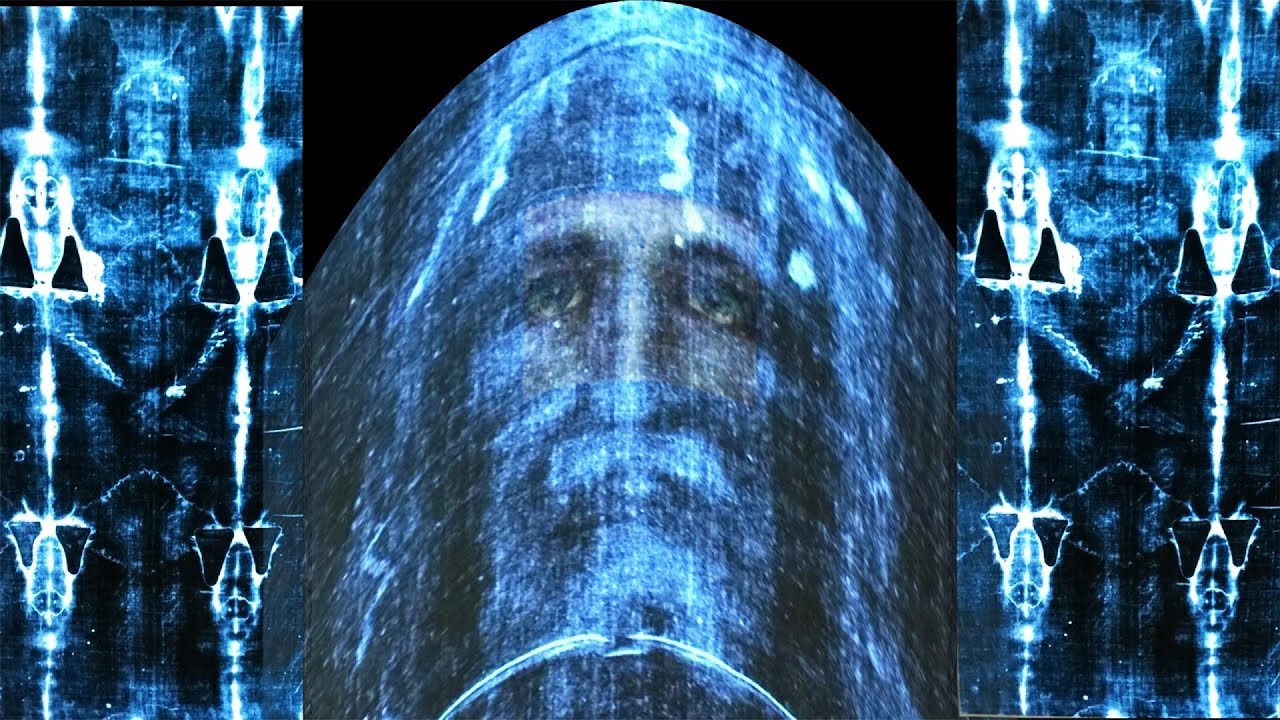
Imagine unfolding an ancient linen cloth and discovering the full-length image of a brutally beaten man.
His body bears the marks of scourging.
His head shows punctures consistent with a crown of thorns.
His wrists and feet appear pierced.
Blood flows follow gravity in a way forensic experts say matches crucifixion.
Now imagine something even more unsettling: the image behaves like a pH๏τographic negative, contains three-dimensional information, and displays characteristics similar to an X-ray and a hologram.
Yet it existed centuries before pH๏τography, radiography, or laser optics were ever invented.
That is the mystery surrounding the Shroud of Turin.
For millions of believers, it is the burial cloth of Jesus Christ.
For skeptics, it is an elaborate medieval forgery.
For scientists, it remains one of the most perplexing artifacts ever studied.
But beyond the debate over authenticity lies a deeper question that refuses to fade: how was the image formed at all?
The cloth, more than four meters long, bears the faint sepia-toned front and back image of a man.
At first glance it looks like a faded painting.
But detailed analysis has revealed something shocking.
There is no pigment, no paint, no dye.
Under magnification, only the outermost layer of microscopic linen fibers is discolored.
The coloration penetrates only a fraction of the thickness of a human hair.
Even more astonishing, only about one fibril out of roughly 200 in a thread is affected.
No brush could achieve that.
No known medieval technique can discolor fibers so selectively and so superficially across such a large surface.
The image is not sitting on the cloth like paint.
It is a chemical change within the surface layer itself, a process scientists describe as rapid aging, dehydration, and oxidation of the linen.
So what could cause such a phenomenon?
To understand the possibility, researchers often look to a modern historical event: the atomic bombing of Hiroshima.
After the explosion, eerie human silhouettes were discovered imprinted on walls and sidewalks.
At first glance they appeared painted.
In reality, the intense burst of light and radiation bleached the surrounding surfaces.
Where a human body blocked the light, the original color remained, creating what looked like a shadow.
There was no brush.
No ink.
No physical carving.
Only light and heat interacting with material surfaces.
The Shroud presents similarities.
The body appears to have been extremely close to the cloth.

The image is darker where the body was nearer and fades where the cloth would have hung farther away.
The shading encodes distance.
And unlike the Hiroshima shadows, the Shroud image carries measurable three-dimensional information.
When scientists processed the image using a VP8 image analyzer, a device originally designed for NASA, the brightness values translated into an accurate 3D representation of a human form.
Paintings and pH๏τographs do not behave this way.
Their brightness variations produce distorted shapes when run through the same analysis.
The Shroud does not distort.
It renders a realistic human figure.
This discovery stunned researchers.
If the image is not pigment, and not simply a stain, then what created it? Experiments attempting to replicate the superficial discoloration on linen fibers have produced the closest results using high-intensity ultraviolet radiation, specifically UVB light delivered in extremely concentrated bursts, similar to laser pulses.
Ultraviolet radiation is known to cause rapid aging and browning in organic materials.
Human skin tans under UV exposure.
Linen fibers can undergo similar oxidative changes.
But ordinary sunlight scatters broadly and cannot target individual fibrils with microscopic precision.
The image on the Shroud suggests a highly directional, extremely brief, high-energy event.
Where would such energy come from?
Some researchers have pointed to a little-known scientific fact: living cells emit ultraweak pH๏τon emissions.
DNA releases tiny bursts of light in the ultraviolet spectrum.
These emissions are normally faint and undetectable without sensitive equipment.
But what if, under extraordinary conditions, that emission were amplified?
The hypothesis remains controversial, but it is discussed in serious academic circles.
If a mᴀssive burst of coherent UV radiation were emitted from within the body itself, it could theoretically alter the linen fibers in direct proximity.
The cloth would act like a pH๏τographic plate.
The body would be the light source.
That would explain why the image encodes distance information.
The closer a part of the body was to the cloth, the stronger the discoloration.
As distance increased, the image faded.
But the Shroud’s mystery does not end with physics.
Forensic pathologists who have studied high-resolution pH๏τographs of the cloth describe the man as having suffered severe scourging.
More than 100 wound marks consistent with Roman flagellation appear across the back and legs.
Blood flows from the wrists, not the palms, matching the mechanics of crucifixion where nails would likely be driven through the wrist to support body weight.
There is a wound in the side with a flow pattern consistent with blood and clear fluid separation, suggesting a post-mortem piercing.
The head bears puncture wounds encircling it, not just a small cap, consistent with a thorn helmet rather than a simple wreath.
The body posture suggests rigor mortis.
Knees slightly bent.
Head inclined.
Abdomen somewhat distended.
Experts estimate the body would have been in contact with the cloth between 24 and 72 hours.
Yet there is no evidence of decomposition on the linen.
No signs of prolonged decay.
The bloodstains appear to have transferred to the cloth first.
The body image formed afterward.
This sequence suggests two separate events: contact with blood, then a later burst of energy that created the body image without disturbing the bloodstains.
The timeline aligns strikingly with the Gospel narrative of Jesus’ crucifixion, burial, and resurrection on the third day.
Of course, critics often point to the 1988 radiocarbon dating results, which placed the Shroud’s origin in the 14th century.
That finding fueled claims of medieval forgery.
But subsequent textile analysis revealed that the sampled area for testing came from a corner of the cloth known to have undergone repairs after damage.
Cotton fibers and dye were detected in that section, unlike the main body of the Shroud, which is pure linen.
If the sample included later repair material, the dating would not represent the original fabric.
Debate over the validity of the radiocarbon test continues to this day.
Adding to the intrigue, the image behaves like a negative.
When pH๏τographed and inverted, facial features become strikingly clear.
Swelling, closed eyes, beard details emerge with pH๏τographic realism.
The cloth also exhibits what some describe as X-ray-like properties.
In certain areas, underlying structures such as hand bones appear subtly visible, though this interpretation remains debated.
The image is extremely superficial.
When the cloth is illuminated from behind, it nearly disappears, much like a hologram viewed incorrectly.
PH๏τograph.
X-ray.
Hologram.
Yet not fully any one of them.
There is no second artifact in human history that behaves in this way.
For believers, the implications are profound.
If the image cannot be explained by medieval artistry or chemical trickery, if it encodes 3D information and microscopic fiber alteration consistent with intense radiation, then the Shroud could represent a singular physical event.
A burst of light from a body that was no longer ᴅᴇᴀᴅ.
Some theologians describe it as a testimony written in light.
A relic not meant to be worshiped, but to provoke a question.
Who is the man in the cloth?
The Shroud does not preach.
It does not argue.
It presents a silent image of suffering and death, imprinted with mathematical precision.
Skeptics demand further testing.
Believers see confirmation.
Scientists continue to debate mechanisms involving radiation, chemistry, and textile aging.
No laboratory has successfully reproduced the image in full.
More than two thousand years after a crucifixion outside Jerusalem, a piece of linen preserved in Turin continues to ignite arguments in laboratories, churches, and universities.
Whether it is the burial cloth of Jesus or an as-yet-unexplained phenomenon, one fact remains: the Shroud of Turin challenges modern ᴀssumptions about history, physics, and faith.
It stands at the crossroads of science and belief, asking a question that echoes across centuries.
If this image truly marks the moment of resurrection, then it is not just an artifact.
It is a message.
And the message is simple.
Who do you say he is?


