🌊 AREQUIPA RIVER TURNS RELENTLESS: A CITY HOLDS ITS BREATH 🚨
The rain did not arrive with spectacle.

It came steadily, almost politely at first, veiling the skyline of Arequipa in a gray hush that felt seasonal, familiar.
Residents along the banks of the Chili River have seen storms before.
They know the scent of wet volcanic stone, the way runoff threads through narrow streets, the rhythm of water tapping against tin and tile.
Nothing about the first hours suggested that the river was measuring its moment.
Then the sound changed.
Witnesses describe it not as a splash or a crack, but as a low, sustained growl—something between distant thunder and shifting earth.
Those closest to the river say the water darkened before it rose, thick with sediment pulled from hillsides already saturated beyond reason.
By nightfall, the Chili River was no longer gliding through the city.
It was pressing against it.
Authorities would later refer to “unusually intense seasonal precipitation.” Engineers would cite accumulated runoff from higher elevations.
Yet the timeline unsettles some residents.
The surge, they insist, was too sudden, too synchronized with subtle failures along embankments that had been inspected only months earlier.
Barriers that had stood through previous wet seasons appeared to buckle almost in sequence.
Street-level videos show water curling over concrete edges as if testing them—then pouring through with force.
In the district of Alto Selva Alegre, families watched water advance across intersections that had never before flooded.
The current moved with unsettling confidence, carrying branches, fragments of fencing, and the occasional household object that no longer belonged where it had been left.
Emergency crews worked through the night, their headlights cutting through sheets of rain, evacuating homes nearest the river’s bend.
Some residents left reluctantly, convinced the waters would recede as they had in years past.
Others left without turning off lights.
Bridges trembled under the strain.
Officials confirmed structural stress in at least two crossings, prompting temporary closures.
Footage circulating on social media shows one pedestrian span vibrating as debris slammed against its supports.
The visual alone would be enough to rattle confidence.
What troubles observers more is what cannot be seen: the saturation beneath the surface, the soil losing cohesion grain by grain.
Hydrologists note that the Chili River basin has experienced periods of variability before.
El Niño patterns, shifting rainfall distribution, upstream land use changes—each factor can amplify runoff in ways that outpace infrastructure designed for another era.
Yet some local engineers, speaking cautiously, acknowledge that maintenance budgets have been stretched thin.
Reinforcements proposed after prior flooding events were delayed or reduced.
No one is prepared to say that corners were cut.
No one is fully prepared to say they were not.
As dawn broke, the scale of damage began to clarify.
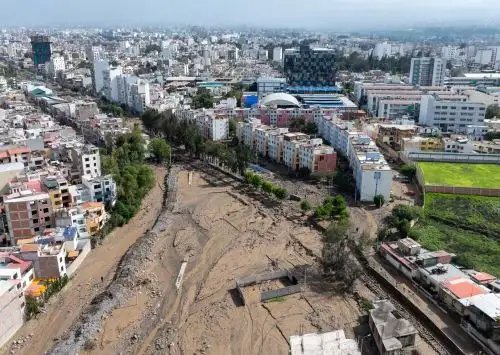
Sections of roadway near the riverbank had collapsed inward, forming jagged cavities where asphalt once lay flat.
Retaining walls showed hairline fractures that seemed to lengthen under continued pressure.
Utility poles leaned at angles that suggested slow surrender rather than sudden impact.
Electricity flickered in several neighborhoods before stabilizing, though residents report intermittent outages still ripple unpredictably through the grid.
The psychological toll is harder to quantify.
In interviews, residents describe listening for the river even when the rain subsides.

They speak of a vibration felt through floors at night, of windows rattling in rhythms that do not align neatly with wind.
One shopkeeper, whose storefront now sits inches above a layer of dried silt, said the silence after the surge was more unsettling than the noise.“It was like it had finished saying something,” he remarked, declining to elaborate.
City officials emphasize that response protocols were activated promptly.
Emergency shelters were opened.
Water pumps were deployed.
ᴀssessments are underway to determine the integrity of levees and flood defenses.
Public statements project calm, even confidence, noting that the worst of the rainfall appears to have pᴀssed.
Yet meteorological forecasts remain ambiguous.
Additional precipitation cannot be ruled out.
Soil saturation levels remain high.
The margin for error has narrowed.
There are quieter questions circulating beyond official briefings.
Why did certain drainage channels clog so quickly? Why did water levels spike with such abrupt acceleration despite monitoring systems intended to provide early warning? Some point to upstream sediment accumulation, arguing that riverbeds gradually rise when not dredged regularly, reducing capacity in critical moments.
Others raise concerns about unregulated construction along peripheral zones that may have altered natural runoff patterns.
None of these explanations, alone, fully accounts for the speed of the transformation witnessed over the past 48 hours.
In historical archives, records show that Arequipa has endured flooding episodes before, though rarely with this particular choreography of events.
The city’s geography—cradled between Andean slopes and defined by volcanic terrain—creates a complex hydrological puzzle.
Water descends from high elevations with little hesitation once pathways open.
When the ground is already burdened with moisture, resistance becomes symbolic.
By midweek, cleanup efforts had begun in earnest.
Mud was shoveled from entryways.
Furniture was hauled to sidewalks.
Children, kept home from school, watched as adults scraped sediment from tile floors in slow, repeтιтive motions.
Yet beneath the visible recovery lies a question that lingers with uncomfortable persistence: has the river merely retreated, or is it recalibrating?
Engineers surveying embankments note that water pressure can undermine structures invisibly before outward signs appear.
Microfractures in concrete may widen over days, not hours.
Saturated earth may shift incrementally until a threshold is crossed.
In that sense, the danger is not confined to moments of peak flow.
It extends into the uneasy calm that follows.
Economic implications compound the uncertainty.
Local businesses reliant on tourism face cancellations as images of flooding circulate internationally.
Agricultural areas downstream report crop losses due to prolonged submersion.
Insurance claims begin to accumulate, though coverage gaps may expose vulnerabilities in household finances.
Reconstruction funds will be debated, allocated, and perhaps contested.
Critics argue that climate variability has been signaling its intentions for years.
Increased intensity of rainfall events, they say, is no anomaly but a pattern.
Infrastructure designed for historical averages struggles when extremes become frequent.
Supporters of municipal leadership counter that no city can insulate itself entirely from nature’s volatility.
The debate, predictable in its contours, grows sharper as repair costs mount.
And still, the river moves.
On the surface, it appears calmer now—its level lower, its current less aggressive.
Yet residents along the banks report that its color remains unusually dark, as though carrying more than runoff.
Sediment levels remain elevated.
Monitoring stations track fluctuations hour by hour.
Each centimeter of rise is noted, analyzed, contextualized.
In private conversations, some officials concede that the event may prompt a reevaluation of flood defense strategies.
Proposals once deemed excessive may be reconsidered.
Reinforcements once postponed may advance in priority.
Whether funding aligns with urgency remains uncertain.
What remains undeniable is the memory of the sound—the deep, rolling resonance that preceded visible damage.
It has become a reference point in conversation, a shorthand for the moment certainty dissolved.
Residents replay it in recollection, attempting to ᴀssign meaning.
Was it simply water colliding with stone? Or was it the structural language of a system under strain?
The narrative of this flood will likely be distilled into data: rainfall totals, river height measurements, cost ᴀssessments.
Yet data rarely captures the tension of waiting in darkness as water edges closer to a doorstep.
It does not reflect the hesitation before opening a door to see whether the street still exists.
It does not account for the way silence can amplify unease.
For now, Arequipa continues its measured recovery.
Streets are drying.
Temporary barriers stand where permanent ones faltered.
Meetings are convened.
Reports are drafted.
The Chili River resumes a semblance of normal flow, threading through the city as it has for generations.
But something has shifted.
Perhaps it is only perception, sharpened by proximity to risk.
Or perhaps it is structural—a recalibration of ᴀssumptions about what is stable and what is not.
In the aftermath, the line between natural disaster and systemic oversight blurs, inviting scrutiny that extends beyond water levels.
As forecasts remain uncertain and soil remains saturated, vigilance persists.
The river has withdrawn, but it has not been forgotten.
In the quiet hours before dawn, when rain taps lightly against rooftops once more, some residents listen for that sound again—the one that seemed to signal more than rising water.
Whether it was warning, coincidence, or something less easily categorized, no official statement has settled the matter.
And in a city shaped by stone and river alike, that ambiguity may linger long after the mud has dried.


