A rare medical condition made doctors predict he wouldn’t live past age seven. But Rocky Dennis, the boy who inspired the movie *Mask*, proved them all wrong. His incredible journey touched millions of hearts and changed how the world sees those who look different. Here’s what really happened to him.
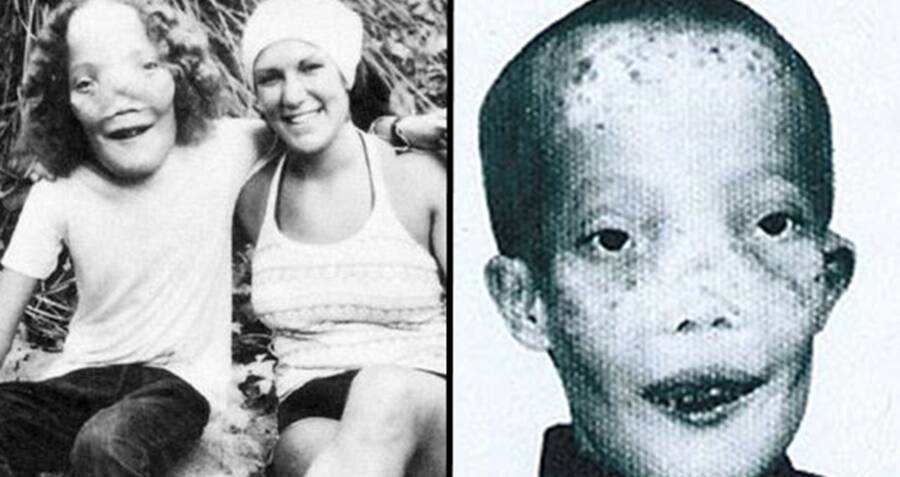
“Take off your other mask, too!” a stranger called out to the teenage boy going door-to-door on Halloween night. Rocky Dennis smiled, his uniquely shaped face stretching into a grin that was all his own. “It must be stuck on,” he joked, then continued his trick-or-treating. For Halloween was the one night he blended in. But the rest of the year, he never let his looks stop him from living his life.
Born on December 4, 1961, in Glendora, California, Roy L. “Rocky” Dennis started life as any other baby. His mother, Florence “Rusty” Dennis, and father, Roy, welcomed what appeared to be a perfectly healthy boy. He had an older half-brother named Joshua from his mom’s previous marriage, and everything seemed normal for the first two years of his life. The family soon moved to Covina, where they faced unprecedented challenges that tested their resilience and spirit.
During what should have been a routine tonsillectomy at age 2, an x-ray technician noticed something unusual about Rocky’s skull. Frequent ear and sinus infections had plagued the young boy, but no one expected what the x-rays would reveal. Further tests at UCLA Medical Center delivered a shocking diagnosis: craniodiaphyseal dysplasia. An extremely rare bone disorder that causes excessive bone tissue buildup in the skull. At the time, only seven cases had ever been recorded worldwide.
The doctor’s prognosis was devastating. They explained that the growing pressure from abnormal calcium deposits would eventually destroy Rocky’s brain. His eyes would be pushed toward the edges of his head, his nose would become distorted, and he would gradually lose both his sight and hearing. The verdict seemed final: Rocky wouldn’t live past his seventh birthday. The condition would cause severe neurological disorders, and the medical community offered little hope for the young boy’s future.
But Rusty Dennis wasn’t the kind of mother who accepted defeat easily. A free-spirited icon with an unshakable spirit, she refused to let the diagnosis define her son’s life. “I didn’t allow the doctors to talk him into death,” she later explained to United Press International. “You know what you believe works. And he believed he could stick around as long as he wanted to.” This philosophy would become the cornerstone of their approach to Rocky’s condition. Rusty’s unconventional parenting style and determination would prove crucial to Rocky’s development. Instead of isolating him or treating him as disabled, she raised him just like any other child. Her biker friends became an extended family, especially after Rocky’s parents divorced in 1971 when he was 10 years old. Though Roy remained close to his son after the divorce, it was Rusty and her community of bikers who provided the daily support system Rocky needed.
When Rocky was 6 years old, Rusty fought to enroll him in public school despite fierce opposition from educators who claimed his intelligence might be impaired. “I think they wanted to keep him out of the classroom because they thought it would bother the other kids’ parents,” Rusty recalled. The real test came when Rocky was declared blind at age six. An ophthalmologist told him he would never learn to read. Rocky’s response would become legendary. He picked up a nearby book and started reading it aloud, looking the surprised doctor straight in the eye. He declared, “I don’t believe in being blind.” It was the first of many times Rocky would defy medical expectations.
Life wasn’t always easy in the Dennis household. Money was тιԍнт, and Rocky’s medical bills were substantial—though genetic research organizations partially covered them. The constant headaches from his condition would have broken many people’s spirits. But Rocky and his mother developed an unusual coping mechanism. Instead of relying on medicine, his mother gave him natural remedies like vitamins and alfalfa sprouts and raised him on the philosophy of self-healing through force of belief. Rusty’s philosophy was simple: “I decided early in my life, if you could make yourself sick, you could make yourself well.” Whenever pain struck, she would tell him, “Go to your room and don’t come out until you’ve made yourself well.” Remarkably, it worked.
Rocky’s true character shone through in how he handled others’ reactions to his appearance. At Sanberg Junior High School in 1976, teacher Barbara Silva remembered her first encounter with him. She initially thought that he was wearing an oversized Halloween mask and had planned to ask him to remove it. When she realized her mistake, she was mortified. But Rocky’s graceful handling of the situation left a lasting impression. Years later, in 2013, Silva would recall how Rocky’s presence changed her perspective on teaching and life itself. “If I make you uncomfortable, you can move,” he would tell his classmates with disarming honesty. “But I can’t change my face.” This straightforward approach, combined with his quick wit and kind heart, made him surprisingly popular among his peers. He earned a reputation as the class comedian, using humor to bridge the gap between himself and others.
A pivotal moment in Rocky’s development came during a trip to Las Vegas with his mother. Seven-year-old Rocky noticed a female dwarf walking through the Hacienda Resort H๏τel lobby and giggled. Rusty seized this as a teaching opportunity. “Do you understand now?” she asked. “Do you understand why people sometimes treat you the way they do?” When Rocky nodded, she gave him the words he would live by: “Rocky, everyone can look like anyone else, but no one can look like you. Take pride in that.”
As he grew older, doctors offered Rocky plastic surgery to “normalize” his facial features. His response revealed wisdom beyond his years: “Who will I see in the mirror if I change my face?” He chose to remain true to himself, a decision that would later inspire countless others. Through his teenage years, this unwavering self-acceptance became his greatest strength.
Despite all medical predictions, Rocky excelled academically. He consistently ranked at the top of his class and participated in various school activities. At summer camps for handicapped children, he won numerous awards for being the “best buddy,” “most good-natured,” and “friendliest camper.” His creativity and entrepreneurial spirit showed in various ways. His determination to live life fully led him to join the school debate team, where his articulate arguments and confident presence challenged others’ preconceptions about physical differences. Teachers often remarked that Rocky’s presence in their classrooms created an atmosphere of greater empathy and understanding among his peers.
On graduation day from Sanberg Junior High, he proudly accepted his honors student certificate wearing a new suit. The gold certificate reading “Rocky Dennis – Honor Student” was a testament to his determination and intelligence, defying all early predictions about his mental capabilities.
But in September 1978, things began to change. Rocky’s health had deteriorated, and now using a wheelchair, he showed signs of fatigue that worried his mother. For the first time, he expressed regret about his condition, apologizing to Rusty for being “such a problematic child.” It was completely out of character for her eternally optimistic son.
On October 3, after a dinner out, Rocky complained of a headache. The family had gone to their favorite local diner, where Rocky’s unusual weakness was apparent to everyone. He struggled to lift his fork and barely touched his favorite chocolate milkshake. His half-brother noticed how he kept rubbing his temples throughout the meal, but Rocky insisted on staying until everyone finished, not wanting to spoil their family time. Following their usual routine, Rusty told him to go to his room and make his headache better—a phrase that had become their familiar way of handling his frequent discomfort.
Around 6:00 a.m. the next morning, October 4, 1978, Rusty heard some movement from his room but decided to let him rest longer. When she went to check on him at 10 a.m., she found that Rocky had pᴀssed away peacefully in his sleep. The room was exactly as he’d left it. He was 16 years old, having lived twice as long as doctors predicted.
“I hugged him and said goodbye,” Rusty later recalled. “But he wasn’t there. It was like embracing an empty shell. The spark that made him Rocky had already moved on.”
Even in death, Rocky continued to help others. Rusty donated his body to UCLA’s genetics Research Center, hoping that studying his case might advance understanding of his rare condition. His official cause of death was recorded as sudden arrhythmic death syndrome, though whether this was related to his craniodiaphyseal dysplasia remains uncertain. After the research was completed, his remains were cremated.
Rocky’s story might have remained known only to those who knew him if not for a chance encounter. In 1978, Anna Hamilton Phelan, working in a hospital genetics unit, met Rocky shortly before his death. When she sat down with him, she simply said, “I bet you got a story to tell.” Rocky smiled and replied, “I yes, I do.” Struck by his remarkable spirit, she later wrote the screenplay for *Mask*, the 1985 film that would share his story with the world. The movie, starring Eric Stoltz as Rocky and Cher as Rusty, won an Academy Award for Best Makeup, and Cher took home the Best Actress award at the Cannes Film Festival. Rusty received $155,000 for the rights to her story.
But the film’s real impact went far beyond awards or compensation. It changed public perception of people with facial differences and inspired Cher to become the honorary chairman of the International Craniofacial Foundation in 1989. “You know, if Rocky Dennis lived today, the doctors may have been able to help him,” Cher reflected in a 1994 *Parade* Magazine interview. “All a craniofacial wants is not to be abnormal. They just want to walk and not be looked at,” she added. “People are always drawn to what they think is beautiful, and they tend to think that beautiful people are nice people. One has no bearing on the other. Everything is so packaged now that there is a perfection orientation—that we don’t want to look at people that aren’t completely beautiful.”
Today, Rocky Dennis’s legacy lives on, not just through the film but through the countless lives he touched and the barriers he broke down. He showed the world that true beauty lies in how we treat others, not in how we look. He proved that life isn’t measured in years but in impact. Most importantly, he demonstrated that sometimes the most extraordinary heroes come in the most unexpected packages.
A year after Rocky’s death, Rusty had an experience she would never forget. She woke up in the middle of the night to find what she believed was Rocky’s spirit sitting in a chair in her bedroom. “Hi, Mom,” she recalled him saying. “I’m on my way to San Francisco. I’ll see you there.” It was a fitting farewell for a boy whose brief life had touched so many and whose story would continue to inspire generations to come.
Rocky Dennis’s journey from a baby born in Glendora, California, to becoming the inspiration for an Academy Award-winning film is more than just a medical case study. It shows the power of unconditional love, acceptance, and the indomitable human spirit. His story reminds us that every life, no matter how brief or challenging, has the potential to create lasting positive change in the world.


