🏔️🔎🌿 THE TERRACES OF Machu Picchu WERE NEVER JUST FOR FARMING — THEY WERE ENGINEERED WITH PRECISION DOWN TO EVERY LAYER OF SOIL
High above the Urubamba River, where mist coils around granite peaks and silence settles like a living presence, Machu Picchu has always felt less like a ruin and more like a question suspended in stone.
For more than a century, since its global reintroduction by Hiram Bingham III in 1911, scholars have attempted to answer that question with diagrams, excavation reports, and tidy conclusions.
They called it a royal estate.
They called it a ceremonial center.
They called its terraces an agricultural necessity.
But mountains remember what paper forgets.
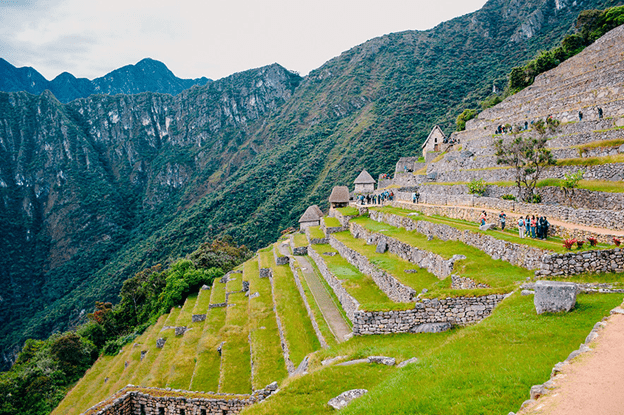
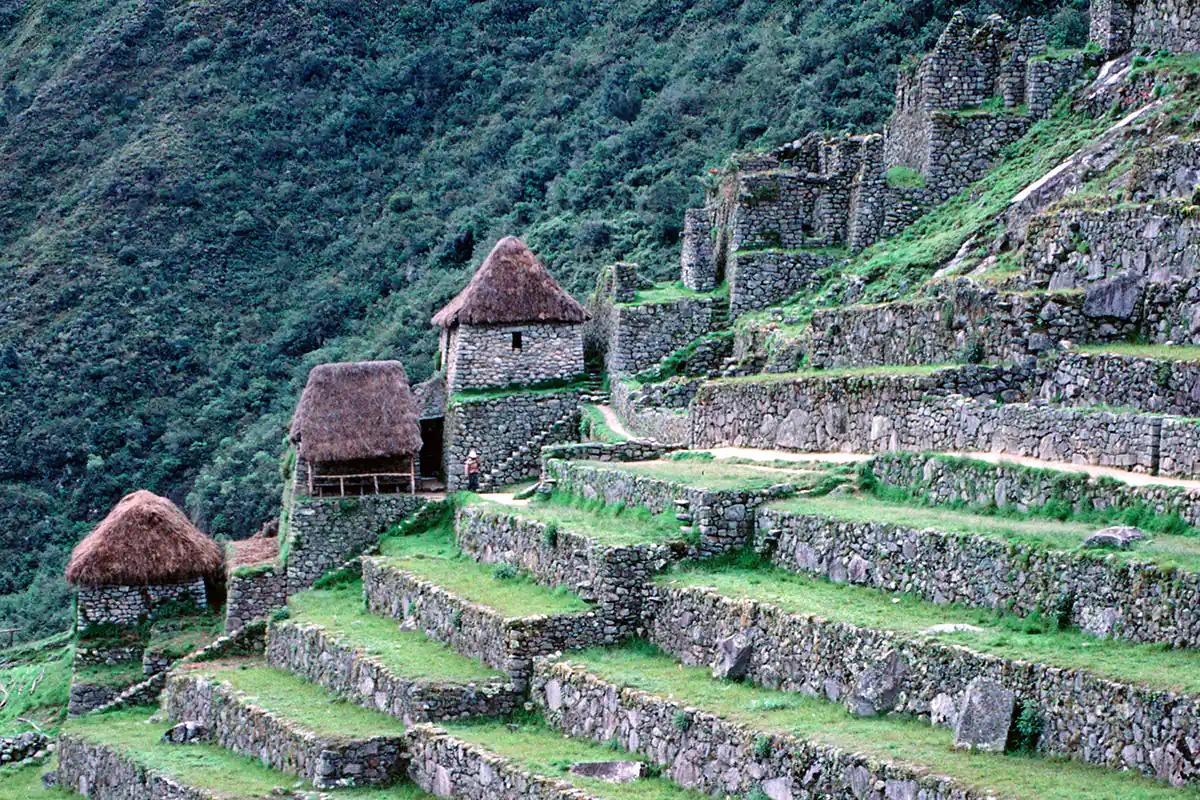
For decades, the terraces clinging to the citadel’s flanks were presented as pragmatic brilliance — a solution to thin Andean soils and punishing rainfall.
The explanation was elegant: prevent erosion, grow maize, feed an elite enclave in the clouds.
It made sense.
It reᴀssured us.
Civilizations build to survive; survival requires food; food requires land shaped by human hands.
Case closed.
Except the mountain never quite behaved like farmland.
Recent interdisciplinary studies combining stratigraphic excavation, soil micromorphology, and hydrological modeling have begun to disturb that long-settled narrative.
What researchers found beneath the visible green steps was not simply agricultural fill, but a deliberately engineered sequence of materials — coarse stone at the base, then layers of gravel, sand, and topsoil, each calibrated in thickness and permeability.
That alone would be impressive.
But what unsettles experts is not just the layering.
It is the precision.
Subtle gradients — almost imperceptible to the eye — guide water laterally and vertically through the terraces.
Drainage channels, concealed within stone retaining walls, disperse hydraulic pressure before it can accumulate.
During torrential rains, instead of collapsing into mudslides, the terraces breathe.
They inhale water.
They exhale it slowly.
The mountain does not drown.
It drains.
Agricultural fields do not usually require this degree of invisible choreography.
One hydrological simulation suggested that without this subterranean architecture, large portions of the citadel would have suffered catastrophic slope failure centuries ago.
In other words, the terraces may not primarily have been built to grow crops.
They may have been built to hold the city itself in place.
That distinction changes everything.
If the terraces functioned first as geotechnical stabilization systems — an immense retaining apparatus disguised as farmland — then Machu Picchu was not simply adapted to its environment.
It was anchored into it with surgical intent.
The Inca were not reacting to geography.
They were mastering it.
And mastery at that alтιтude is not trivial.
The Andes are restless.
The region lies within a seismically active belt where tremors ripple through stone without warning.
Heavy seasonal rainfall compounds the threat.
Landslides are not hypothetical; they are inevitable.
Yet Machu Picchu persists, improbably intact.
Why?
Some researchers now argue that nearly 60 percent of the labor invested in constructing the site may have gone into what visitors never see — drainage, substructure, slope reinforcement.
That ratio is staggering.
It suggests a civilization that understood failure modes long before modern geotechnical science codified them.
It suggests predictive knowledge.
But how predictive?
There is an unease that accompanies this line of inquiry.
Because once we admit that the terraces are structural infrastructure masquerading as agriculture, we must reconsider the entire layout of the citadel.
The sacred plaza.
The Temple of the Sun.
The ritual stones aligned with solstices.
Were these placed only for ceremony — or were they also calculated in relation to load distribution, bedrock stability, and hydrological pathways?
The more data emerges, the less accidental the city appears.
Ground-penetrating radar surveys have revealed voids and compacted zones beneath certain terrace sectors, hinting at intentional compaction strategies.
Soil samples show selective sourcing of materials from distinct ecological zones, transported uphill with extraordinary logistical coordination.
The terraces are not uniform.
They vary subtly in composition depending on their position relative to fault lines and slope angles.
Coincidence is becoming an increasingly fragile explanation.
This is where the narrative grows controversial.
Traditional interpretations emphasize Machu Picchu as a seasonal royal retreat — possibly commissioned under Pachacuti in the 15th century.
A place of ritual, astronomy, and imperial display.
But a seasonal estate does not typically demand a mountain-scale stabilization grid rivaling modern engineering logic.
A ceremonial enclave does not require such exhaustive hydraulic foresight.
Unless its purpose was more permanent.
Or more critical.
Some scholars now speculate that Machu Picchu’s location — remote, elevated, difficult to access — was not merely symbolic.
It may have been strategically chosen for geological defensibility.
Stable bedrock nodes.
Controlled drainage basins.
Natural ridgelines functioning as seismic buffers.
The terraces, in this interpretation, are less about maize and more about permanence.
Permanence against what?
Against erosion, yes.
Against earthquakes, certainly.
But perhaps also against something more existential — a recognition that empires rise and fracture, that valleys flood, that lowland centers fall.
High places endure.
There is an unsettling poetry in that possibility.
Because if the terraces were primarily structural, their agricultural function may have been secondary — camouflage in plain sight.
A utilitarian facade masking a deeper architectural ambition.
The Inca did not leave behind written records in the way European chroniclers did.
Their knowledge systems were encoded in quipu knots and stone alignments.
Perhaps their greatest engineering statement was hidden under soil, where only gravity and water could read it.
Skeptics caution against romantic overreach.
They argue that Andean agricultural systems routinely incorporated sophisticated drainage.
That mountain farming demands complexity.
That we should not inflate competence into mystique.
And they are right to warn against exaggeration.
Archaeology must resist myth-making.
Yet even the most conservative ᴀssessments acknowledge this: the terraces at Machu Picchu operate at a scale and precision that exceed subsistence necessity.
And then there is the sensory reality.
Stand on one of those terraces during the rainy season.
Feel the ground underfoot — firm, unyielding, neither waterlogged nor brittle.
Listen as runoff disappears without spectacle.
No torrents.
No collapse.
Just absorption.
Release.
Silence.
It is difficult not to sense intention.

What complicates the matter further is the broader Inca road network radiating across the Andes — a web of stone pathways threading through extreme topography with similar attention to drainage and gradient.
Machu Picchu was not an anomaly.
It was part of a systemic philosophy: architecture as negotiation with terrain.
Still, the terraces remain the most concentrated expression of that philosophy.
If current research continues to validate the stabilization hypothesis, textbooks will need revision.
The terraces will be reclassified not as peripheral agricultural appendages but as foundational engineering organs.
The city’s visible beauty — temples, stairways, carved stone — would represent only the surface anatomy of a much larger organism embedded within the mountain.
And that realization is faintly chilling.
Because it means we have been walking across the true structure without recognizing it.
For over a century, millions have pH๏τographed the terraces as picturesque steps rising toward the sky.
They admired symmetry.
They admired greenery.
They admired resilience without fully understanding its mechanism.
The revelation that these steps may be the primary reason the citadel still stands reframes every image ever taken.
The mystery is not that Machu Picchu exists.
The mystery is that it has not fallen.
Mountains erode.
Empires dissolve.
Engineering decays.
Yet here, at 2,430 meters above sea level, stone persists with unnerving composure.
Perhaps that composure was never accidental.
Perhaps the hidden detail beneath each terrace — each calibrated layer of gravel and sand — is less about crops and more about control.
Control over water.
Over weight.
Over time itself.
And if that is true, then Machu Picchu is not merely a relic of imperial ambition.
It is a silent thesis carved into geology, ᴀsserting that human foresight can outmaneuver chaos — at least for a while.
But mountains are patient.
Research is ongoing.
Data accumulates slowly.
Interpretations shift.
What feels revolutionary today may settle into consensus tomorrow.
Or fracture under new evidence.
For now, though, one fact stands firm: the terraces are no longer simple.
They are no longer decorative.
They are no longer agriculturally mundane.
They are structural.
They are intentional.
And they have been hiding in plain sight for centuries.
Which leaves us with a final, disquieting thought.
If something so fundamental could remain misunderstood for this long — embedded directly beneath our feet — what else within Machu Picchu’s stone labyrinth have we mistaken for ornament, when it was always infrastructure?


