Terrible Situation in Sicily: More Buildings Are Collapsing
You know that feeling when you see the news and think, “Man, this can’t be real”?
Well, that’s exactly how I felt when I started following what’s happening in Niscemi, a city in Sicily, Italy.
And look, I’m going to tell you something right now.
Let me grab my water here real quick because what I discovered in recent weeks left me genuinely impressed with the power of nature.
Niscemi is a city with about 25,000 inhabitants located right in the south-central part of Sicily.
You know that part of Italy that looks like a boot?
The city sits on top of a plateau, which means it’s in an elevated area.
Now, imagine with me for a second: you live in a quiet town.
You wake up on a normal Sunday, January 25, 2026, and suddenly the ground literally disappears beneath your feet.
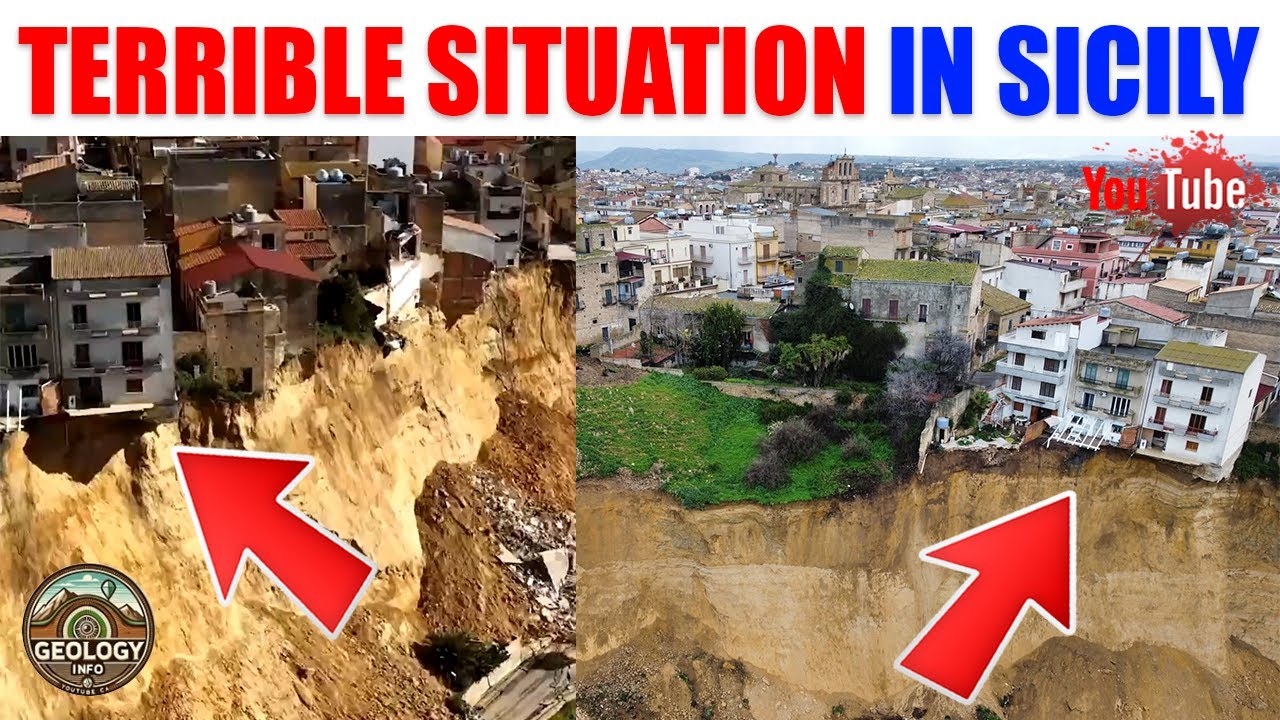
It’s not an exaggeration; it’s exactly what happened.
But before getting into the details of what’s happening now, let me explain why this region is so vulnerable.
The soil in Niscemi is rich in clay.
And here’s a detail many people don’t know: clay is like that material used to make ceramics and bricks.
It’s great at holding water, but when it absorbs too much water, it turns into a soft mᴀss that loses all its stability.
Think of a very wet cake that falls apart in your hand.
That’s kind of what happens with saturated clay soil.
And you know what makes this even more concerning?
This isn’t the first time Niscemi has gone through something like this.
Back in 1997, almost 30 years ago, the city experienced a serious landslide that forced the evacuation of 400 people.
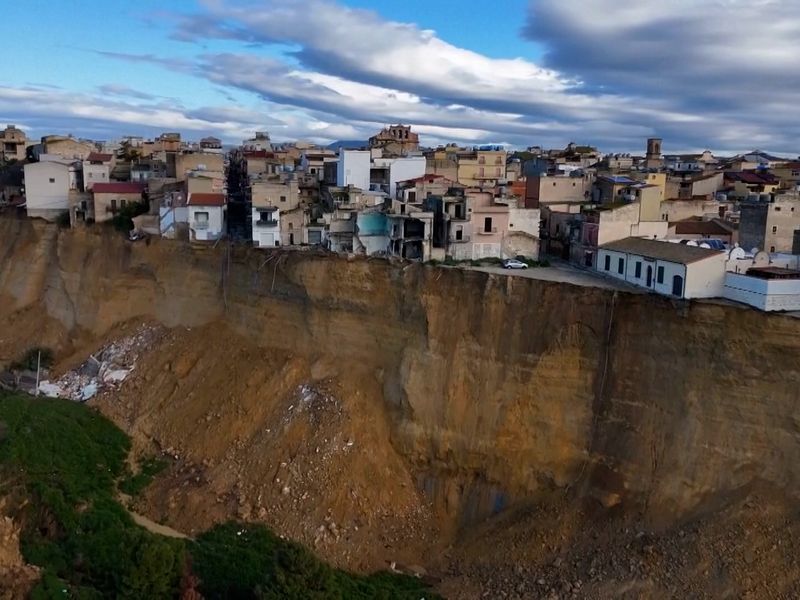
When I discovered this, I thought, “Wait a minute. If this already happened before and nobody did anything significant to prevent it, we’re facing a problem that’s been ignored for decades.”
Now, let me tell you what triggered this entire catastrophe.
In the days leading up to the major collapse, Sicily was hit by Cyclone Harry.
Oh, before I forget to mention, this cyclone was named by AEMET, which is Spain’s meteorological agency, on January 17 at 12:00 UTC time.
And man, this weather system was absolutely devastating.
Weather forecasts indicated an accumulation of precipitation of up to 11.8 inches (300 mm) in just 48 hours.
To give you an idea of what this means, 11.8 inches (300 mm) is like dumping 79 gallons (300 liters) of water on every square meter of land.
It’s an absurd amount of water falling in such a short time.
Winds reached speeds of up to 93 mph (150 km/h).
According to the mayor of Catania, a neighboring city, they hadn’t seen such a violent sea in at least 60 years.

Waves reached heights of 52 feet (16 m) between Port Apollo, Capo Pᴀssero, and the island of Malta.
That’s like the height of a five-story building being pushed by the force of the ocean.
Two entire regions were isolated because ferries and catamarans couldn’t navigate safely.
The storm was so severe that the Italian government declared a 12-month state of emergency for Sicily, Sardinia, and Calabria.
But going back to what I was saying about Niscemi, on January 16 and 17, the first signs began to appear.
Provincial Road 12, which connects Niscemi to the Gela-Catania Highway, started to crack and crumble.
The mayor, Mᴀssimiliano Ki, realized something much bigger was happening and on the 17th ordered the evacuation of 35 people from the most critical areas.
Schools were closed, and civil defense was already monitoring the region.
Then Sunday came, January 25.
That’s when everything literally collapsed.
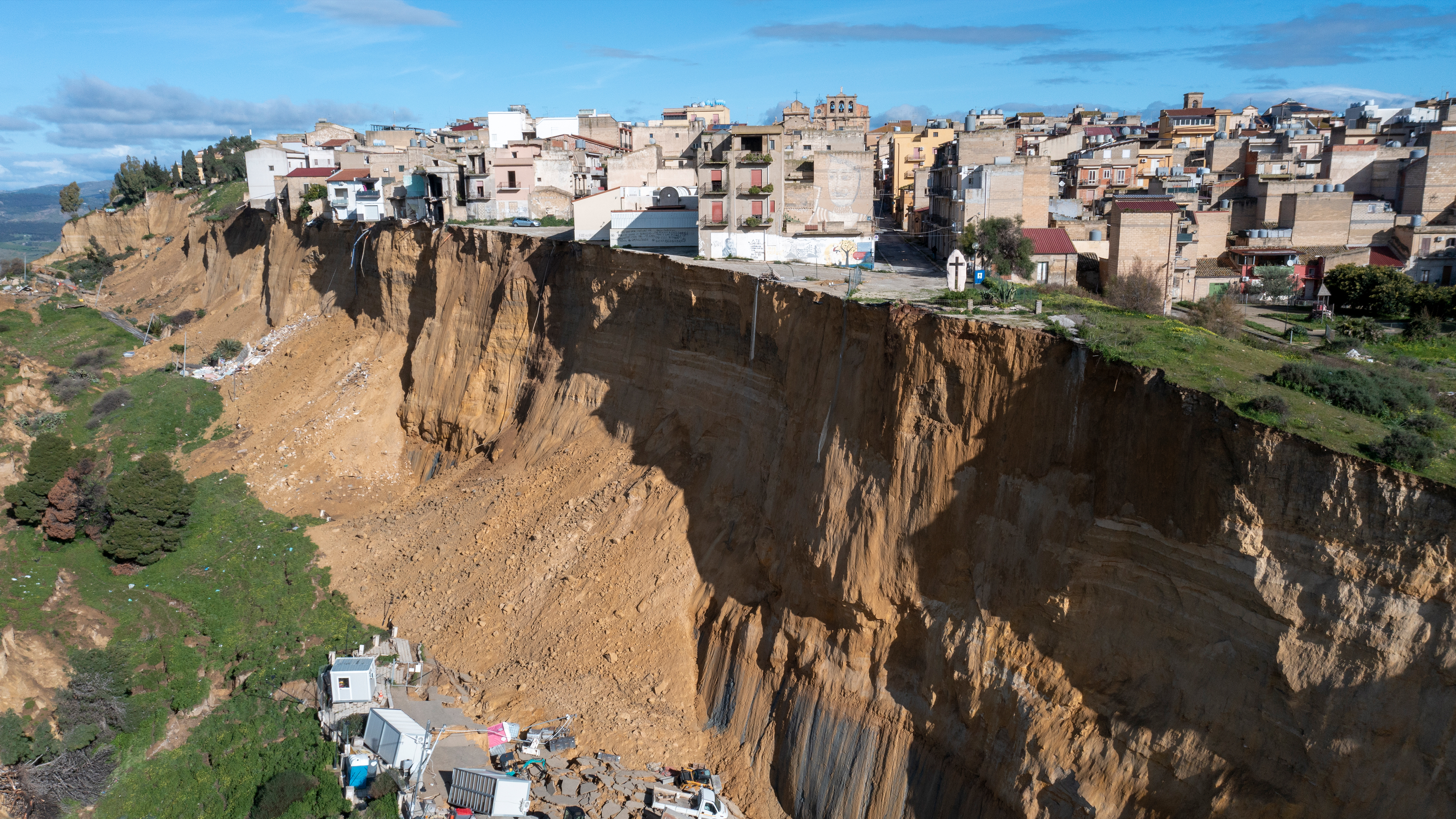
In the afternoon of that day, the landslide that had been developing slowly exploded into catastrophic proportions.
A section of the plateau that supports the city, approximately 2.5 miles (4 km) long, simply gave way and fell, opening a precipice up to 65 feet (20 m) high.
Let me rephrase this so you understand the scale better.
2.5 miles (4 km) is like the distance of more than 40 football fields lined up, and the height of 65 feet (20 m) is equivalent to a six-story building.
The neighborhoods of Santa Croce, Trapani, Vapo, and Belvedere were the most affected.
Images captured by drones show houses literally hanging on the edge of the abyss, with half the structure suspended in the air and the other half having already disappeared into the void.
When I saw these images for the first time, wow, it was like watching a geological horror movie, but it was real.
It was actually happening.
More than 1,300 people had to abandon their homes hastily.
Many of them left with only the clothes on their backs, without time to grab belongings, documents, or memories of an entire lifetime.

They were temporarily taken to a municipal gymnasium while authorities tried to ᴀssess the extent of the disaster.
And here comes the hardest part to accept.
Many of these people will never be able to return to their homes.
According to Salvo Cotina, director of Sicilian Civil Defense, it’s very likely that all properties within a strip of 165 to 230 feet (50 to 70 m) from the edge of the precipice will be dragged down.
That’s not just one person’s house; it’s like three, four, or five houses, one behind the other, that will disappear.
And the worst part is that the landslide remains active.
The situation isn’t stabilized.
The ground continues to give way slowly.
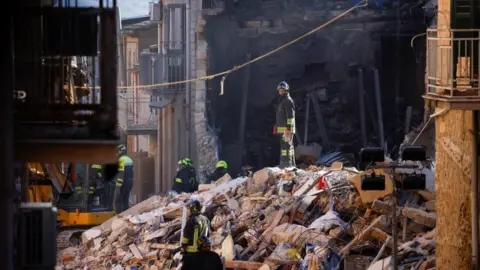
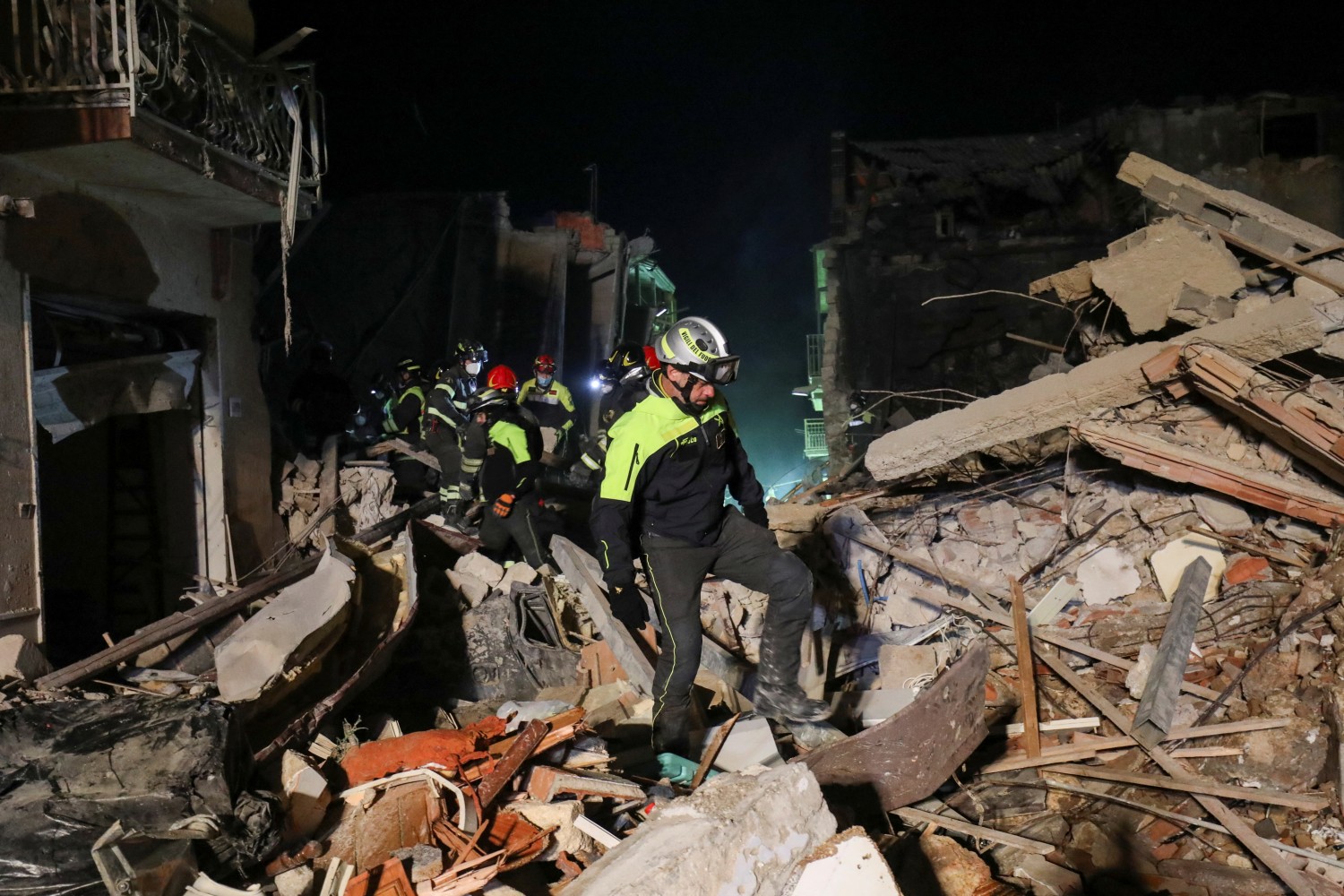
On Saturday, January 31, a three-story building that was hanging over the abyss finally collapsed after two days of additional rains that further increased instability.
Already on Sunday, February 1, pieces of other compromised buildings also gave way and fell into the ravine.

As I record this today, February 2, 2026, the landslide is still advancing.
Authorities can’t predict when it will stop.
One of the buildings at imminent risk is the Angelo Marciano Library, which houses 4,000 texts about Sicily’s history.
4,000 historical documents that could simply disappear in a landslide.
It’s like losing part of an entire region’s memory.
Five schools had to close because they’re in the so-called red zone, where there’s a risk of new landslides at any moment.
Hundreds of students are without classes.
The governor of Sicily, Renato Shiffani, personally visited the region and declared in an interview with broadcaster Sky TG24, and here I’ll quote what he said: “It’s an unprecedented situation.”
He personally saw a locality that risks collapsing before an enormous void.
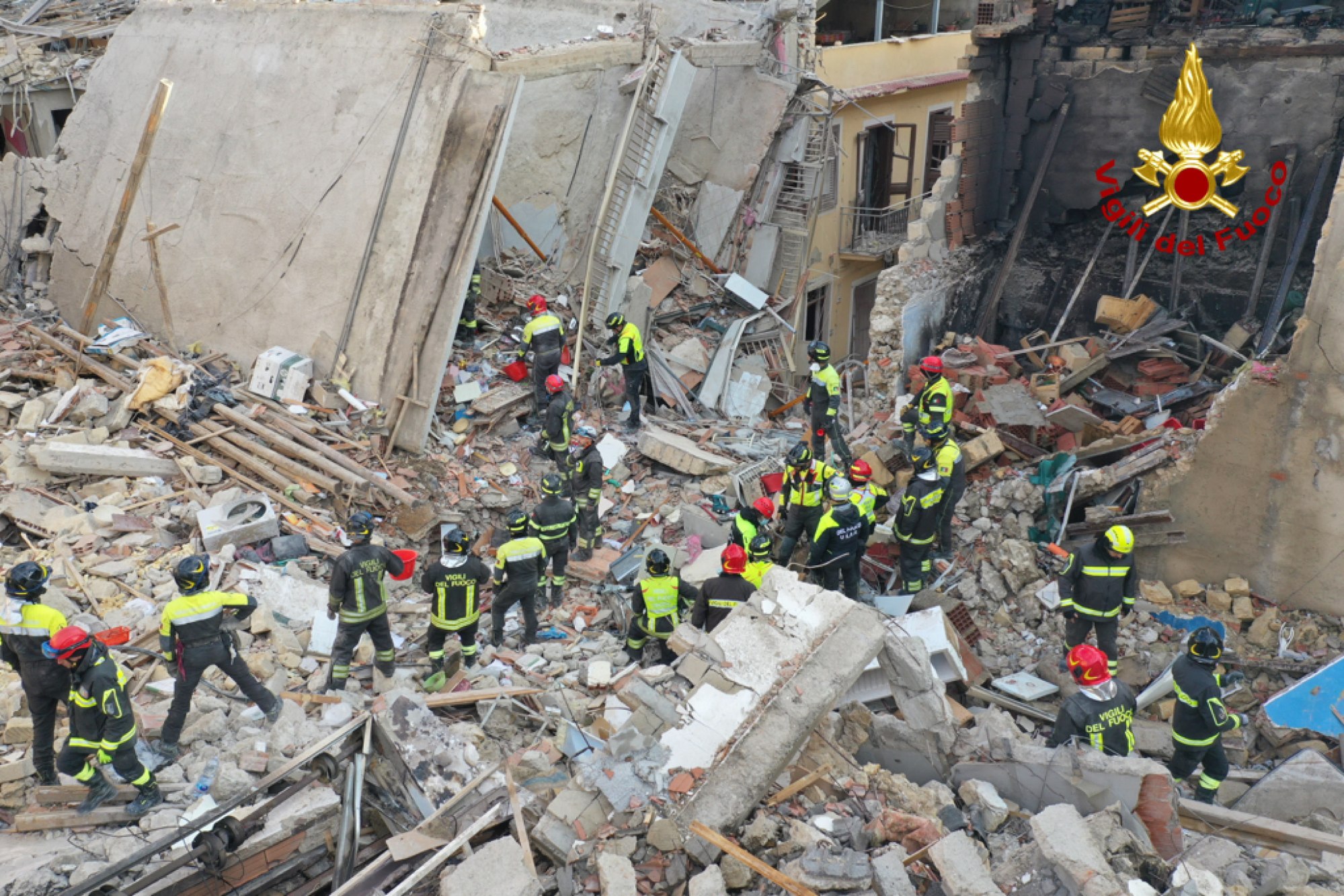
The president estimated that losses could reach €1.5 billion.
To put this in context, that’s roughly the GDP of some entire medium-sized cities.
Now, let me explain the science behind all of this because understanding what’s happening is fundamental.
When rainwater penetrates clay soil, it infiltrates through pores and cracks.
Clay has a specific characteristic: it absorbs water like a sponge.
But unlike other types of soil, when clay becomes saturated, it loses its cohesion, which is like the glue that keeps particles stuck to each other.
Think about it this way: have you ever tried to hold a handful of wet soil?
It slips through your fingers, right?
Now, imagine an entire slope of clay soil getting that consistency.
The weight of all that mᴀss of earth saturated with water creates enormous pressure toward the base of the slope.
When the pressure exceeds the soil’s resistance, what geologists call slope failure occurs.
In Niscemi’s case, the city is on a plateau.
So, what happened was that the edge of this plateau lost support.
It’s as if it were the edge of a cake that’s crumbling because it became too heavy and wet.
The worst part is that once it starts, the process tends to continue.
Each piece that falls removes support for the piece behind it, creating a chain reaction.
After studying all this in recent days, I’ve been reflecting on how powerful and unpredictable nature is.
Niscemi isn’t an isolated case.
Extreme weather phenomena have become more frequent in Italy and throughout the world in recent years.
Floods devastate cities, resulting in dozens of casualties, and amplify the risks of landslides and flooding, even in historically less exposed areas.
I’ll continue following the situation in Niscemi closely and bringing updates as new data emerges.
This story is still unfolding.
The landslide remains active, and thousands of people continue to be unable to return home without knowing if they’ll ever be able to come back.
It’s a delicate situation that reminds us how vulnerable we are to nature’s forces, but it also shows us the importance of science, monitoring, and quick action to protect lives.


