US Navy Launched Something That Shouldn’t Exist… Iran Can’t Stop It
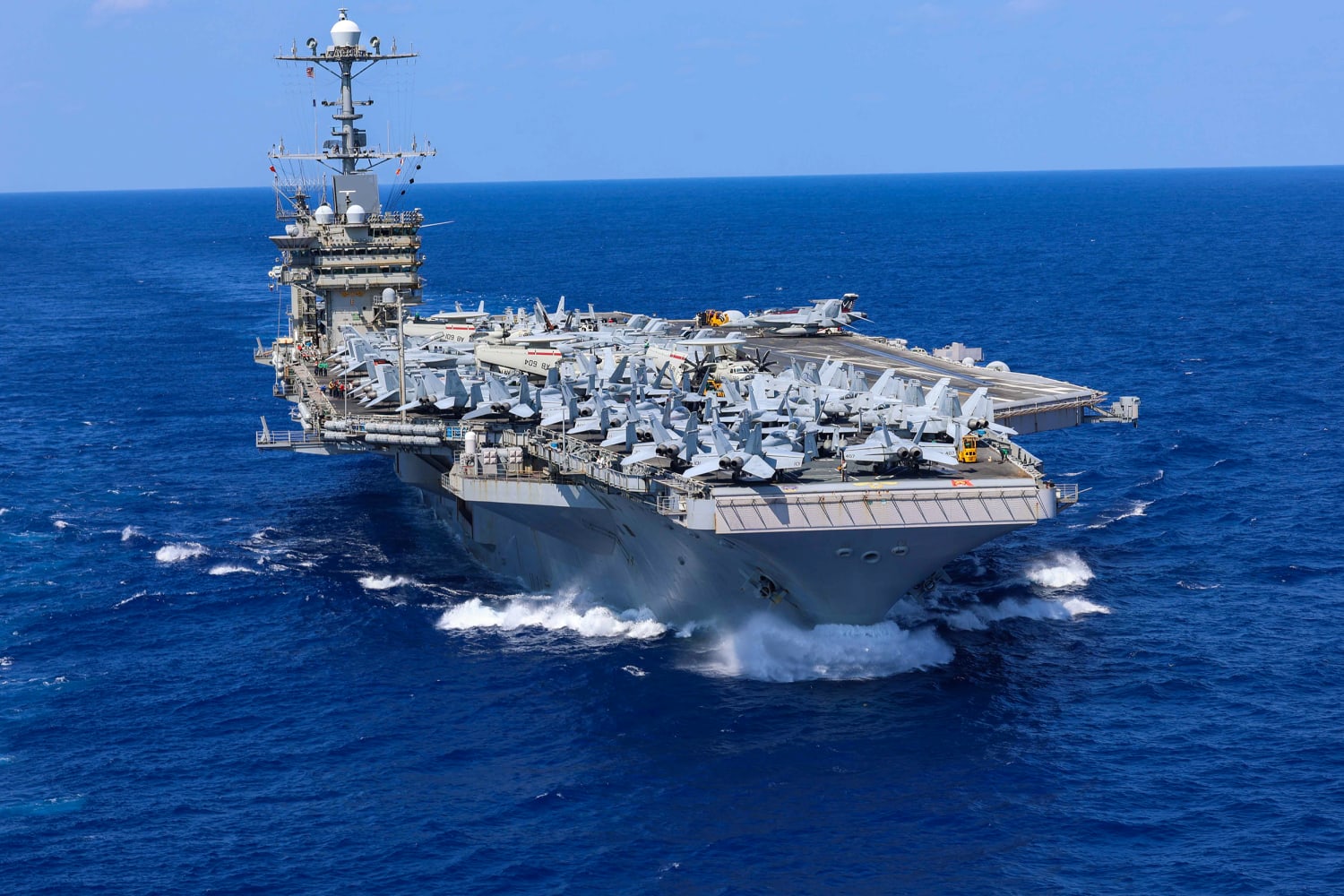
On January 26th, Iran’s Revolutionary Guard released footage of a target representing the USS Abraham Lincoln being attacked by a swarm of drones.
Their message was simple: we can see you.
We can reach you.
And our drone swarms will hit your carriers before your jets ever leave the deck.
There’s just one problem: the Navy has a new weapon that makes Iran’s entire strategy obsolete.
Let’s examine what would actually happen if Iran tried to turn that propaganda footage into a real attack.
It would start at 0600 local time when 12 contacts climbed off a coastal site near Bandar Abbas and turned south toward the Strait of Hormuz.
Their target: the USS Abraham Lincoln and its strike group.
These are Shahed 136 one-way attack drones, which Ukrainians refer to as “mopeds” because of the high-pitched whine from their two-stroke engines that could have come off a leaf blower.
That’s generous; mopeds can at least change direction.
Once the Shahed launches, it follows pre-programmed GPS coordinates until it hits something or runs out of fuel.
There’s nothing on board to detect threats, communicate with its operator, or deviate from its heading.
Iran cannot recall it, redirect it, or even confirm it’s still flying.
It’s essentially a lawn dart with a guidance chip you could order off of Amazon.

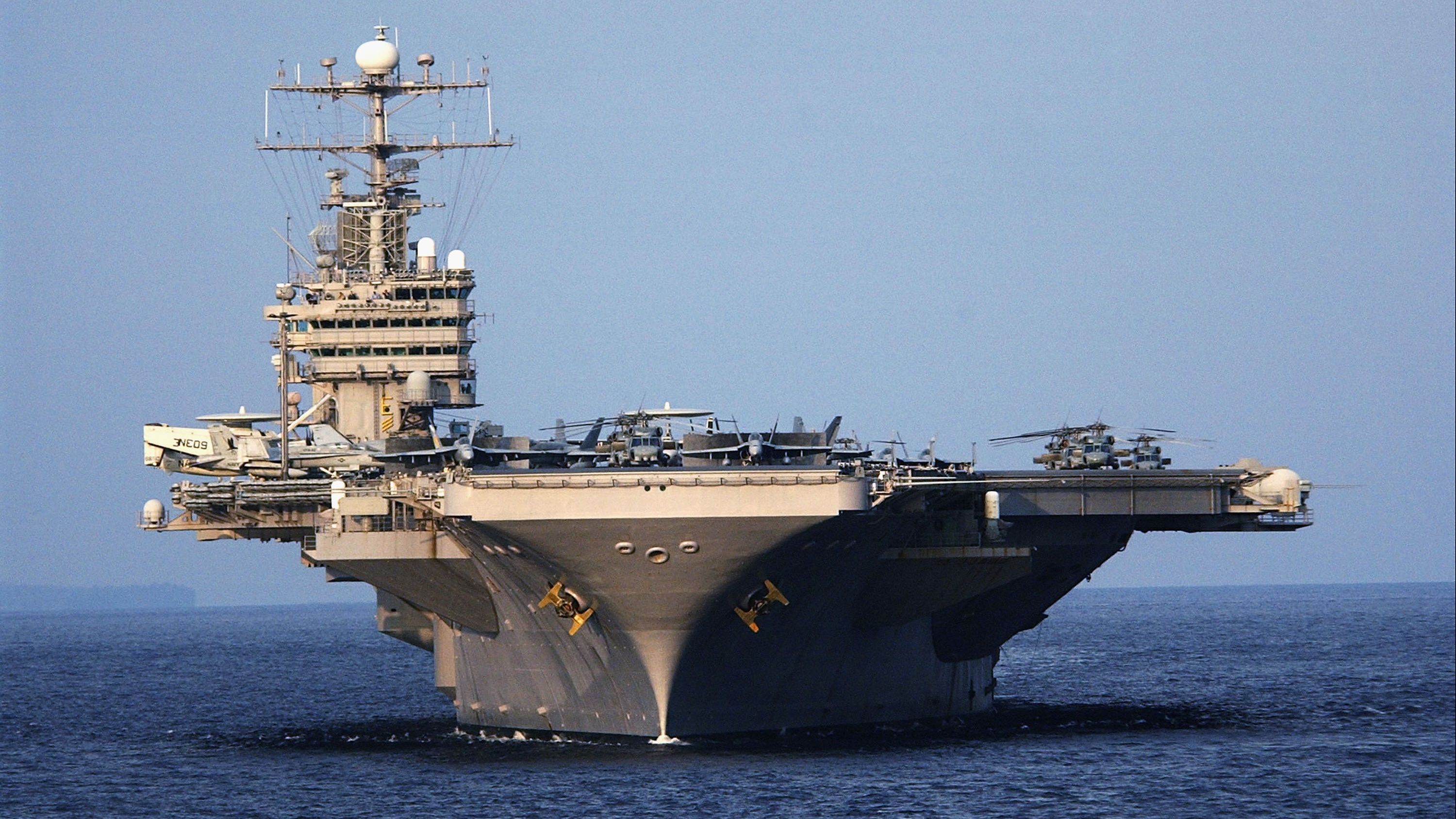
The E-2D Hawkeye circling at 25,000 feet had all 12 contacts before they finished climbing.
If you look at the dome on the top of this aircraft, that housing covers the AN/APY-9 radar, a system that can track objects the size of a dinner plate past 400 miles while processing over 2,000 contacts simultaneously.
Twelve Shahed drones, with the radar cross-section of a riding lawnmower flying straight and level at constant alтιтude, registered about as challenging as spotting a bonfire at Burning Man.
America spent $260 million on that aircraft, and what it just detected cost Iran about $30,000 apiece.
Within 1.2 seconds of detection, every destroyer in the strike group had the same targeting picture.
That’s the Cooperative Engagement Capability in motion.
The Hawkeye spots 12 drones at the edge of the Earth, and before the Combat Information Center (CIC) watch team looks up from their coffee, a destroyer 40 miles away has computed a firing solution.
Iran built these drones with off-the-shelf GPS.
America built a sensor network that turns a carrier strike group into one giant radar with a dozen trigger fingers.
At 41 minutes to impact, the commander picks up the handset and gives an order that will cost the Navy millions.
Conventional weapons only.
He could end this engagement in 15 seconds with what the strike group is actually carrying.
He doesn’t.
Not yet.
There’s an Iranian Mohajer 6 surveillance drone circling at 12,000 feet to the east, relaying real-time video to a command post near Bandar Abbas.
The commander has been tracking it for 40 minutes.
He could splash it with a single SM-2 and blind Iranian intelligence completely.
Instead, he lets it watch.
He wants them to see exactly what they expect to see: expensive American interceptors burning through a finite magazine against cheap disposable drones.
He wants them to feel confident enough to send more.
At 0638, things get interesting.
The lead drones cross inside 20 kilometers.
If you look at the destroyer’s foredeck, the Mark 45 5-inch gun is already trained on bearing.
This 127 mm weapon fires proximity-fused rounds—shells designed to detonate near the target and spray shrapnel at 800 m/s through composite airframes built to survive rain, not warfare.
Three rounds, three Shahed drones come apart in midair.
$6,000 well spent.
Nine contacts are now at 15 kilometers aboard one of the destroyers.
Its SeaWiz mounts spin up with the sound every sailor knows in their sleep—a rising mechanical whir that indicates something is about to have a very bad day.
The M61A1 rotary cannon puts 4,500 rounds of 20 mm tungsten penetrators per minute into targets that couldn’t dodge a kite.
In just 11 seconds, four drones turned to confetti raining into the Gulf.

With five drones left at 10 kilometers, each RIM-116 rolling airframe missile you see launching here costs the price of an average home in the U.S. to chase down something Iran ᴀssembled for less than a used Camry.
Five launches, five hits.
The infrared seekers barely had to work for it.
Ninety-four seconds from the first sH๏τ to the last—12 drones down.
But Iran just learned everything they needed to know because that surveillance drone at 12,000 feet transmitted every detail back to Tehran.
The final tab: $2.5 million in American ordnance to stop $360,000 in Iranian drones—$7 of defense for every dollar of attack.
Those five RIM-116s are gone.
The magazine is lighter, and there’s no way to refill missiles unless in port.
The commander knows this.
He’s been watching the surveillance drone too.
He could have splashed it an hour ago.
At 0650, three coastal launch sites activate simultaneously.
Seventy-six drones lift off in staggered groups.
Behind them, 20 more hold at low alтιтude near the coast.
The Iranians told exactly what they expected, but unknown to them, the Navy has something hiding in plain sight they never expected.
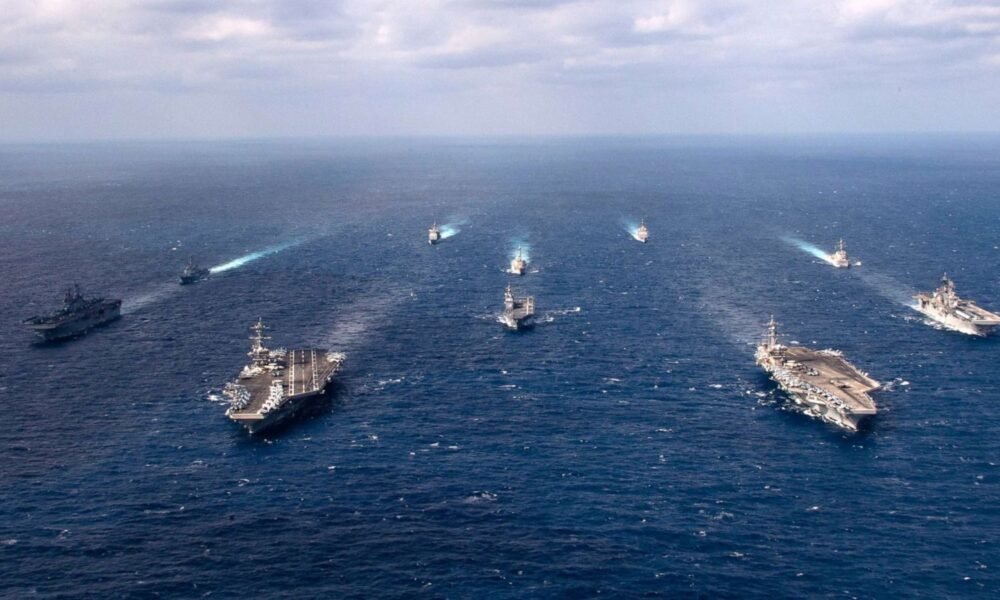
At 0651, the Hawkeye paints all 76 contacts converging from two bearings: 41 from the northeast and 35 from the east, plus those 20 reserves hugging the coastline at 50 meters just above the waves.
An Arleigh Burke-class destroyer like you see here carries 96 vertical launch cells.
But those aren’t all loaded for air defense.
The SM-3s are reserved for ballistic threats.
SM-6s are embarked for high-value targets.
Tomahawks are needed for offensive strikes.
Maybe 60 interceptors are available for air defense at $2.1 million per sH๏τ.
That’s $126 million in missiles to stop $2.3 million worth of drones.
And Iran staged 20 reserves behind the main wave specifically because they’ve done this arithmetic.
Wave one empties the magazine.
Wave two walks in unopposed.
No amount of creative allocation changes that arithmetic.
You run out of missiles before Iran runs out of Shaheds. Period.
Unless the missiles never leave the tubes.
At 0720, the commander gave an order that confused half of his CIC watch team: “Meteor, weapons free all sectors.”
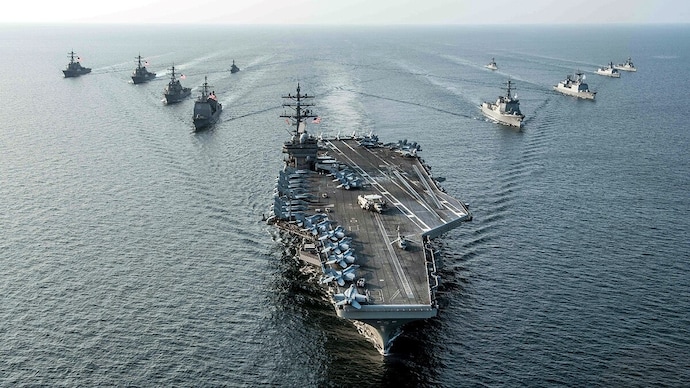
If you look at the destroyer’s forward deck, between the VLS cells and the bridge, there’s a flat panel array about the size of a commercial refrigerator.
No rotating dish, no barrel.
It looks like a slab of metal bolted to the deck—another antenna among dozens on a warship bristling with them.
Three years ago, this system didn’t exist.
Two years ago, it was a laboratory prototype that melted its own components after four seconds of operation.
One year ago, it deployed on this destroyer under a classification level that doesn’t even have an official name.
This is Project Meteor, the Navy’s first operational shipboard high-powered microwave weapon, and Iran is about to become its first real-world test subject.
Iranian intelligence analysts reviewed satellite imagery of every American destroyer in the Fifth Fleet.
This array was cataloged as a communications upgrade—classification non-threatening.
That single line in an intelligence report was about to become the most expensive mistake in Iranian military history.
And it can do something that was impossible until now.
At 0735, the northeastern formation enters engagement range at 18 kilometers.
Forty-one contacts in a 25° arc.
Six minutes to impact.
Meteor fires.

But as you can see, you can see nothing.
In the Mohajer’s ground control station near Bandar Abbas, the operator watched his screen in confusion.
Thirty-seven drone feeds had just turned to static simultaneously.
No missile warnings, no explosions on the optical feed.
The contacts simply stopped.
He cycled through frequencies, checked his equipment, then reached for the secure phone.
His supervisor would want to see this.
What neither of them understood was that they were witnessing the future of naval warfare, and Iran was on the wrong side of it.
What actually happened behind that flat panel is where the engineering matters.
Thousands of gallium nitride semiconductor elements— a material that wasn’t mature enough for weapons applications a decade ago—generated focused microwave energy and combined it into a single coherent beam steered electronically at the speed of light.
Here’s the physics that makes Meteor possible and why Iran never saw it coming.
Microwave energy at the right frequency doesn’t need to burn through armor or punch holes in airframes.
It just needs to reach the electronics.
A Shahed’s GPS chip operates on milliamps.
Meteor delivers amps.
The difference between those two numbers is the difference between a drone that flies and a lawn dart that falls.
Thirty-seven contacts dropped off the Aegis display simultaneously, falling out of the sky without burning or exploding—just nosing over and dropping into the Gulf like someone pulled the battery, which is essentially what happened.
Four contacts at the formation’s edge are still tracking.
They were riding the boundary of Meteor’s 30° cone, where energy density drops below the threshold needed to fry hardened circuits.
The cone’s width matters; it determines how much sky the weapon covers per pulse.
And these four Shaheds were just outside of it.
With a six-second recharge cycle, the system draws from the ship’s generators, feeding the same electrical bus that runs the radar, the combat systems, and the coffee pot in the CIC.
Iran spent a decade building a strategy around depleting American ammunition.
Meteor’s ammunition is diesel fuel.
The weapon swings 15° and catches the four stragglers.
One pulse, four debris tracks.
The eastern formation now has 35 contacts bearing 090.
Meteor orients and fires.
Thirty-five drones nose over and drop into the Gulf without so much as a spark.
Somehow, this is more humiliating than getting sH๏τ down.
Fifteen seconds of engagement time, 76 drones neutralized.
The SM-2 canisters haven’t moved.
The VLS cells Iran spent a decade trying to empty are sitting at 100%.
Now the 20 reserves go to full throttle and drop to wavetop alтιтude—20 feet above the surface.
At that height, they vanish into sea clutter.
The Hawkeye loses them.
SPY can’t separate them from whitecaps.
Twenty armed contacts just disappeared from every display in the strike group.
Meteor needs a radar track to aim.
Without targeting data, the most powerful directed energy weapon on Earth is a very expensive space heater.
Twelve minutes to estimated arrival.
Failing to engage was designed for stragglers, not an incoming wave.
SM-2s could engage, but $2.1 million per intercept against $30,000 drones is the exact trap the Navy built this weapon to avoid.
The magazines the commander has been protecting all morning are about to matter if missiles are inbound.
Twelve minutes is a long time when 20 warheads are out there and your best weapon can’t find them.
On every ship, SeaWiz mounts track empty ocean.
SPY sweeps the surface and returns nothing but wave noise.
Somewhere below the radar horizon, 20 GPS-guided warheads are closing at 3 km per minute.
The only thing the strike group knows for certain is the math.
At 185 km/h from the last known position, those drones will reach engagement range in roughly 11 minutes.
Everything between now and then is guesswork.
At 11 km, a merchant tanker forces the sea skimmers above the radar horizon.
Eighteen contacts, two never made it.
Flying blind at 20 feet in a drone held together by commercial GPS and optimism is exactly as reliable as it sounds.
Two pulses, 16 down.
Two survivors skim through at the extreme edge of detection, possibly below Meteor’s medium depression angle, 3 km out.
SeaWiz picks them up.
Without Meteor handling the other 94, this would be 20 simultaneous contacts inside minimum engagement range.
With Meteor, the system gets a problem.
It was actually designed for two bursts, two debris clouds settling on the water.

Ninety-six launched, ninety-six down.
Missiles expended, zero.
In Tehran, 96 telemetry feeds just went dark, and nobody knows why.
Satellites show wreckage, but no missile exhaust, no interceptor tracks.
Something broke the model.
So at 0800, Iranian command throws everything it has at the strike group.
Two Khaleej Fars anti-ship ballistic missiles roar off mobile TEL launchers near Shiraz.
These are Iran’s big sticks—Mach 3 terminal descent, 650 kg warheads, electro-optical seekers that adjust aim in the final seconds to hit a maneuvering ship.
While the ballistic arcs climb, 80 more Shahed drones launch from four coastal sites.
And from Bandar Abbas Harbor, six fast attack boats surge out at 52 knots, each carrying two C-802 anti-cruise ship missiles.
Three timelines are running at once.
The Khaleej Fars will impact in 90 seconds.
The boats need 23 minutes to reach the C-802 release range.
The drones are 44 minutes out.
This is the combined arms scenario Iranian war colleges have taught for 20 years: simultaneous threats across every domain until something gets through.
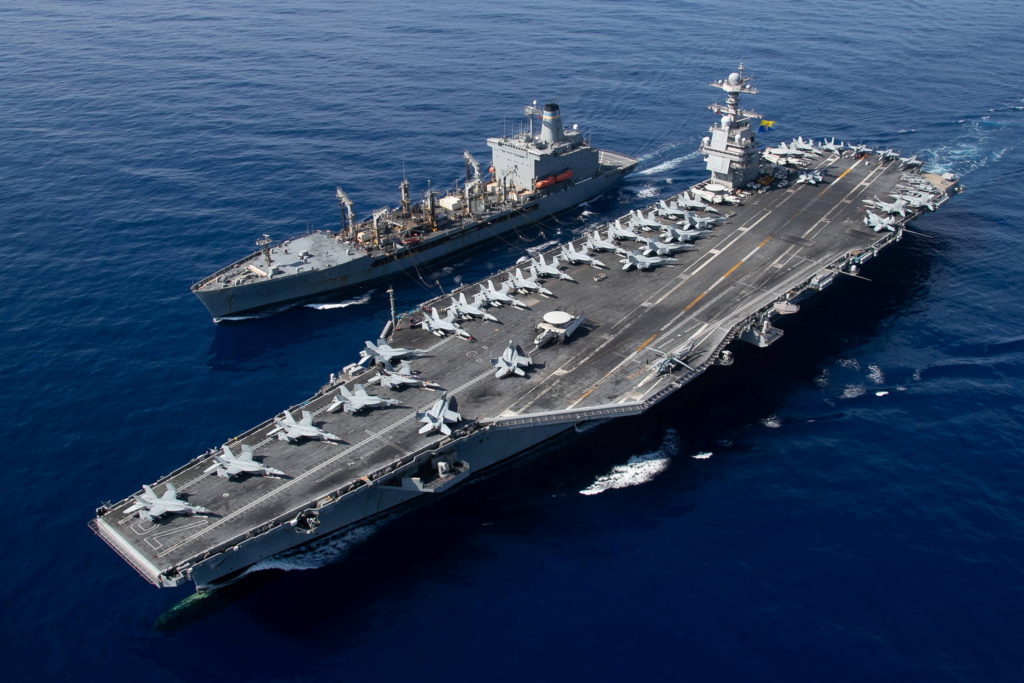
The Khaleej Fars demand SM-2 Block 3C.
Nothing else in the inventory stops a Mach 3 ballistic warhead.
Four SM-2s punch out of the VLS cells and climb toward intercept at 80,000 feet.
Their trajectories cut directly across Meteor’s northeastern engagement sector.
This is the problem nobody outside the Navy talks about.
A microwave pulse doesn’t check idenтιтy, friend or foe.
It will fry a $2.1 million SM-2’s guidance package exactly as fast as a Shahed’s GPS chip for those 11 seconds while interceptors transit Meteor’s cone.
The weapon goes dark in that sector.
And during a real combined arms fight with multiple missile types in flight across multiple bearings, the cone can shrink from 360° to less than half.
The more missiles you launch to handle the serious threats, the less your microwave weapon can handle the cheap ones.
Iran stumbled into the exact attack profile that stresses this trade-off the most.
What Meteor is actually computing in those milliseconds is sector scheduling.
The system divides the battle space into time-sliced firing windows and ᴀssigns each weapon a lane.
Meteor gets the northeast sector from time 0 to 4 seconds.
SM-2s transit that sector from 4 to 15 seconds.
Meteor resumes at 15.
Now multiply that across every bearing where friendly ordnance is in flight.
Update it continuously as new missiles launch and recalculate every time Meteor slews to a new arc.
If you look at the large-screen displays in CIC, what normally shows a tactical picture now looks like choreography.
One timing error, and you’ve just blasted your own interceptor.
An SM-2 entering the cone a half-second early absorbs the same microwave pulse that fries a Shahed.
The guidance package melts, and the missile goes ballistic, allowing the Khaleej Fars warhead to arrive unopposed.
The margin between flawless defense and catastrophic friendly fire is measured in fractions of a second, and no human being can manage it.
The weapons control system maps the full battle space: threat trajectories, interceptor flight paths, Meteor firing arcs, and the timing windows where they overlap.
SM-2s are routed through corridors that avoid the microwave cone.
Meteor is ᴀssigned sectors clear of friendly ordnance.
Dozens of weapons against hundreds of targets across three domains deconflicted in milliseconds.
The commander doesn’t touch a ʙuттon.
Aegis handles the entire choreography autonomously.
That’s not a targeting computer; that’s the most expensive air traffic controller on Earth.
SM-2s converge on the Khaleej Fars at 30 km alтιтude.
Two intercepts—$8.4 million against warheads that would have opened a destroyer like a tin can.
During those 11 seconds of blackout to the northeast, Meteor was pulsing south and east.
The moment the SM-2s cleared the cone, it slewed back north and caught the drones that had been coasting through the gap.
Total wasted time in any sector: zero.
The MH-60 Romeo was already airborne for surface surveillance and handling the boats.
The Seahawk is 40 km south, hunting boats on a completely different bearing from Meteor’s active sectors.
That’s not an accident.
The tactical air coordinator ᴀssigned the helicopter operating area outside every planned firing arc before the Romeo even left the deck.
The same sector scheduling that keeps SM-2s out of the cone keeps the helicopter out of it too.
And even if the beam swept that direction, military avionics are hardened to electromagnetic interference standards.
Shielded wiring, Faraday cage flight computers, components rated to survive orders of magnitude more interference than Shahed’s commercial GPS chip ever could.
Six AGM-114 Hellfires in 8 minutes.
Six boats converted to debris fields before the crews reached their C-802 launch baskets.
The commander spent years building those paycaps.
The helicopter spent 8 minutes ending the conversation.
Eighty Shaheds across four bearings get Meteor in a firing sequence that Aegis computed to maximize cone coverage while respecting the thermal budget.
Four pulses, six seconds between each.
Twenty-four seconds—80 contacts gone.
Iranian EW stations have been jamming since the Khaleej Fars launched.
However, Meteor only transmits.
Trying to jam a directed energy weapon is like trying to stop a flashlight by shouting.
The Hawkeye at 25,000 feet sits above the jamming layer entirely and feeds clean targeting coordinates through CEC.
Under that cover, 60 more drones launch from every remaining coastal site.
The commander’s final hand.
Meteor receives Hawkeye coordinates and catches 53 in 30 seconds.
But 400 seconds of sustained pulsing in Gulf heat has pushed the seawater cooling exchangers to their ceiling.
The weapon needs 90 seconds for core temperatures to come back inside safe parameters.
Seven surviving drones at 185 km/h.
Ninety seconds of recharge means 4.6 km of closure with no directed energy coverage.
For the first time all day, the strike group is defending itself the old-fashioned way.
And the magazine math the commander built his doctrine on is briefly back in play.
SeaWiz handles three, shredding them inside 4 km.
RAM takes two at 6 km.
Meteor comes back online and catches the last two at 9 km.
By 0700, total conventional expenditure against 300 drones, two ballistic missiles, and six fast attack boats: four SM-2s and six Hellfires.
Everything else was handled by a weapon running on the same generators that power the air conditioning.
And shooting down a bunch of drones was just the obvious benefit of this weapon.
While Meteor was swatting 300 drones, the Hawkeye was running a completely different mission.
Launch sites that opened their blast doors got geolocated to within 3 meters.
The mobile TELs that drove out of concealment to fire the Khaleej Fars were tracked from shelter to firing position and back.
Coastal radar stations that activated to guide the combined arms attack exposed their exact locations and operating frequencies.
Three hundred Shahed worth of launch infrastructure revealed itself to an aircraft with a 400-mile view of the battlefield.
The carrier’s air wing is now ready to launch strikes against those launch points.
The destroyers are programming Tomahawks for the hardened shelters where Iran stores its drones.
Iran didn’t just lose 300 drones; they revealed their entire coastal launch network to a strike group with full magazines and a reason to use them.


