🦊 DIVINE OR DIGITAL ILLUSION? VIRAL VIDEO CLAIMS ARTIFICIAL INTELLIGENCE HAS UNCOVERED JESUS’ TRUE APPEARANCE! 🔥
The claim that artificial intelligence has revealed the “real face of Jesus” is a powerful and emotionally charged idea.
It blends technology, faith, mystery, and visual drama into one compelling narrative.
Videos with тιтles like “Watch the REAL Face of Jesus Uncovered by AI” often go viral because they promise something extraordinary: the unveiling of a historical truth that has been hidden for two thousand years.
But when we step back from the excitement and examine the evidence carefully, it becomes clear that no AI has uncovered the actual, historically verified face of Jesus Christ.
To understand why, we need to begin with what we actually know.
Jesus of Nazareth lived in the first century in Roman-occupied Judea, a region that is part of modern-day Israel and Palestine.
The earliest Christian texts, including the Gospels, describe his teachings, actions, crucifixion, and resurrection, but they do not provide a physical description of his appearance.
There are no references to his height, facial structure, eye color, or skin tone.
That silence is significant.
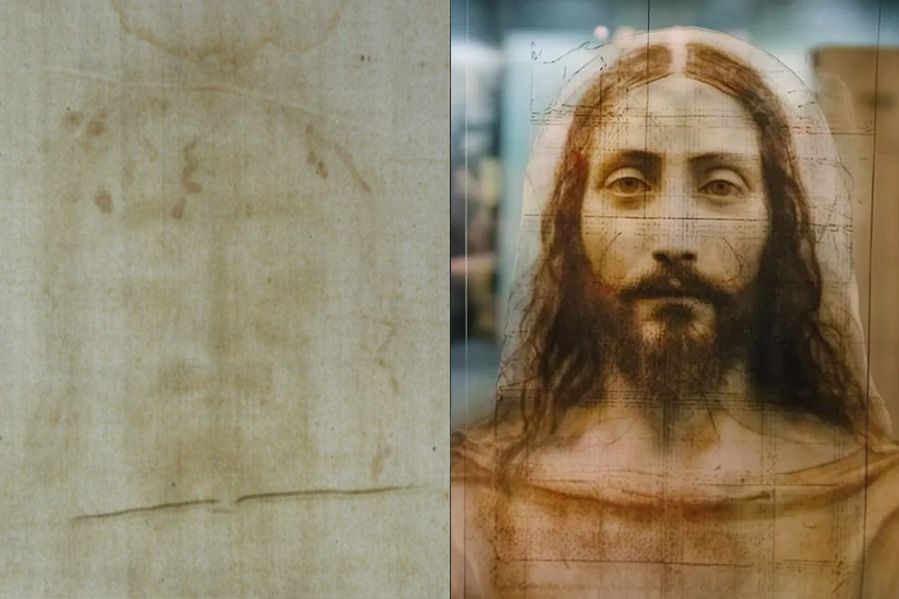
If early followers had intended to preserve a physical likeness, they did not record it in writing.
There are also no contemporary portraits of Jesus created during his lifetime.
PH๏τography did not exist, of course, and painted portraits from that era were rare and typically reserved for wealthy elites or rulers.
Jesus was a traveling preacher from a modest background.
There is no historical record of anyone creating a verified image of him while he was alive.
The earliest artistic depictions of Jesus appeared centuries later, and these were shaped by cultural, theological, and artistic influences of the regions in which they were created.
This is where artificial intelligence enters the picture.
AI systems that generate faces work by analyzing enormous datasets of human features.
They learn patterns from existing images and then produce new images that match certain criteria.
If you instruct an AI to create the face of a “first-century Jewish man from Judea,” it will combine historical, anthropological, and artistic ᴀssumptions to generate a plausible image.
But plausible does not mean proven.
Some of the most well-known “AI Jesus” images are based on forensic reconstructions.
In the early 2000s, forensic anthropologists used skulls from first-century Judean remains to create a model of what a typical man from that region might have looked like.
The result differed significantly from the familiar Western depiction of Jesus with long, flowing light-brown hair and pale skin.
The reconstruction suggested darker skin, short curly hair, dark eyes, and more robust Middle Eastern facial features.
When AI is used to enhance or stylize such reconstructions, the results can appear remarkably lifelike.
However, these images represent an average or typical face, not the face of Jesus specifically.
Without his skull, DNA, or a confirmed portrait, there is no way to identify his individual features with certainty.
AI is not discovering hidden data; it is generating an educated guess based on probabilities.
It is a sophisticated form of artistic modeling, not historical revelation.
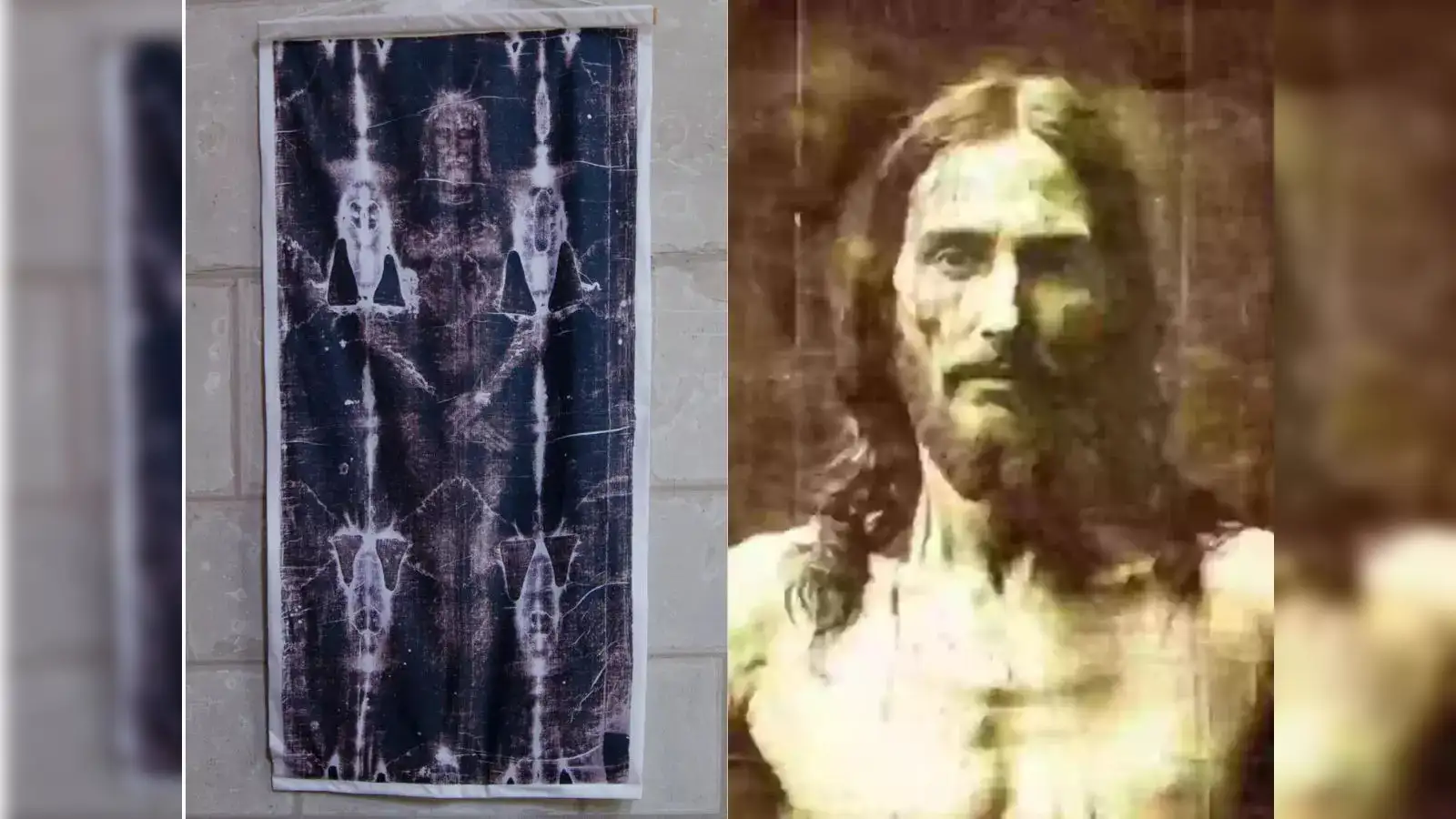
Another source often cited in discussions about Jesus’ appearance is the Shroud of Turin.
The Shroud is a linen cloth that bears the faint image of a crucified man.
Some believe it to be the burial cloth of Jesus.
Over the centuries, it has been the subject of intense religious devotion and scientific investigation.
In 1988, radiocarbon dating tests suggested the cloth originated in the Middle Ages, between 1260 and 1390 CE.
Some researchers dispute those findings, arguing that contamination may have affected the results.
The debate continues.
AI reconstructions based on the Shroud attempt to enhance the faint facial image and render it more clearly.
But even if one accepts the Shroud as authentic, which remains controversial, the AI would only be refining the image already present on the cloth.
It would not be uncovering new information beyond what the artifact contains.
And if the Shroud is medieval, then any AI-enhanced face derived from it would reflect a medieval artistic or devotional image, not a first-century historical portrait.
The viral appeal of “AI revealing the real face of Jesus” lies partly in how we respond to visual media.
Seeing a lifelike face triggers emotional reactions more strongly than reading text.
A moving animation that transforms a faded icon into a realistic human face can feel like witnessing history come alive.
The addition of dramatic music, slow-motion effects, and emotionally charged narration heightens that sense of revelation.
But the emotional impact of an image does not make it historically accurate.
It is also important to consider how depictions of Jesus have varied across cultures.
In European art from the Renaissance onward, Jesus is often portrayed with light skin, long hair, and soft facial features.
In Ethiopian Christian art, he may appear with distinctly African features.
In East Asian depictions, artists sometimes render him with features that resonate with local populations.
These variations reflect the way different cultures internalize religious figures.
They are theological and symbolic representations, not documentary evidence.
If Jesus was a Jewish man living in first-century Galilee, he would likely have shared the physical characteristics common among Semitic populations of that time and place.
Historical and archaeological evidence suggests he probably had olive or brown skin, dark eyes, and dark hair.
He may have worn his hair shorter than many Western paintings suggest, since long flowing hair was not typical for men in that region during that period.
But beyond these general probabilities, specifics become speculative.
Some people ask whether modern genetic science could ever provide more precise answers.
In theory, if remains definitively identified as Jesus’ were discovered and verified, DNA analysis could offer insights into ancestry and physical traits.
But no such remains have been confirmed.
Christianity itself traditionally holds that Jesus was resurrected bodily and ascended, leaving no physical remains behind.
That theological belief further complicates the idea of finding biological evidence.
The desire to know what Jesus looked like reflects a deeply human impulse.
Faces are personal.
They make historical figures relatable.
When we can visualize someone clearly, we feel closer to them.
For believers, seeing what they imagine to be the real face of Jesus can feel spiritually meaningful.
For skeptics, it can feel like solving a historical mystery.
But the limits of evidence still apply.
Artificial intelligence is a powerful tool, but it does not possess secret access to hidden archives of history.
It cannot conjure lost portraits from thin air.
It works with the data provided to it.
If that data consists of average skull measurements, artistic traditions, or debated relics, then the output will reflect those inputs.
The technology can produce highly realistic images, but realism in appearance is not the same as authenticity in origin.
It is also worth noting that religious faith does not depend on precise physical features.
The core message of Christianity centers on Jesus’ teachings, actions, death, and resurrection.
The Gospels emphasize his compᴀssion, authority, and moral insight, not the structure of his jaw or the shape of his nose.

Throughout Christian history, artists have adapted his image to communicate theological truths within their cultural contexts.
The spiritual significance of Jesus has never rested on a confirmed portrait.
When confronted with viral claims about AI revealing the true face of Jesus, a healthy response is thoughtful curiosity combined with critical thinking.
Ask what data was used.
Ask whether the image represents a general reconstruction or a specific identification.
Recognize the difference between historical probability and definitive proof.
Appreciating the artistry and technological achievement of AI-generated images does not require mistaking them for verified history.
In the end, the real story is not that AI has uncovered a hidden face from antiquity.
The real story is about how modern technology intersects with ancient belief.
It shows how powerful visual tools can shape perception.
It reminds us that in a digital age, realism can be manufactured with stunning precision.
And it highlights the enduring fascination with one of history’s most influential figures.
There is beauty in imagining what Jesus might have looked like as a man walking the dusty roads of Galilee.
There is value in grounding those imaginings in historical and cultural context.
But there is also wisdom in acknowledging uncertainty.
Two thousand years separate us from his earthly life.
The available evidence allows for informed approximation, not definitive reconstruction.
So, is the “AI-revealed real face of Jesus” real? No, not in the sense of confirmed historical authenticity.
It is a modern interpretation built on layers of ᴀssumption and probability.
It may be visually compelling.
It may even be historically informed.
But it is not a rediscovered pH๏τograph or a recovered portrait.
It is, at best, a technologically enhanced guess at what a first-century Jewish man—and possibly Jesus himself—might have looked like.
Understanding that distinction allows us to appreciate both the power of AI and the limits of historical knowledge.
It encourages thoughtful engagement rather than unquestioning acceptance.
And it reminds us that some mysteries of the past remain mysteries—not because technology has failed, but because history itself left us with silence where we wish there were details.


