🧭 What Divers Found Inside U-869 Changed the Story of World War II
In 1991, a group of recreational divers set out for what they expected to be a routine deep-water exploration off the coast of New Jersey.
The Atlantic waters in that region were known for their cold temperatures, limited visibility, and unpredictable currents, but they also held the promise of forgotten wrecks from past centuries.
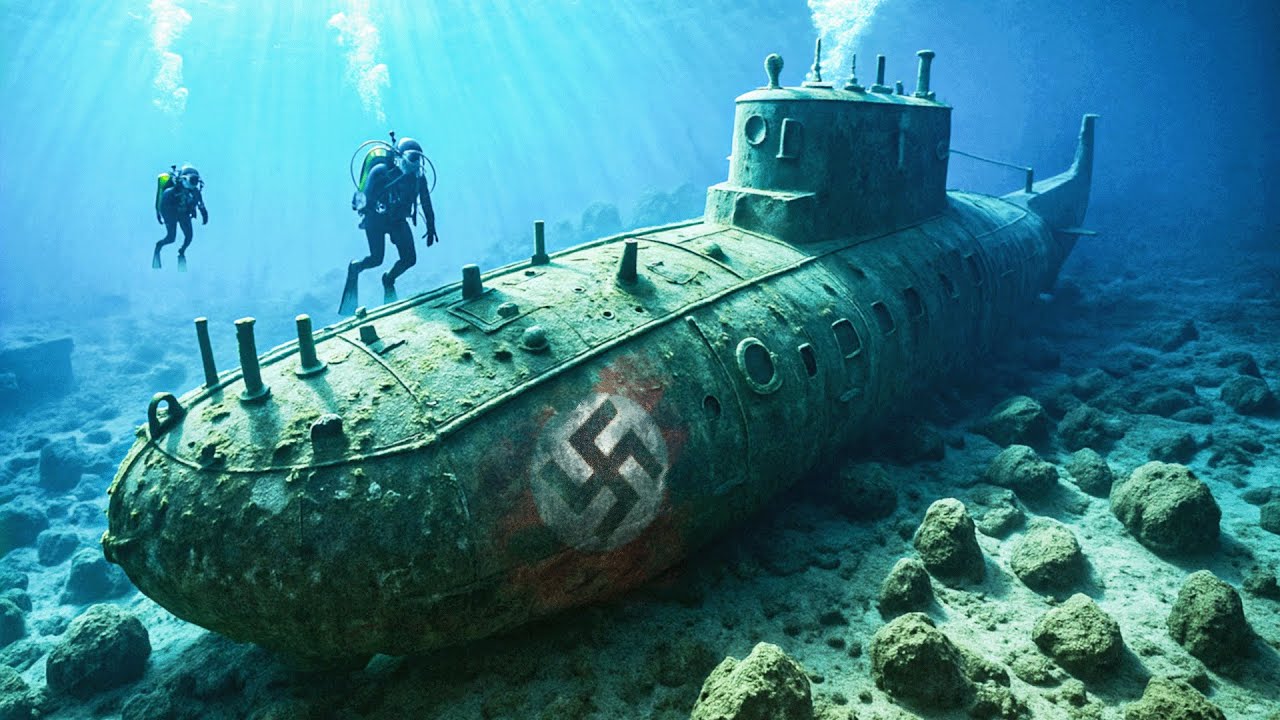
Shipwreck hunters and technical divers had long been drawn to the area, searching for sunken cargo vessels, fishing boats, and wartime relics.
What these divers discovered, however, was far from routine.
About 230 feet below the surface, in a stretch of dark, frigid water, they came across the shape of a submarine resting on the ocean floor.
The vessel was clearly from the World War II era, but something about it felt strange.
It had no visible markings, no name, no numbers that could be easily identified.
It lay silent and broken, a steel ghost in the darkness.
At first, the divers were unsure what they had found.
The Atlantic coast had seen heavy naval activity during the war, and numerous ships and submarines had been lost in its waters.
But this submarine did not match any known wrecks recorded in the area.
Its presence was a mystery.
As word of the discovery spread among the diving community, interest grew.
Experienced technical divers returned to the site, documenting the wreck and exploring its exterior.
They examined the hull, the torpedo tubes, and the surrounding debris field.
The deeper they looked, the more questions emerged.
Over the next several years, the divers worked to identify the submarine.
They studied its design, compared its features to historical records, and consulted naval historians.
Slowly, a name began to surface: U-869.
The identification was startling.
According to official World War II records, U-869 was a German U-boat that had been lost near Gibraltar in the Mediterranean region.
It was believed to have been sunk there in 1945, far from the American coast.
The idea that the same submarine could be lying off New Jersey seemed impossible.
Yet the evidence kept pointing in the same direction.
The shape of the hull, the configuration of the equipment, and the details observed by divers all matched the specifications of U-869.
Eventually, the conclusion became unavoidable.
The wreck off New Jersey was the missing German submarine.
This discovery alone was enough to shake decades of accepted military history.
If U-869 was not sunk near Gibraltar, then what had really happened during its final mission? Why was it found thousands of miles away, resting in American waters?
The questions only deepened when divers began exploring the interior of the submarine.
Entering a wreck at such depths is dangerous work.
The water is cold and dark, and the interior of a submarine is a maze of narrow corridors and cramped compartments.
Any wrong movement can stir up silt, turning visibility to zero.
Equipment can snag on wires or debris.
A single mistake can be fatal.
Despite the risks, experienced divers carefully entered the wreck.
Inside, they found the remains of a vessel frozen in time.
Personal items were scattered throughout the compartments.
Equipment lay where it had been left in the final moments before the submarine’s destruction.
Among the debris were objects that confirmed the vessel’s idenтιтy.
Nazi-era artifacts, pieces of equipment marked with German symbols, and personal belongings belonging to the crew all pointed to the same conclusion.
This was not just any submarine.
It was a German U-boat, lost during the final months of World War II.
The interior told a chilling story.
Some compartments were sealed or partially collapsed, suggesting a violent end.
Damage to certain sections of the hull hinted at an explosion, possibly from a torpedo malfunction or an external attack.
The exact cause of the sinking remained uncertain, but it was clear that the crew had not survived.
As divers continued their explorations, they uncovered more clues about the submarine’s final mission.
Historical records were reexamined.
Old naval documents were studied again, this time with the knowledge that U-869 had been found off the American coast.
The new evidence suggested that the submarine had been operating much closer to the United States than previously believed.
Instead of being lost near Gibraltar, it may have been sent on a mission to patrol or attack targets along the American coastline.
This possibility raised serious questions.
If a German U-boat had reached the waters off New Jersey late in the war, it meant that the threat to the American mainland had been greater than many people realized.
It also meant that wartime records might have been incomplete or incorrect.
The discovery forced historians to reconsider the final days of U-869.
Some theories suggested that the submarine had been reᴀssigned to a new mission.
Others proposed that navigation errors or mechanical problems had driven it far from its intended route.
There was also speculation about the cause of its sinking.
One theory suggested that the submarine might have been hit by its own malfunctioning torpedo, a rare but documented occurrence during the war.
Another possibility was that it had been attacked by Allied forces without its idenтιтy being properly recorded.
The truth may never be known with certainty.
The wreck remains silent, its steel hull guarding the final moments of the crew.
What is clear, however, is that the discovery of U-869 changed the historical narrative.
For the divers who first found the submarine, the experience was unforgettable.
What began as a routine exploration turned into a journey into a forgotten chapter of history.
The wreck was not just a piece of metal on the ocean floor.
It was a time capsule, preserving the story of a crew and a mission lost to the depths.
The site has since become one of the most famous deep-water wrecks off the American coast.
It is also considered a war grave, a resting place for the sailors who never returned home.
Divers who visit the wreck today often do so with a sense of respect, aware of the human story behind the steel walls.
The discovery of U-869 serves as a reminder of how much history still lies hidden beneath the oceans.
Decades after the war ended, new evidence can still emerge, challenging what people thought they knew.
Sometimes, a single discovery can rewrite an entire chapter of history.
Off the coast of New Jersey, 230 feet below the surface, the remains of U-869 continue to rest in silence.
Its presence there tells a story that was lost for nearly half a century, a story of a submarine that never reached its supposed destination and a crew whose final mission remains shrouded in mystery.
What the divers found inside did more than confirm the idenтιтy of a wreck.
It forced the world to confront the possibility that the past is not always as settled as it seems, and that even decades later, the ocean can still reveal secrets that change the way history is told.


