🌊 Oregon’s Underwater Volcano “Awakens”? Strange Signals Beneath the Ocean Floor Raise Alarms 🔥
Far beneath the steel-gray surface of the Pacific Ocean, where sunlight fades into a cold blue hush and pressure crushes anything fragile, something has been stirring.
Not violently. Not yet. But persistently.
Miles off the coast of Oregon, in a stretch of ocean most people will never see, a mᴀssive underwater volcano known as Axial Seamount has begun to show signs that it may not be as dormant as it once seemed.
For years, Axial Seamount has been treated as both a scientific treasure and a quiet threat.
Rising nearly 3,600 feet above the ocean floor, it is the most active submarine volcano in the northeastern Pacific.
It last erupted in 2015, an event that unfolded silently beneath the waves, unnoticed by the public but meticulously recorded by an array of instruments anchored to the seafloor.
Lava flowed.
The ocean floor cracked open.
Entire microbial ecosystems were reshaped in a matter of hours.
And yet, on land, life continued undisturbed.
Now, researchers are once again watching their screens a little more closely.
Over the past several months, monitoring equipment installed around Axial Seamount has recorded a steady increase in seismic swarms—small earthquakes rippling through the volcanic structure.
At first, the tremors were subtle, almost routine. After all, this volcano is known for its frequent activity.
But the pattern has shifted.
The frequency is rising.
The intervals between quakes are shortening.
The ground itself appears to be inflating, ever so slightly, as magma accumulates below the surface.
Inflation is not a metaphor here.
The seafloor is physically swelling, lifting by measurable centimeters as molten rock presses upward from deep within the Earth’s crust.
Scientists describe it calmly, clinically.
“Recharge cycles.” “Magma chamber replenishment.” But behind those technical phrases lies a simple reality: pressure is building.
The question is not whether Axial Seamount will erupt again.
It will.
The real question—the one that lingers in research labs and conference calls—is when.
Some experts suggest that the volcano operates on a relatively predictable cycle, with eruptions occurring roughly every decade.
By that timeline, the window is opening.
Others caution that volcanoes do not follow human calendars.
They follow physics.
And physics can be impatient.
What makes this moment different is not just the uptick in seismic activity.
It is the density of the data.
Axial Seamount is one of the most instrumented underwater volcanoes on the planet, connected to the Ocean Observatories Initiative’s cabled array, which delivers real-time information from the seafloor to scientists on land.
Every tremor, every shift in temperature, every subtle chemical change in hydrothermal vents is transmitted instantly.
There is no mystery about whether something is happening.
Something is happening.
Yet mystery remains in the interpretation.
Seismic swarms have intensified, with hundreds of small quakes occurring in rapid succession.
Hydrothermal vents—those otherworldly chimneys that spew mineral-rich fluids into the dark ocean—have shown fluctuations in temperature and chemical output.
Even the shape of the caldera, a mᴀssive depression at the summit of the volcano, appears to be changing as magma pushes upward.
None of these signs guarantee an imminent eruption.
But taken together, they paint a picture of a system under stress.
And stress, in geology, has consequences.
An underwater eruption does not resemble the cinematic spectacle of a terrestrial volcano.
There are no towering ash plumes blotting out the sky, no rivers of lava racing toward populated towns.
Instead, the drama unfolds in darkness.
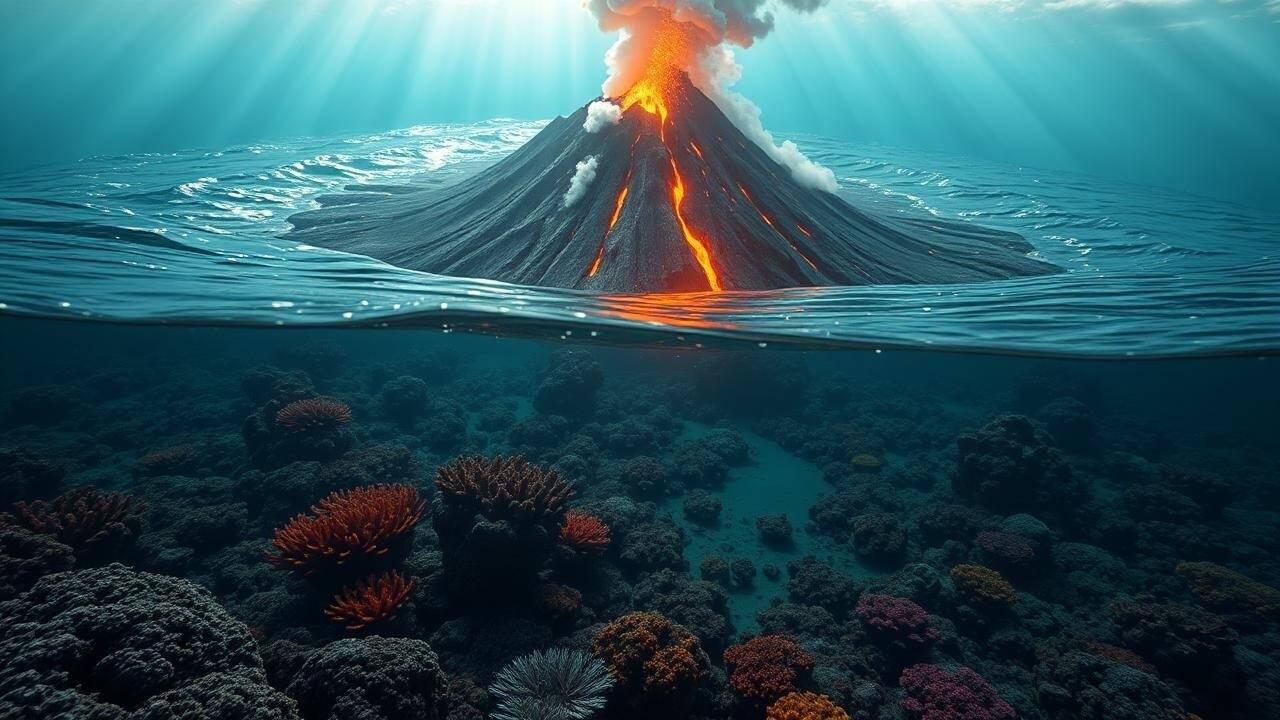
Lava erupts into freezing seawater, cooling instantly into bulbous formations known as pillow basalt.
Superheated fluids burst from fissures.
Entire sections of the seafloor can crack and shift within hours.
To the casual observer on the Oregon coastline, there may be no visible sign at all.
But absence of spectacle does not mean absence of impact.
When Axial Seamount erupted in 2015, it released mᴀssive volumes of lava, reshaping parts of the ocean floor by several feet.
Earthquake activity surged to thousands of events per day at its peak.
The eruption lasted for weeks.
Marine life around hydrothermal vents was devastated—then, remarkably, rebounded.
Scientists documented one of the fastest ecological recoveries ever observed in such extreme environments.
It was a reminder that destruction and renewal often share the same stage.
Still, there are whispers of larger implications.
Could a powerful submarine eruption trigger localized tsunamis? Most researchers say the risk is low.
Axial Seamount lies too deep and too far offshore to pose a significant tsunami threat under normal eruptive conditions.
But the word “normal” carries weight.
Geological systems are complex.
Landslides on underwater slopes, if large enough, could theoretically displace water.
No one is predicting catastrophe.
Yet no one is dismissing possibility outright, either.
The more provocative discussions revolve around what Axial Seamount represents in a broader geological context.
It sits along the Juan de Fuca Ridge, part of a vast network of tectonic boundaries where the Earth’s crust is being pulled apart.
Magma rises to fill the gap, creating new ocean floor.
It is a place of constant creation—and constant instability.
Some geophysicists quietly note that studying Axial Seamount offers insights into much larger tectonic systems, including the Cascadia Subduction Zone, a fault capable of generating mᴀssive earthquakes.
The two systems are not directly linked in a simple cause-and-effect chain.
But they share the same restless region of crust.
In other words, Axial Seamount is not an isolated anomaly.
It is a visible symptom of a dynamic planet.
As seismic activity continues, public curiosity has begun to grow.
Online forums speculate about “mega-eruptions.” Social media posts exaggerate data into doomsday scenarios.
Scientists, meanwhile, urge calm.
They emphasize that submarine eruptions are common in mid-ocean ridge environments.
They point out that Axial Seamount has erupted multiple times without causing harm to coastal communities.
And yet, behind the measured statements, there is a sense of anticipation.
Because this time, they are watching in real time.
Never before have researchers had such detailed instrumentation on an underwater volcano poised on the brink of eruption.
If Axial Seamount does erupt in the coming months or years, it could become one of the most closely documented volcanic events in history.
Every second of seismic buildup.

Every chemical shift.
Every pulse of magma ascent.
It would be a scientific windfall.
But science thrives on tension—the tension between prediction and surprise.
Volcanoes have a way of humbling even the most sophisticated models.
Pressure thresholds can hold longer than expected.
Or they can fail abruptly.
Magma pathways can shift.
Eruptions can stall.
Or escalate.
Right now, the data tells a story of accumulation.
The magma chamber beneath Axial Seamount appears to be approaching levels similar to those recorded before its previous eruption.
The seafloor has inflated to heights comparable to pre-2015 measurements.
Earthquake counts are rising into the thousands per month.
Patterns repeat—until they don’t.
In laboratories and university offices, researchers refresh dashboards displaying live feeds from the ocean floor.
Each tremor is cataloged.
Each anomaly flagged.
The tone remains professional, almost routine.
But make no mistake: this is the geological equivalent of a drawn breath.
The Pacific Northwest is no stranger to tectonic unease.
From towering stratovolcanoes on land to fault lines hidden offshore, the region lives with a quiet awareness that the Earth beneath it is active.
Axial Seamount is simply the latest reminder that much of that activity unfolds out of sight.
And perhaps that is what makes it so unsettling.
There is something inherently eerie about a force powerful enough to reshape landscapes operating in complete darkness, miles below the surface, beyond human senses.
No rumble underfoot.
No smoke on the horizon.
Just data—lines on a graph, numbers ticking upward, silent warnings transmitted through fiber-optic cables.
Some scientists predict an eruption could occur within the next year or two if current trends continue.
Others caution that volcanic systems can plateau, releasing pressure gradually without a dramatic event.
The truth may lie somewhere in between.
For now, Axial Seamount waits.
Or perhaps it prepares.
The ocean above remains deceptively calm.
Fishing boats cross its surface.
Storms roll in and out.
Tourists walk along Oregon’s rugged coastline, unaware that far offshore, the seafloor is subtly rising.
Deep below, magma continues its slow ascent.
And somewhere in the endless black of the Pacific, a volcano is reminding the world that even in silence, the Earth is never truly still.


