⏳ Was Christmas Placed on the Wrong Day? The Clues Say Yes
For centuries, millions of people around the world have gathered every December 25 to celebrate the birth of Jesus.
Lights fill the streets, churches hold midnight services, and families come together to remember the moment that changed human history.
The date feels fixed, unquestioned, and sacred.
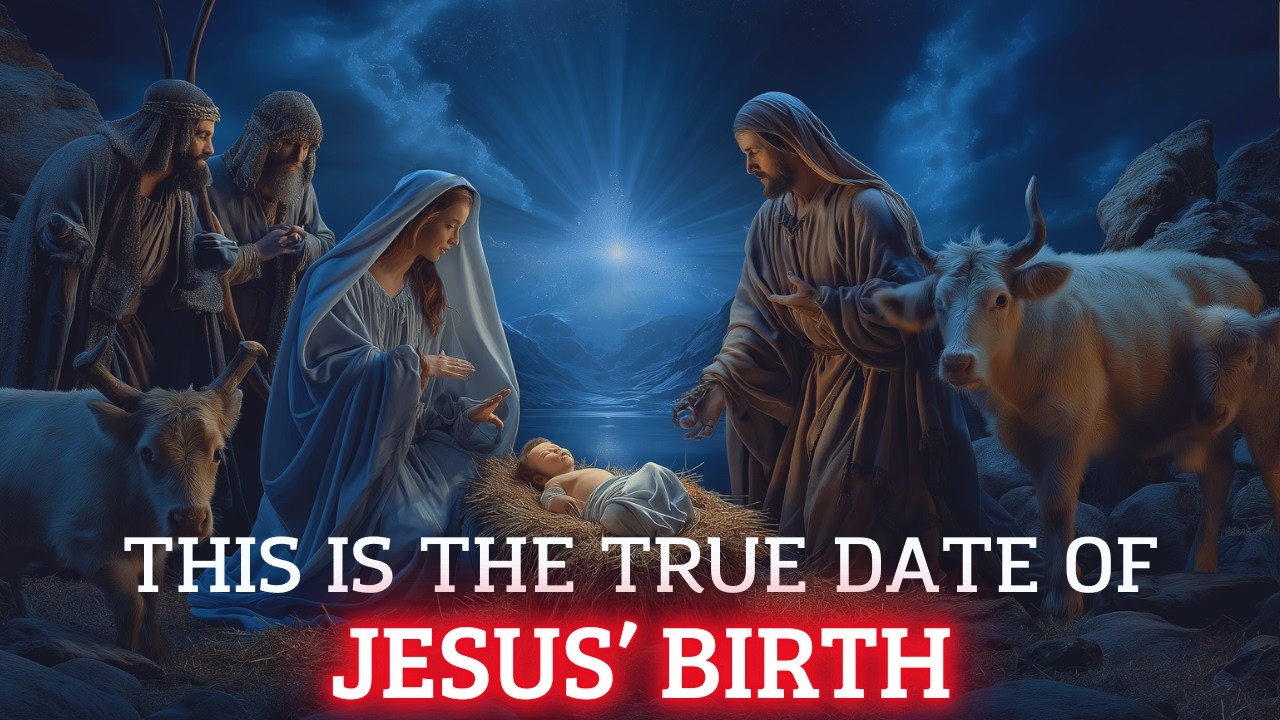
But when historians and biblical scholars look closely at scripture, one surprising fact emerges.
None of the four gospels ever mention December 25 as the day Jesus was born.
Not Matthew.
Not Mark.
Not Luke.
Not John.
The date that billions of people celebrate each year does not come directly from the Bible.
Instead, it developed centuries later through a combination of tradition, cultural practices, and calendar decisions.
This has led some researchers to reexamine the scriptures themselves, searching for clues that might reveal when the birth of Jesus actually took place.
According to one interpretation, the Bible contains a series of details that function like puzzle pieces.
When these clues are examined together, they appear to point toward a different season altogether.
Instead of winter, the evidence seems to suggest early fall, somewhere around September or October, and not in the year traditionally ᴀssumed.
The first clue comes from a Roman decree.
The Gospel of Luke describes an empirewide census ordered by Caesar Augustus.
This census required people to travel to their ancestral towns to register.
Joseph, the husband of Mary, had to travel from Nazareth to Bethlehem, a journey of nearly eighty miles.
Mary, who was pregnant, went with him.
The important detail is not just the census itself, but the conditions under which it would have taken place.
The Roman Empire was known for its administrative precision.
Large population movements were not scheduled during harsh winter conditions, especially in regions where cold rains and muddy roads could make travel dangerous.
Spring and fall were the preferred seasons for such events, when roads were more stable and the weather was milder.
If the census occurred in one of those seasons, it would place the birth of Jesus away from the middle of winter.
The second clue comes from the temple schedule in Jerusalem.
Luke provides an unusual detail about the father of John the Baptist, a priest named Zechariah.
He belonged to the priestly division of Abijah.
According to records found in the Old Testament, the priesthood was divided into twenty-four groups, each serving in the temple at specific times of the year.
Historical reconstructions suggest that the division of Abijah likely served in late spring, around May or June.
During that time, the angel Gabriel appeared to Zechariah and told him that his wife Elizabeth would conceive a son.
That child would become John the Baptist.
Later, Luke writes that in the sixth month of Elizabeth’s pregnancy, Gabriel appeared to Mary and announced that she would give birth to Jesus.
If Elizabeth conceived shortly after Zechariah’s temple service in late spring, then six months later would fall in late autumn.
This would place the conception of Jesus around November or December.
Adding a typical nine-month pregnancy leads to a birth sometime in early fall, around September or October.
The third clue comes from the Jewish festival calendar.

Ancient Israel followed a series of festivals throughout the year, each carrying symbolic meaning.
One of the most important fall celebrations was the Feast of Tabernacles, also known as Sukkot.
This festival commemorated the time when the Israelites wandered in the wilderness and God dwelled among them.
During the festival, families built temporary shelters and lived in them for a week, symbolizing God’s presence with his people.
In the Gospel of John, there is a phrase describing Jesus that carries a striking connection to this idea.
The text says that the Word became flesh and dwelt among us.
The original language suggests the idea of tabernacling, or living among people in a temporary dwelling.
For some interpreters, this connection between the festival and the concept of God dwelling among humanity suggests that the timing of Jesus’s birth may have aligned with this fall celebration.
The fourth clue comes from a simple but important detail: shepherds in the fields.
Luke describes shepherds watching their flocks at night when the angels announced the birth of Jesus.
In the climate of ancient Judea, winter nights were cold, wet, and uncomfortable.
During the colder months, shepherds typically moved their flocks into shelters or caves for protection.
Open-field grazing at night was more common during milder seasons like spring, summer, or fall.
This detail suggests that the birth likely took place outside the harsh winter months.
The fifth clue involves the mysterious star of Bethlehem.
The Gospel of Matthew describes a star that guided the Magi to the place where Jesus was born.
Over the years, astronomers have studied ancient records and celestial events to see if any unusual phenomena match the description.
One theory points to a rare planetary alignment between Jupiter and Saturn that occurred around 7 BC.
In ancient astrology, Jupiter was ᴀssociated with kingship, and Saturn was sometimes linked with the Jewish people.
Their convergence in the sky would have been interpreted as a sign of a royal birth.
This event falls within the time frame suggested by other historical markers connected to the birth of Jesus.
The sixth clue comes from the reign of King Herod.
Matthew describes how Herod, after hearing about the birth of a new king, ordered the killing of boys in Bethlehem who were two years old and under.
This decision suggests that the birth of Jesus may have occurred up to two years before that event.
Historical records indicate that Herod died in 4 BC.
If the mᴀssacre happened shortly before his death, then the birth of Jesus would likely have taken place sometime between 6 and 4 BC.
This range aligns with the timeline suggested by the planetary alignment and the earlier clues.
The seventh and final clue comes from the beginning of Jesus’s ministry.
Luke states that Jesus was about thirty years old when he began his public ministry.
The gospel also links this event to the fifteenth year of the reign of the Roman emperor Tiberius.
Historians place that year around AD 29 or 30.
If Jesus was about thirty at that time, it would place his birth between 6 and 4 BC, once again aligning with the earlier clues.
When all seven clues are considered together, a consistent picture begins to emerge.
The birth of Jesus likely took p
This raises another question.
If Jesus was not born in year one, why does the global calendar revolve around that date?
The answer traces back to a monk in the sixth century named Dionysius Exiguus.
He was tasked with creating a calendar centered on the birth of Christ.
Using the historical information available to him at the time, he calculated the year of Jesus’s birth.
However, later discoveries revealed that his calculations were slightly off.
He did not account for certain historical details, including the exact date of Herod’s death.
As a result, the calendar began a few years later than the actual birth of Jesus.
Despite the error, the calendar spread across Europe and eventually the world.
By the time scholars realized the miscalculation, the system was too widely used to change.
Today, the world continues to follow a calendar that begins a few years after the actual birth of the figure it was meant to honor.
Yet for many believers, the exact date is not the most important detail.
What matters most is the meaning behind the event.
The celebration is not only about a birthday, but about the belief that God entered human history in the form of a child.
Whether that moment took place in December, September, or another month, the story remains the same.
It is a story of faith, hope, and the idea that the divine stepped into the world in a personal and transformative way.
The debate over the date of Jesus’s birth may continue, but the impact of that moment, however it is dated, continues to shape history, culture, and belief around the world.


