🔥 Repair Forbidden? The Viral Project That Sparked a Global Debate About Who Really Owns a Car
A damaged hypercar worth millions of dollars, a creator known for bringing wrecked vehicles back to life, and a global brand synonymous with exclusivity—when these elements collided, the result was more than just a rebuild project.
It became a flashpoint in an ongoing debate about ownership, control, and the boundaries between manufacturers and independent repair.

At the center of the controversy is a Bugatti Chiron, one of the most advanced and expensive production cars in the world.
With a price tag reaching around $3 million and engineering that represents the cutting edge of automotive technology, the Chiron is not just a vehicle—it is a statement of performance, precision, and prestige.
Every component, from its quad-turbocharged W16 engine to its highly specialized carbon fiber structure, is designed with extraordinary attention to detail.
When a Chiron is damaged, it is not treated like an ordinary car.
Repairs require specialized knowledge, proprietary tools, and access to manufacturer-approved parts.
In many cases, such work is carried out exclusively by authorized technicians under strict conditions.
This level of control is often justified by the need to ensure safety, maintain performance standards, and protect the integrity of the brand.
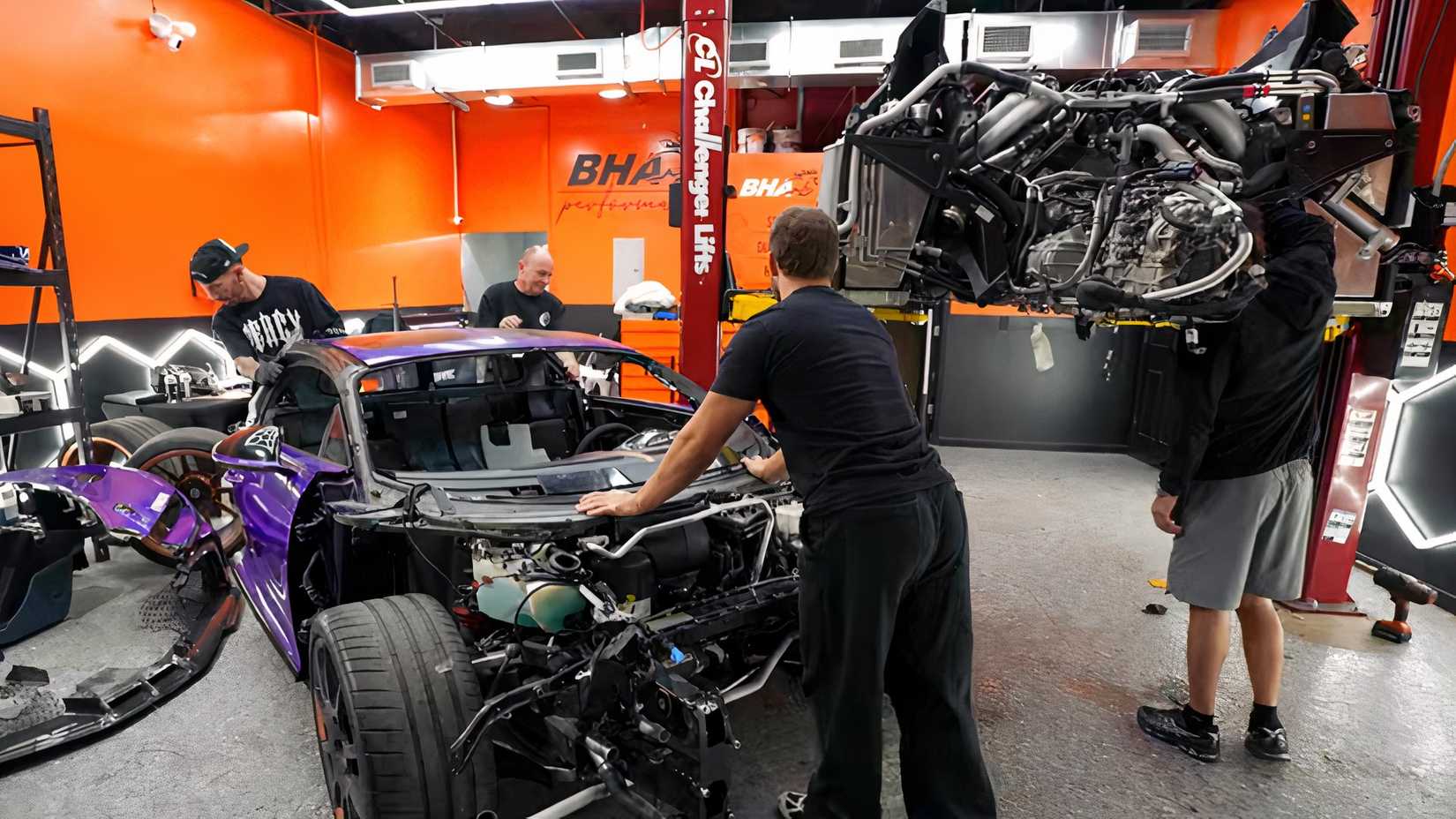
But what happens when someone outside that system decides to take on the challenge?
Matt Armstrong, a well-known automotive content creator, built his reputation by restoring vehicles that many would consider beyond repair.
His projects are followed by millions, drawn to the combination of technical skill, problem-solving, and the satisfaction of seeing a wrecked machine return to life.
When news emerged that he had acquired a crashed Bugatti Chiron, interest surged immediately.
The project promised to be unlike anything he had attempted before.
From the outset, the scale of the challenge was clear.
The Chiron’s complexity goes far beyond conventional vehicles.
Its systems are integrated in ways that require precise calibration.
Components are not only expensive but often restricted in terms of availability.

Even basic tasks can involve layers of engineering that demand specialized expertise.
Yet that was precisely what made the project compelling.
Viewers followed each step as Armstrong ᴀssessed the damage, sourced parts, and began the meticulous process of rebuilding.
The narrative was one of determination—taking on a machine designed for exclusivity and attempting to restore it outside the traditional framework.
Then came the twist.
Reports began to circulate suggesting that Bugatti had intervened, effectively preventing the repair from continuing as planned.
Details varied depending on the source, but the core idea remained consistent: the manufacturer had stepped in, raising questions about authorization, safety, and control.
The reaction was immediate.
Supporters of Armstrong argued that ownership should grant the right to repair.
If an individual legally owns a vehicle, they contend, they should be free to modify, rebuild, or restore it as they see fit.
This perspective aligns with broader discussions around the “right to repair,” a movement that advocates for consumer access to tools, parts, and information needed to fix their own products.
From this viewpoint, the situation represents a conflict between individual autonomy and corporate control.
On the other side, arguments focus on responsibility and risk.
Vehicles like the Chiron operate at performance levels where precision is critical.
A mistake in repair or calibration could have serious consequences, not only for the driver but for others.
Manufacturers invest heavily in ensuring that their vehicles meet strict standards, and maintaining those standards may require limiting who can perform certain types of work.
There is also the question of brand integrity.
For companies operating at the highest levels of the luxury and performance market, reputation is everything.
A poorly executed repair—especially one that gains widespread attention—could reflect negatively on the brand, even if the work was not authorized.
These competing perspectives create a complex landscape.
The situation is not simply about one car or one project.
It touches on broader issues that extend across industries.
As technology becomes more advanced and products more integrated, the balance between user control and manufacturer oversight becomes increasingly difficult to define.
In the automotive world, this tension is particularly pronounced.
Modern vehicles rely on software, sensors, and interconnected systems.
Access to diagnostic tools and technical information is often restricted.
While this can enhance safety and reliability, it also limits the ability of independent mechanics and owners to perform repairs.
For high-performance vehicles, these restrictions are often even тιԍнтer.
The Chiron represents an extreme example.
Its engineering pushes boundaries in terms of speed, power, and design.
Maintaining such a machine involves considerations that go beyond standard automotive practice.
From this perspective, manufacturer involvement in repairs may be seen as a necessary safeguard.
Yet the visibility of Armstrong’s project has brought these issues into public focus.
What might once have been a niche discussion among enthusiasts and industry professionals has become a widely debated topic.
Social media platforms, forums, and comment sections are filled with opinions, each reflecting different priorities and values.
Some see the situation as a defense of safety and quality.
Others view it as an overreach, limiting what individuals can do with property they own.
The truth may lie somewhere in between.
As the story continues to develop, clarity around the specifics remains limited.
Without detailed official statements or comprehensive documentation, much of the narrative is shaped by interpretation and inference.
This uncertainty adds to the intrigue, fueling discussion and speculation.
What is clear, however, is the impact.
The controversy has highlighted the evolving relationship between manufacturers and consumers.
It has raised questions about access, control, and the future of repair in an increasingly complex technological environment.
For Armstrong, the project represents both a challenge and a platform.
Regardless of the outcome, it has drawn attention to the possibilities and limitations of independent work on highly specialized machines.
It has also sparked conversations that extend beyond a single build, touching on issues that affect a wide range of products and industries.
For Bugatti, the situation underscores the challenges of maintaining standards in a world where information and content spread rapidly.
Balancing exclusivity, safety, and public perception is not a simple task, especially when actions are interpreted through multiple lenses.
As discussions continue, one question remains at the center of it all:
When you own something as advanced, as expensive, and as тιԍнтly controlled as a hypercar—where does ownership end and oversight begin?
The answer is not straightforward.
It is shaped by law, by technology, and by evolving expectations.
And as this story shows, it is a question that is far from settled.


