🚨 THE SUN’S INVISIBLE DEFENSE WALL FALTERS — A WARNING SIGNAL FROM DEEP SPACE 🌠
For several hours, nothing seemed different.
The Sun rose, as it always does, pouring quiet light over oceans, cities, and sleeping continents.
But high above Earth, beyond the reach of weather and sound, instruments began recording something that did not fit the pattern.
At first it was a flicker in magnetic data—subtle, almost dismissible.
Then came the distortions.
Then the surge.
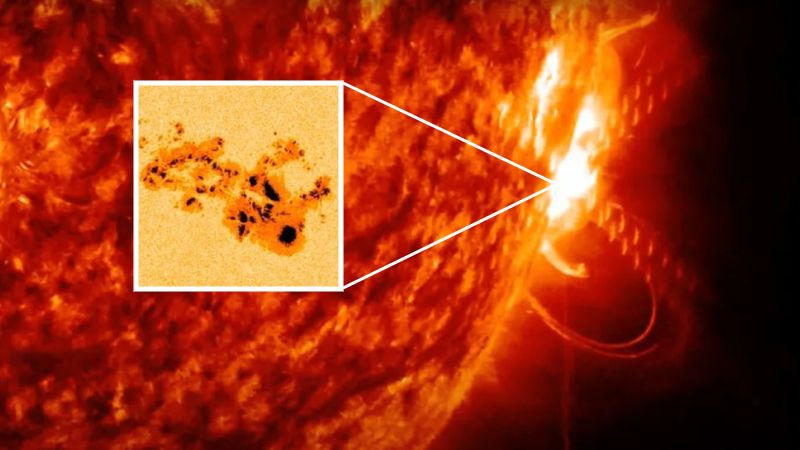
Solar observatories orbiting millions of miles away captured a region on the Sun’s surface behaving in ways that veteran researchers struggled to describe without hesitation.
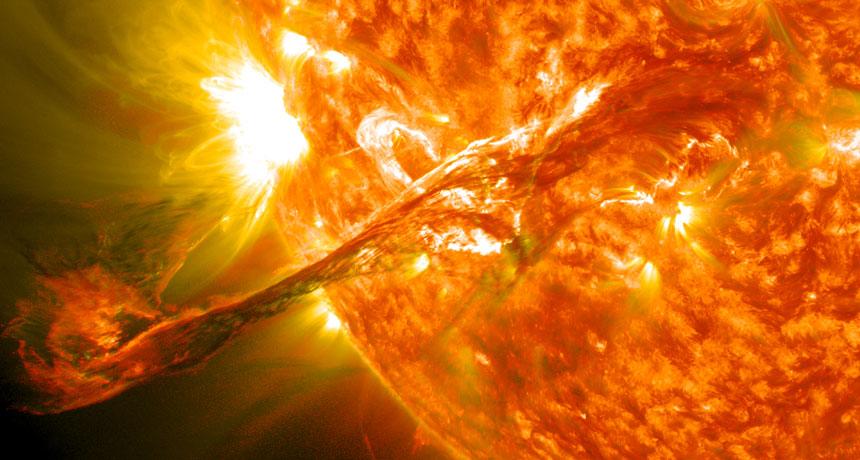
A vast magnetic structure—one long considered stable—appeared to fray at its edges, its lines of force tangling, stretching, and then snapping into new configurations like overstressed wires recoiling in slow motion.
What followed looked less like a flare and more like a wound opening.
Streams of incandescent plasma arced outward in looping bridges of fire, some stretching farther than models had comfortably predicted.
Official statements used careful words: “magnetic reconfiguration,” “elevated activity,” “complex filament destabilization.
” But behind those phrases, the raw images told a more unsettling story.
Crimson prominences twisted into shapes resembling spirals and hooks, folding back toward the surface before lashing outward again.
One researcher, speaking off the record, admitted the sequence felt “unsettlingly asymmetric,” as if the Sun were not simply releasing energy—but rearranging something deeper in its magnetic skeleton.
The Sun’s magnetic field is often described as a shield, an invisible architecture that shapes solar winds and governs eruptions.
It waxes and wanes in roughly 11-year cycles, flipping polarity, building tension, and releasing it in storms of radiation.
None of that is new.
What has drawn attention this time is not just intensity, but behavior.
Monitoring teams noted that a region expected to quiet down instead grew more chaotic, its field lines fragmenting into smaller, rapidly shifting zones.
Instead of one clean release, there were multiple pulses—staggered, overlapping, almost rhythmic.
Satellites designed to track space weather registered spikes in charged particles that arrived in uneven waves.
Not catastrophic, not yet, but enough to trigger alerts in agencies responsible for protecting communications and navigation systems.
Engineers watched dashboards that most people never see: radiation flux, magnetospheric compression, ionospheric density.
Numbers climbed, dipped, then climbed again.
On Earth, the effects were subtle—so subtle most would never connect them to a star 150 million kilometers away.
A few satellites briefly switched to safe mode.
Some high-frequency radio routes reported unusual noise.
Auroral forecasts were revised upward, promising brighter displays near the poles.
Beautiful, harmless, even romantic—if you didn’t think too long about what fuels them.
Yet in research centers, the mood leaned toward focused unease rather than wonder.
The concern is not that the Sun is “breaking,” as some dramatic headlines suggest, but that its magnetic choreography is revealing gaps in understanding.
Solar physics has advanced enormously, yet prediction remains probabilistic, not precise.
Scientists can say when the stage is set for activity.
They cannot always say how the drama will unfold once it begins.
One of the more debated aspects of this event is the apparent thinning of a large-scale magnetic arc that had spanned a significant portion of the Sun’s atmosphere.
Imagery showed it dimming before destabilizing, like a bridge losing tension before collapse.
Some specialists argue this is a normal prelude to a coronal mᴀss ejection.
Others note the geometry looked “fragmented,” as though multiple systems were interacting in ways not fully captured by current models.
And then there is the timing.
The Sun is in an active phase of its cycle, yes—but certain indicators had suggested a gradual tapering in this region, not escalation.
The reversal has fueled quiet discussions about whether deeper magnetic layers, hidden beneath the visible surface, might be evolving faster than expected.
Helioseismology—the study of sound waves rippling through the Sun—offers hints, but interpreting those signals is notoriously complex.
Publicly, experts stress perspective.
Solar outbursts are part of the star’s natural behavior.
Earth’s magnetic field and atmosphere provide substantial protection.
Truly extreme events are rare.
All true.
Yet history lingers in the background: the 1859 Carrington Event, when telegraph systems sparked and auroras glowed near the equator; more recent storms that disrupted satellites and power grids.
Modern civilization, woven together by electronics and orbital infrastructure, is more exposed than ever to disturbances that once pᴀssed largely unnoticed.
What makes this moment different is not confirmed danger, but the feeling of watching a system in transition without a clear script.
Data streams in continuously, each update refining the picture while also revealing new uncertainties.
Some models suggest the recent plasma expulsions will disperse harmlessly.
Others leave room for additional releases if underlying magnetic tensions remain unresolved.

Meanwhile, the images keep coming.
Loops of fire collapsing back onto the surface.
Dark filaments lifting like curtains before tearing free.
Shock waves rippling through the corona, visible only in specific wavelengths.
To the untrained eye, it is abstract art on a cosmic scale.
To those who study it, each shape is a clue—and sometimes a question.
There is also a psychological dimension rarely discussed outside academic circles.
The Sun is a constant in human experience, a symbol of reliability.
When headlines hint at instability, even exaggerated ones, they tap into something primal: the unease of realizing our life-giving star is also a volatile engine of nuclear fusion, governed by forces far beyond human control.
Scientists balance this narrative carefully, emphasizing resilience while acknowledging limits of foresight.
In the coming days, monitoring will intensify.
Spacecraft will adjust orientations.
Power operators may review contingency plans, as they routinely do during active solar periods.
Most likely, the episode will join the long catalog of energetic but manageable solar events.
Yet the data collected now will feed into future models, slowly improving the ability to anticipate the Sun’s moods.
Still, a lingering question threads through the conversation: are these patterns simply part of the familiar cycle, or hints of subtler shifts in how magnetic energy organizes within the star? No one claims a definitive answer.
Science moves by reducing uncertainty, not eliminating it.
As night falls on one side of Earth and dawn rises on the other, the Sun continues its restless dance, indifferent to headlines or human worry.
Its surface boils, fields twist, plasma flows along invisible lines of force that bend and snap in silence.
We watch from a safe distance—close enough to feel the consequences, far enough to study without being consumed.
Perhaps that is the most unsettling truth: not that disaster is imminent, but that we are witnesses to a colossal system whose full complexity still escapes us.
Each flare, each magnetic unraveling, is both spectacle and reminder.
The star that makes life possible is not a steady lamp, but a dynamic, evolving sphere of fire.
And every so often, it does something that makes even seasoned observers lean closer to their screens, lower their voices, and admit there is still more to learn than we once imagined.


