Minnesota at the Epicenter: How a Federal Crackdown Uncovered a Hidden Drug Hub
Minnesota was never supposed to be the front line of America’s opioid war.
Yet over the past year, federal agencies quietly reached a conclusion that stunned even seasoned investigators: the state had transformed into one of the Midwest’s most critical logistics hubs for synthetic narcotics.
What began as a routine narcotics operation spiraled into a sweeping federal intervention involving the FBI and ICE, resulting in more than 3,000 arrests and triggering an unprecedented political and legal showdown.

At first, the signs seemed familiar.
Local police units across Minneapolis and St. Paul reported an uptick in street-level drug arrests.
Dealers were being picked up, small quanтιтies seized, and the usual statistics logged.
But something didn’t add up.
Despite constant enforcement, drugs became easier—not harder—to obtain.

Overdose calls surged.
Emergency rooms filled.
And then came the moment that set off alarm bells across federal task forces: street prices collapsed.
Synthetic opioid pills that once sold for $20 apiece were suddenly going for as little as one or two dollars.
In law enforcement economics, such a crash signals only one thing—the market is flooded.
Investigators realized Minnesota wasn’t just a transit point.

It was a warehouse.
As federal agencies widened their net, arrest numbers climbed into the hundreds, then the thousands.
Patterns emerged.
The same aliases, phone numbers, and intermediaries kept appearing across unrelated cases in different neighborhoods.
Undercover agents confirmed that bulk quanтιтies were being stockpiled, cut, repackaged, and redistributed locally.
Minnesota had become a central distribution engine feeding surrounding states.

Much of this activity appeared concentrated in and around parts of the Somali diaspora community.
Officials were careful to stress that a community hit hardest by addiction is not the same as a community responsible for trafficking.
Still, data painted a grim picture: opioid fatalities within the Somali population were rising at nearly double the general rate, with young people hit hardest.
Elders and families quietly mourned sons and neighbors, often avoiding official overdose reports due to cultural stigma, which masked the true scale of the crisis.
As Operation Metro Surge accelerated, federal agents moved beyond street dealers and targeted infrastructure—cash flows, communications, and supply coordinators.
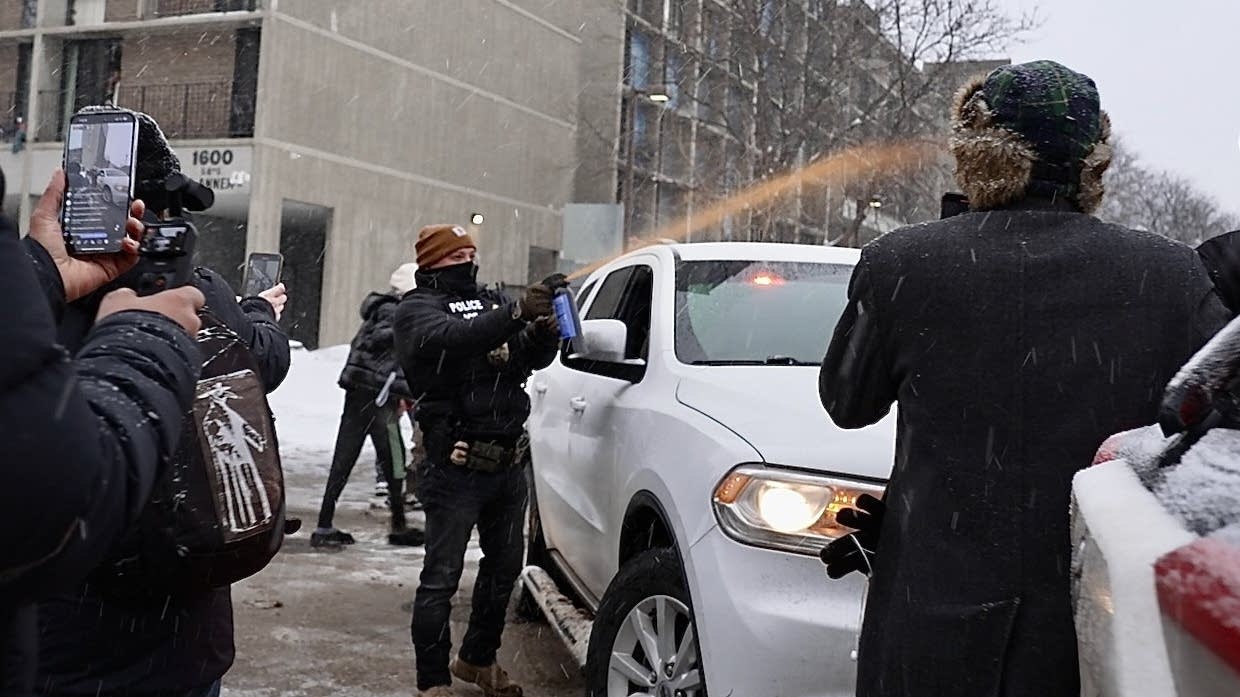
Arrest totals surpᴀssed 3,000.
According to federal briefings, many detainees were linked to organized trafficking networks, some with violent criminal histories and immigration violations.
Then came the political explosion.
Minnesota’s governor and the mayors of Minneapolis and St. Paul publicly condemned the federal operation.
They accused immigration agents of terrorizing communities, disrupting daily life, and violating civil rights.

Officials urged residents to record ICE activity and pushed back hard against federal presence.
Lawsuits followed.
Protests escalated.
The state and Washington appeared to be on a collision course.
But behind the scenes, the Department of Justice opened a separate investigation—this time into the politicians themselves.
Prosecutors examined whether public statements and actions by state and city leaders had crossed the line into obstruction of federal law enforcement.
Grand jury subpoenas soon landed on the desks of the governor, the Minneapolis mayor, the St. Paul mayor, and other top officials, demanding emails, documents, and internal communications related to the crackdown.
The narrative shifted overnight.
No longer was the story solely about drugs and arrests.
It became a consтιтutional and legal battle over the limits of political resistance to federal authority.
Meanwhile, the drug crisis showed no sign of slowing.
In 2023 alone, the DEA seized more than 417,000 illicit pills in Minnesota—more than double any neighboring state.
Pills arrived hidden in mailed packages, stuffed into toys, and scattered across both urban blocks and rural towns.
Seven out of ten seized tablets contained potentially lethal doses.
Despite record seizures, availability remained high, reinforcing investigators’ belief that supply chains were deeply embedded.
Overdose statistics continued to climb, and community advocates worked desperately on the ground, distributing Narcan and pleading for transparency as families buried loved ones in silence.
As of now, no elected official has been charged.
Many investigative theories remain unproven in court.
Federal agencies are still cross-referencing arrest data, overdose patterns, price fluctuations, and communication networks to determine how such an operation grew so large, so fast—and how it remained shielded for so long.
What is clear is this: Minnesota’s crisis is no longer local.
It has become a national case study in how drug economics, community vulnerability, and political conflict can collide with devastating consequences.


