At 4:01 a.m., the phones started lighting up.
Not in one city.
Not in one state.
But across twenty-three.
Doors were breached in Arizona before sunrise touched the desert. In Chicago, tactical teams moved through narrow alleys under flickering streetlights. In Atlanta, agents waited in silence outside a quiet suburban house while sprinklers watered a perfect lawn.
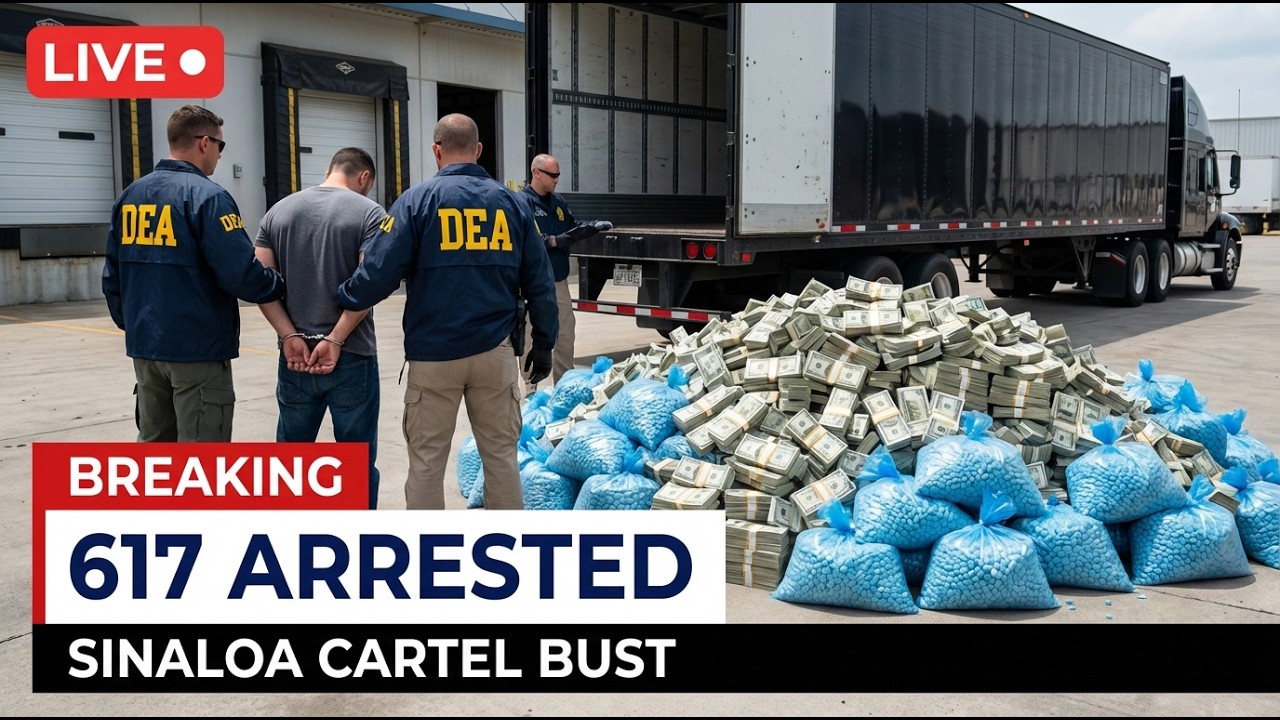
By 8:30 a.m., the first headline broke:
617 arrests.
Officials called it one of the largest coordinated enforcement actions in recent years — a sweeping operation targeting a distribution network allegedly tied to Sinaloa-linked supply chains.
But for Special Agent Lucas Hale, the numbers felt wrong.
Too clean.
Too symmetrical.
And far too convenient.
The Analyst Who Didn’t Celebrate
Hale wasn’t on the front lines kicking in doors.
He was in a dark operations center in Virginia, watching blinking grids on a wall-sized digital map. Freight corridors. Communication nodes. Financial spikes. Movement patterns.
For two years, he had been mapping what he called “the Iron Grid” — a structured logistics ecosystem embedded across the United States. It didn’t look like chaos.
It looked like infrastructure.
Warehouses positioned near interstate interchanges.
Distribution hubs overlapping with legitimate trucking routes.
Financial transfers layered through shell import-export firms.
He’d flagged anomalies in Ohio, Colorado, North Carolina.
Each connected to one another in subtle ways.
Then Operation Surge went live.
Twenty-three states. Coordinated warrants. 617 arrests.
The room applauded.
Hale didn’t.
Because as the arrests ticked upward, the freight data didn’t drop.
The First Crack
Three days after the operation, Hale ran the numbers again.
Street-level chatter decreased.
Social media noise dipped.
But long-haul trucking volume across specific corridors remained steady.
Almost as if nothing had happened.
He brought it to his supervisor, Deputy Director Kessler.
“Give it time,” she said. “Networks take days to react.”
Hale nodded.
But he’d studied adaptive systems before joining federal service. Criminal networks weren’t brittle anymore. They were resilient.
Self-healing.
That night, he ran a deeper model.
He cross-referenced arrests against warehouse lease records and utility usage.
A pattern emerged.
Of the 617 arrested, fewer than 12% had direct control over logistics infrastructure.
Most were mid-tier distributors. Transport drivers. Coordinators.
Replaceable.
The core nodes? Untouched.
The Second Twist
Two weeks later, one of the arrested coordinators — Miguel Aranda — requested to speak.
Not to negotiate.
To warn.
Hale watched the interrogation feed from behind glᴀss.
“You think you shut it down?” Aranda said quietly. “You shut down what you were allowed to see.”
Allowed.
The word stuck.
Aranda described something called “Sequence.”
Each regional hub was numbered. Structured. Compartmentalized.
When one fell, the next absorbed its routes automatically.
Hale’s pulse quickened.
“How many sequences?” the interrogator asked.
Aranda smiled faintly.
“You don’t know about Node Zero?”
Node Zero
There was no Node Zero in any official briefings.
Hale dove into archived case files dating back twelve years — seizures that seemed isolated at the time.
He noticed something chilling.
Every major takedown had been followed by a brief dip in activity… then a surge in efficiency.
Like a system stress-tested.
He layered historical operations over freight optimization data.
A ghost node appeared.
Not physical.
Digital.
A central coordination layer hidden inside legitimate logistics software platforms used by dozens of companies nationwide.
It wasn’t smuggling through tunnels or secret compartments.
It was routing through algorithms.
The Leak
Before Hale could escalate his findings, classified details of Operation Surge appeared online through an anonymous data drop.
Specific arrest timelines.
Targeted warehouses.
Operational gaps.
The leak was surgical.
And devastating.
Within forty-eight hours, three additional suspected hubs were cleared out before agents could move.
Someone inside had tipped the grid.
Hale confronted Kessler.
“We have a breach.”
She didn’t deny it.
She didn’t confirm it either.
“Focus on your lane,” she said calmly.
He hated that phrase.
The Third Twist
One night, alone in the operations center, Hale ran a shadow query through a secured freight optimization platform widely contracted by both private carriers and public transportation infrastructure.
He expected access denial.
Instead, the system opened.
A hidden dashboard appeared.
Labeled:
IRON GRID — PHASE TRANSITION
His hands trembled.
The dashboard displayed five regional clusters.
Four were marked disrupted.
The fifth pulsed green.
Operational.
And beneath it:
NODE ZERO — STABLE
He copied what he could before the screen went dark.
The next morning, his system access was suspended pending “security review.”
The Personal Cost
Hale returned home to find his apartment ransacked.
Nothing stolen.
Hard drives wiped clean.
Except one file.
A printed sheet left on his desk.
Coordinates.
And a timestamp three days in the future.
He recognized the location immediately — a freight convergence hub in Missouri flagged months earlier but deprioritized during Operation Surge planning.
Was this a threat?
Or an invitation?
The Missouri Convergence
Off-duty and unofficial, Hale drove west.
The facility looked ordinary.
Trucks loading produce.
Forklifts moving pallets.
But he noticed something subtle — nearly every truck bore a small, identical fleet-tracking device mounted near the rear axle.
Not standard issue.
He pH๏τographed one up close.
The serial number traced back to a subcontractor linked indirectly to a tech firm partially funded through shell investments flagged during earlier investigations.
The same firm contracted by several state transportation departments.
Embedded.
Legitimized.
Untouchable.
The Confrontation
As Hale prepared to leave, his phone buzzed.
Unknown number.
“You’re early,” a voice said calmly.
He spun.
A man stood near the loading dock — clean-cut, wearing a logistics company badge.
“You’re not Sinaloa,” Hale said.
The man smiled slightly.
“Sinaloa is supply. We’re structure.”
“We?”
“Sequence isn’t about drugs,” the man continued. “It’s about proving infrastructure can’t be dismantled once integrated.”
Hale’s mind raced.
“Node Zero?”
The man’s smile widened.
“Contingency.”
Before Hale could respond, sirens wailed in the distance.
Federal units.
Had someone tracked him?
The man stepped back.
“You were supposed to see this,” he said softly. “Phase Two needs observers.”
Then he disappeared into the warehouse as agents flooded the perimeter.
The Fourth Twist
News outlets reported another successful bust in Missouri.
Dozens arrested.
Product seized.
Officials praised Operation Surge’s continuing impact.
Hale watched the press conference from a motel room.
Something felt staged.
He pulled up freight volume metrics.
Missouri routes dipped sharply.
Then rebalanced — not through neighboring states.
Through international maritime ports.
Adaptation.
Diversification.
The grid wasn’t collapsing.
It was expanding.
The Final Revelation
Three months later, Operation Surge was declared a landmark success.
617 arrests.
Billions disrupted.
Infrastructure dismantled.
Hale wasn’t invited to the ceremony.
He sat alone, reviewing the limited data he’d salvaged from Node Zero.
Then a secure message arrived through an encrypted channel he didn’t recognize.
A single line:
Phase Two — International Integration Complete.
Attached was a map.
Not of twenty-three states.
But of five countries.
Freight corridors highlighted across North America.
Legitimate.
Public.
Unstoppable without crippling entire sectors of commerce.
His phone rang.
Deputy Director Kessler.
“You were right,” she said quietly.
A pause.
“But it’s bigger than us.”
“Bigger how?”
Silence.
Then:
“Some systems are allowed to exist because removing them would cause more damage than tolerating them.”
The line went ᴅᴇᴀᴅ.
The Cliffhanger
That night, Hale reopened the Iron Grid model.
Node Zero pulsed brighter than before.
Then a new label appeared:
NODE PRIME — INITIALIZING
He zoomed out.
The grid extended beyond the U.S.
Beyond North America.
Into global shipping lanes.
Trade arteries.
Digital logistics platforms.
A structure so embedded within legitimate infrastructure that dismantling it would collapse supply chains feeding millions.
His screen flickered.
A final message appeared:
You can expose us.
Or you can watch how we evolve.
Outside his window, freight trains rumbled in the distance.
Engines humming.
Routes flowing.
Uninterrupted.
Hale realized something chilling.
Operation Surge had not been an ending.
It had been a calibration test.
And the next phase would not be about twenty-three states.
It would be about control.
The screen went dark.
Then rebooted automatically.
A new dashboard loaded.
Access granted.
NODE PRIME — ACTIVE.
Hale stared at the blinking global map.
Somewhere within those lines, the real architects were watching.
Waiting.
And he understood that stopping them would require more than raids and arrests.
It would require dismantling the very systems modern economies depended on.
The train outside pᴀssed into silence.
But the grid kept humming.


