Cartel’s Secret Signal Empire: FBI Raids Cell Tower Network Linked to Sinaloa Across 8 States
In a sweeping operation that stunned federal investigators and rattled communities across multiple states, the FBI launched coordinated raids on a telecommunications company allegedly controlled by operatives linked to the notorious Sinaloa Cartel.
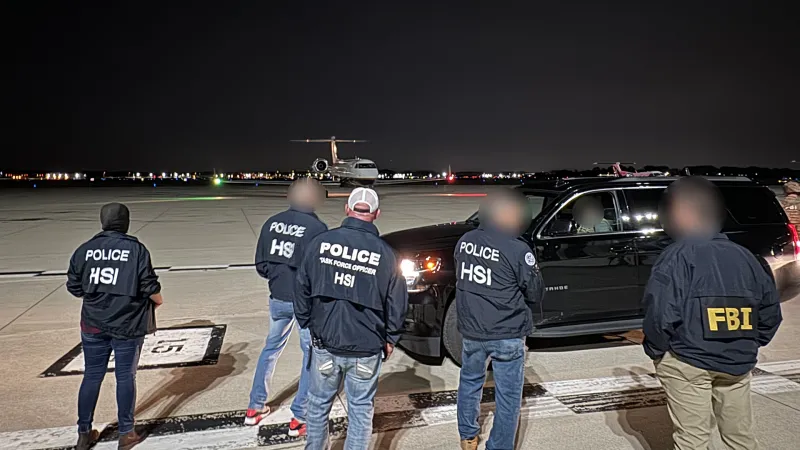
According to officials familiar with the investigation, the company is accused of secretly owning and operating more than 340 cell towers across eight U.S.states — a communications web authorities say was used to facilitate narcotics trafficking, encrypted coordination, and evasion of law enforcement.
What began as a quiet financial probe into irregular telecom licensing agreements evolved into a high-level federal operation involving multiple agencies.
By dawn, tactical teams were moving in simultaneously on corporate offices, storage facilities, and transmission sites.
Agents seized servers, hard drives, financial records, and sophisticated radio equipment believed to have been customized to create private cellular networks layered within legitimate infrastructure.
Federal sources say the network allowed cartel operatives to mask communications in plain sight.

Unlike disposable phones or encrypted messaging apps alone, investigators allege the group built its own backbone — a semi-autonomous cellular grid capable of routing internal traffic without relying fully on mainstream carriers.
Authorities claim the infrastructure provided cartel leaders with a near real-time command system stretching from border regions deep into the American interior.
The company at the center of the raids reportedly operated under the guise of rural broadband expansion and infrastructure leasing.
Public filings suggested modest growth and legitimate contracts.
But investigators allege shell corporations and straw investors concealed ownership tied to individuals already under federal scrutiny for drug distribution and money laundering.
“This wasn’t just about phones,” one federal official said under condition of anonymity.
“This was about control — control over information, logistics, and territory.

The alleged scale of the operation has drawn comparisons to previous crackdowns on cartel infiltration of transportation and financial systems.
But officials privately admit that uncovering a covert communications grid marks a dangerous evolution in organized crime strategy.
By embedding infrastructure inside legitimate business channels, authorities say the network blurred the line between criminal enterprise and corporate operations.
The investigation reportedly gained momentum after unusual signal routing patterns were detected near known trafficking corridors.
Analysts monitoring spectrum usage noticed irregular tower-to-tower handoffs inconsistent with commercial traffic.
That anomaly triggered deeper examination by federal cyber and communications specialists.
Court documents unsealed late Tuesday suggest the infrastructure may have supported high-volume drug shipments coordinated across state lines, including movements of fentanyl and methamphetamine.
Law enforcement officials have long warned that cartels are increasingly dependent on technological sophistication to outpace enforcement efforts.
The alleged ownership of physical communications ᴀssets, however, represents an escalation few anticipated.
The Federal Bureau of Investigation confirmed that multiple search warrants were executed but declined to discuss operational specifics, citing an ongoing investigation.
Officials emphasized that no military takeover occurred, despite widespread online speculation referencing the involvement of national security advisors.
The mention of the “U.S.
Military” in viral headlines appears to stem from coordination with federal infrastructure security units rather than active deployment.
Defense officials have not confirmed direct participation in the raids, though interagency collaboration on cyber and infrastructure threats is not uncommon when communications systems are implicated.
Experts in organized crime say the alleged strategy aligns with the long-term operational doctrine of the Sinaloa Cartel, which has historically emphasized adaptability and structural control.
Founded decades ago and once led by the infamous Joaquín “El Chapo” Guzmán, the cartel evolved from smuggling routes into a diversified global narcotics empire.
While leadership dynamics have shifted in recent years, analysts note the organization remains highly decentralized and technologically adaptive.
“This isn’t a cartel operating out of dirt roads and burner phones anymore,” said one former federal prosecutor.
“We’re talking about logistical sophistication that rivals mid-size corporations.”
Communities across the affected states have reacted with a mix of shock and anger.
Local officials say they were unaware that telecom infrastructure in their jurisdictions could be tied to international criminal syndicates.
Some rural counties, which benefited from expanded coverage attributed to the company, now face questions about oversight and regulatory gaps.
Regulatory agencies are also under scrutiny.
Investigators are examining how the company secured licenses, zoning approvals, and federal grants without triggering red flags.
Preliminary findings suggest that layers of intermediaries obscured beneficial ownership, allowing cartel-linked investors to operate quietly within compliance frameworks.
Financial analysts tracking the company’s reported revenues note inconsistencies between infrastructure footprint and subscriber data.
That discrepancy reportedly fueled suspicions that the towers were not intended primarily for public consumer use but rather to create a parallel communications channel.
Meanwhile, prosecutors are preparing what sources describe as a complex racketeering case that could include charges related to conspiracy, money laundering, wire fraud, and material support of criminal enterprise.
Seizure of physical infrastructure could trigger forfeiture proceedings valued in the hundreds of millions of dollars.
Border security officials stress that while the raids mark a significant disruption, dismantling communications networks does not immediately neutralize trafficking operations.
Cartels historically pivot quickly, exploiting new technologies and decentralized command structures.
Still, federal authorities are signaling that infrastructure infiltration will not be tolerated.
“We will pursue criminal organizations wherever they embed themselves — in our financial system, our supply chains, or our communications networks,” one senior official said.
National security analysts warn that the broader implication extends beyond drug trafficking.
Control over localized communications grids could theoretically enable surveillance, data interception, or coordinated disruption — concerns that elevate the case from criminal enterprise to potential homeland security risk.
The revelation comes amid intensifying national debate over border enforcement and cartel designation.
Lawmakers from multiple states are calling for expanded investigative authority and stronger oversight of telecommunications licensing.
As servers are analyzed and financial trails untangled, the full scope of the alleged network remains unclear.
Authorities have not confirmed how long the towers operated under cartel control or how many communications pᴀssed through the system.
What is clear is that this investigation has exposed a troubling convergence of technology, infrastructure, and organized crime.
The idea that a powerful cartel may have quietly built its own communications grid inside the United States challenges long-held ᴀssumptions about how such organizations operate.
For now, the seized towers stand as silent steel monuments — once ordinary fixtures on the horizon, now symbols of a deeper infiltration that investigators say could reshape how authorities confront transnational criminal networks in the digital age.
The coming weeks are expected to bring indictments, ᴀsset freezes, and possibly international cooperation requests.
Whether this operation delivers a lasting blow to cartel logistics or simply marks another chapter in a long-running struggle remains to be seen.
But one thing is certain: the battle between federal law enforcement and technologically empowered criminal enterprises has entered a new phase — and the airwaves themselves have become the latest front line.


