A Hidden Masterpiece: The Castle That Outsmarted Revolution
In the gentle stillness of the French countryside stands Château de Jizay — a structure that has endured war, revolution, neglect, and reinvention.
At first glance, it appears like many historic estates scattered across the Loire Valley: towers rising from centuries-old stone, long façades stretching across manicured land, and forests extending beyond sight.
But Château de Jizay holds a secret that once saved its artistic soul.
Behind what appeared to be ordinary walls lay vibrant Renaissance masterpieces — hidden deliberately during one of France’s most violent chapters.
For nearly 100 years, they remained untouched, protected not by guards or vaults, but by deception.

The origins of Château de Jizay date back to the 14th century, when defensive towers and thick medieval walls defined its earliest form.
Over time, it evolved.
During the 16th century, under the influence of the French Renaissance, the fortress softened into something more refined — a residence meant to impress as much as defend.
Later still, it transformed again.
By the 18th century, the estate expanded into a vast complex of stables, workshops, bakeries, and blacksmith forges.
At its peak, around 100 people lived and worked within its 250-meter length, making it one of the longest châteaux in the Touraine region.

The property has remained in the same family lineage since 1786, when it was given as a wedding gift.
Generations have cared for it — sometimes thriving, sometimes merely surviving.
And survival would soon depend on quick thinking.
When the French Revolution erupted in 1789, aristocratic homes became targets.
Symbols of wealth and monarchy were vandalized or destroyed outright.

At Jizay, revolutionaries ransacked portions of the estate.
Paintings in some areas were smashed.
Interiors were stripped.
But in one extraordinary act of foresight, a young woman living at the château saw the danger coming.
Determined to save what she could, she enlisted help from local villagers.
Together, they constructed false walls and ceilings inside one of the château’s most magnificent rooms: the Galerie François Premier.
Behind these crude barriers lay elaborate 16th-century frescoes — painted by Italian artists and inspired by Ovid’s Metamorphoses.
The ceiling, fireplace, and walls were covered in mythological scenes, intricate floral arrangements, and rare symbols of wealth, including tulips — an exotic luxury at the time.
Once concealed, the room appeared plain and unremarkable.
The deception worked.
Revolutionaries overlooked it.
Remarkably, the protective false walls were never removed after the Revolution.
They remained in place for nearly 100 years.
The unintended benefit? The artwork inside was shielded not only from destruction but from light, moisture, and human interference.
Without exposure to sunlight, the pigments retained their brilliance.
The colors stayed vibrant.
The surfaces avoided deterioration.
The château changed hands within the family.
Portions fell into agricultural use.
Roofs decayed.
At times, the estate seemed on the brink of collapse.
Yet behind those hidden panels, the Renaissance endured.
The secret might have remained buried longer — if not for curiosity.
In the late 19th century, a young boy — the family’s grandfather — was playing inside the château when he struck part of a wall.
A small hole opened.
Through it, he glimpsed color.
Bright, unmistakable color.
Excited, he widened the gap.
What emerged was astonishing: frescoes untouched for generations, preserved as if time itself had paused.
An entire artistic world had been sleeping behind plaster.
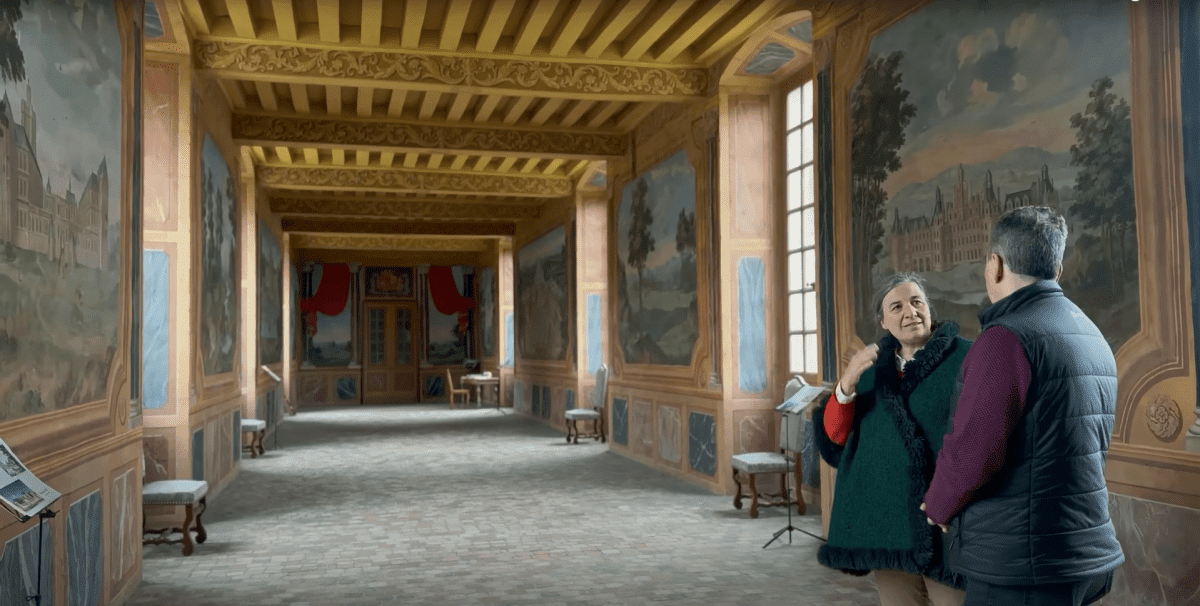
Beyond the rediscovered Renaissance chamber lies another marvel: a 400-square-meter painted gallery created in the 17th century.
Commissioned by a widow during the reign of Louis XIV, the space became an artistic training ground.
A master painter and his students used the corridor walls as a living studio.
Some sections are refined and masterful; others reveal the tentative strokes of apprentices learning perspective and proportion.
Murals depict royal châteaux like Chambord and Versailles — though sometimes with imaginative liberties.
In certain paintings, perspective flattens awkwardly.
In others, animals appear stiff or stylized.
The variation tells its own story: a school in progress.
Even optical illusions — trompe-l’œil techniques — were practiced here.
Stand anywhere in the room, and the garden scenes seem to follow you, much like the eyes of the Mona Lisa.
It is the largest private mural gallery of its kind in France.
The château has not escaped hardship.
Storms tore away roofing.
Portions remain unsafe to enter.
More than two hectares of roofing demand constant maintenance.
Forestland spanning 1,000 hectares surrounds the estate — beautiful but costly to manage.
Yet the family continues to restore, preserve, and share the château’s story with approximately 12,000 visitors each year.
The irony is profound.
The same walls meant to deceive revolutionaries became the ultimate preservation tool.
What was once a desperate act of concealment is now celebrated as an extraordinary example of cultural resilience.
Château de Jizay reminds us that history is not only written in grand battles and royal decrees.
Sometimes, it survives because someone quietly builds a false wall.
And waits.


