Morocco Underwater: One Year of Rain in 24 Hours Triggers a Disaster Worse Than Feared
Morocco is facing one of the most devastating flood disasters in its modern history, as torrential rain—equal to an entire year’s worth in some regions—fell within just 24 hours, unleashing destruction on a scale far greater than initially reported.
What began as an intense storm system quickly turned into a national emergency, overwhelming rivers, collapsing infrastructure, and leaving entire communities cut off from the outside world.
From the rugged foothills of the Atlas Mountains to arid plains that rarely see heavy rainfall, water tore through landscapes unprepared for such extremes.
Dry riverbeds transformed into violent torrents within minutes.
Roads vanished beneath churning mud.

Homes built for heat and drought were suddenly fighting an enemy they were never designed to withstand.
In southeastern Morocco, some meteorological stations recorded rainfall totals typically seen over twelve months—compressed into a single day.
Local officials admitted that early damage ᴀssessments drastically underestimated the scope of the disaster.
As floodwaters receded in some areas, they revealed not just localized destruction, but entire regions fundamentally altered.
Villages near seasonal rivers, or wadis, were among the hardest hit.
These waterways, often dry for most of the year, became ᴅᴇᴀᴅly channels of force.
Residents described hearing a deep, thunderous roar moments before walls of water slammed into their communities.
In several towns, the floods struck at night, giving families little time to escape.
Cars were swept away, livestock drowned, and homes collapsed under the pressure.
Major population centers were not spared.
In and around cities such as Ouarzazate and Errachidia, streets turned into rivers and neighborhoods were submerged under thick, debris-filled water.
Hospitals struggled to remain operational as access roads flooded.
Power outages plunged large areas into darkness, compounding fear and confusion as emergency calls flooded in.
Eyewitness accounts paint a picture of chaos and disbelief.
Residents spoke of water rising waist-high in minutes, leaving no time to gather belongings.
“We are used to drought,” one survivor said.
“Not this.Never this.”
Others described climbing onto rooftops or nearby hills, watching helplessly as floodwaters swallowed their homes below.
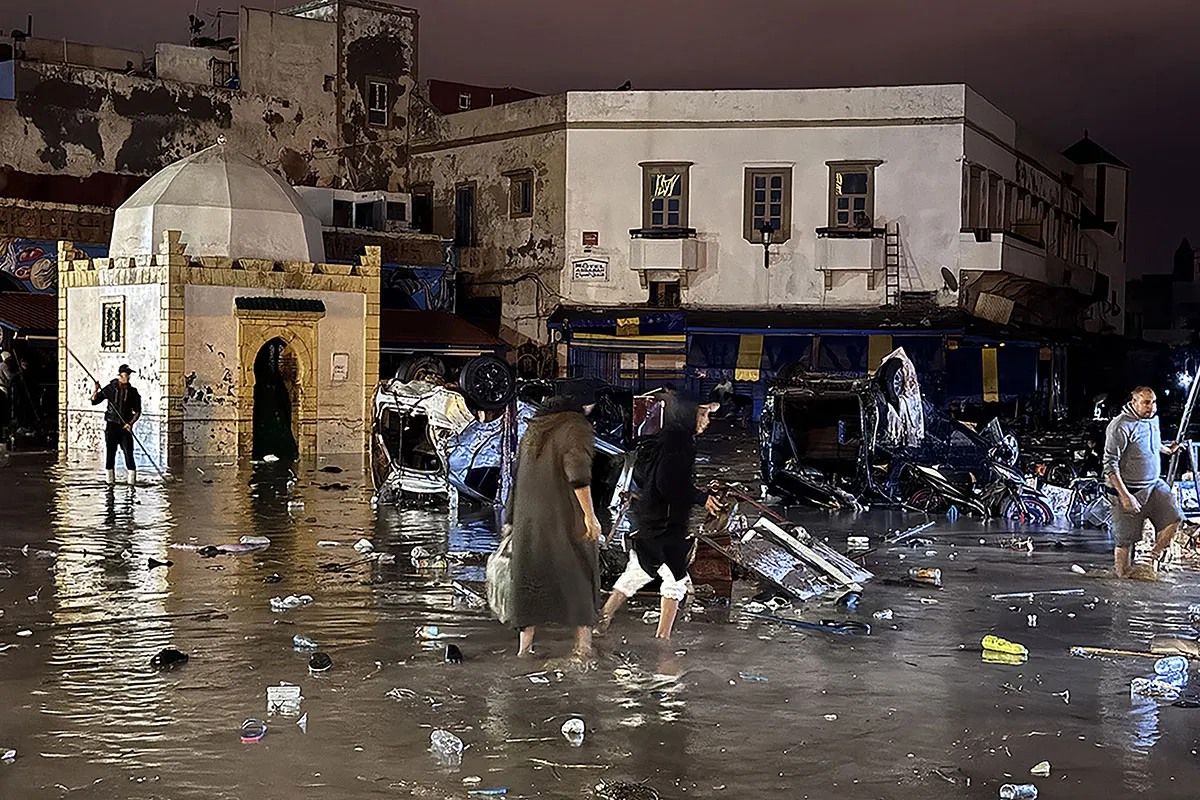
Emergency services faced enormous challenges.
Damaged roads and washed-out bridges delayed rescue efforts, forcing responders to rely on helicopters and off-road vehicles in some regions.
In isolated mountain villages, help took hours—sometimes days—to arrive.
Volunteers joined rescue teams, forming human chains to pull people from fast-moving water and searching through mud-filled ruins for survivors.
As the scale of the flooding became clearer, officials acknowledged that climate patterns played a critical role.
Meteorologists explained that an unusual atmospheric system pulled mᴀssive amounts of moisture inland from the Atlantic, releasing it over regions with little capacity to absorb or redirect such rainfall.
The hardened, drought-baked ground allowed rainwater to run off almost instantly, amplifying the speed and violence of the floods.
The economic damage is expected to be severe.
Farmland was inundated just as crops neared harvest, wiping out a vital source of income for rural families.
Irrigation systems, paradoxically destroyed by excess water, will take months to repair.
Markets, workshops, and small businesses reported total losses as inventory was destroyed by mud and contamination.
Beyond physical destruction, the human toll is profound.
Thousands were displaced, seeking shelter in schools, mosques, and makeshift emergency centers.
Aid organizations rushed to provide food, clean water, and medical ᴀssistance, warning of potential health risks from contaminated floodwater.
With temperatures still high in many regions, concerns grew over the spread of disease and the lack of adequate sanitation.

As images circulated globally—washed-out highways, collapsed homes, and vast stretches of muddy water—questions mounted about preparedness and resilience.
Morocco has long battled drought and water scarcity, investing heavily in dams and reservoirs.
But this disaster exposed a different vulnerability: the inability of infrastructure designed for scarcity to cope with sudden excess.
Government officials vowed a full investigation into early warning systems and emergency response protocols.
While weather alerts had been issued, many residents said they did not grasp the severity of what was coming.
In remote areas, warnings arrived too late or not at all.
“We thought it would be heavy rain,” one local official admitted.
“No one imagined this.”
Environmental experts warn that such extremes may no longer be rare.
As climate variability increases, regions accustomed to drought may face more intense and unpredictable rainfall events.
This combination—long dry periods followed by sudden deluges—is particularly dangerous, creating ideal conditions for flash floods and landslides.
Despite the devastation, stories of resilience and solidarity have emerged.
Neighbors opened their homes to displaced families.
Youth volunteers worked tirelessly to clear mud and deliver supplies.
In towns where everything seemed lost, communal efforts offered moments of hope amid despair.
Yet recovery will be long and painful.
Many families returned to homes filled with thick sludge, walls cracked and foundations weakened.
Some villages may need to be rebuilt entirely.
The psychological impact—especially on children who watched their world disappear overnight—will linger long after the water has gone.
What makes this disaster especially haunting is its scale and speed.
One year of rain in a single day shattered the illusion of predictability.
It revealed how quickly nature can overturn ᴀssumptions, even in places shaped by centuries of environmental hardship.
As Morocco begins to count the cost, the floods stand as a stark warning.
This was not just a storm—it was a stress test that exposed deep vulnerabilities.
And as communities rebuild, the memory of that relentless 24 hours will remain, etched into the landscape and into the lives of those who survived it.


