The Turin Shroud and the “Hidden DNA Code”: What Scientists Actually Discovered
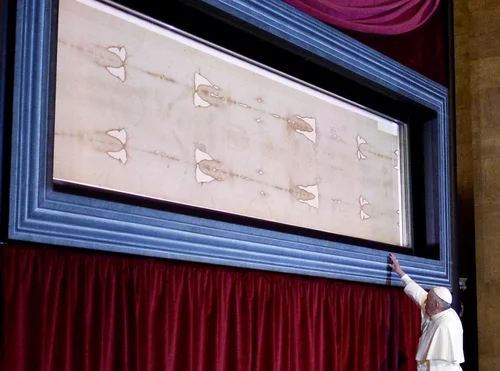
Few religious artifacts have inspired as much fascination — and controversy — as the Turin Shroud. The 14-foot linen cloth bearing the faint image of a crucified man has been venerated by millions as the burial shroud of Jesus Christ. At the same time, skeptics have long argued it is a medieval creation.
In 2015, a study led by Professor Gianni Barcaccia at the University of Padua introduced a new layer to the debate: DNA analysis. Using advanced genetic sequencing techniques, researchers examined microscopic dust particles, pollen grains, and biological material trapped between the linen fibers. The goal was not to “find the DNA of Jesus,” as some sensational headlines suggested, but to better understand the cloth’s history — specifically, where it may have traveled and who may have handled it over the centuries.
The results were complex.
Instead of identifying a single dominant genetic profile, the team detected mitochondrial DNA from multiple human haplogroups ᴀssociated with diverse geographic regions. These included lineages commonly found in Europe, the Middle East, North Africa, and even South and East Asia.
To some commentators, this was explosive. If the Shroud were merely a 14th-century European forgery, they argued, why would DNA linked to distant regions such as India or East Asia appear on the cloth?
However, the actual scientific interpretation is far more measured.

The Shroud has been publicly displayed numerous times over the past six centuries, attracting millions of pilgrims from across Europe and beyond. It has also been handled, repaired, moved, and stored in various locations — including France and Italy. Throughout history, trade routes like the Silk Road connected Europe with Asia and Africa, enabling long-distance travel centuries before modern globalization.
Mitochondrial DNA is highly durable and can persist in trace amounts. Even brief contact — a touch, a breath, a strand of hair — can leave behind genetic material. Over hundreds of years, cumulative exposure from countless individuals would naturally result in a mosaic of genetic signatures.
Importantly, the study did not isolate ancient, uncontaminated DNA from a single first-century individual. Instead, it identified mixed genetic material consistent with multiple layers of handling over time. The researchers themselves cautioned that contamination and historical contact make it impossible to attribute the DNA to any one specific era or person.
In other words, the findings reflect the Shroud’s long and complex journey — not definitive proof of its origin.
Beyond genetics, the Shroud’s authenticity debate has centered for decades on other scientific analyses.

In 1988, three independent laboratories — Oxford, Zurich, and the University of Arizona — conducted radiocarbon dating on a small sample of the cloth. Their results dated the fabric to between 1260 and 1390 AD, placing its origin squarely in the medieval period.
This conclusion was widely accepted at the time. However, critics later argued that the tested sample may have come from a repaired section of the cloth, possibly rewoven after damage from a 1532 fire. Some researchers have proposed that contamination, biological growth, or restoration threads could have skewed the carbon dating results.

In 2022, a separate study using wide-angle X-ray scattering (WAXS) suggested the linen fibers’ structural degradation might be consistent with greater age — potentially aligning with the first century. However, this method is still debated within the scientific community and has not replaced radiocarbon dating as the standard for chronological ᴀssessment.
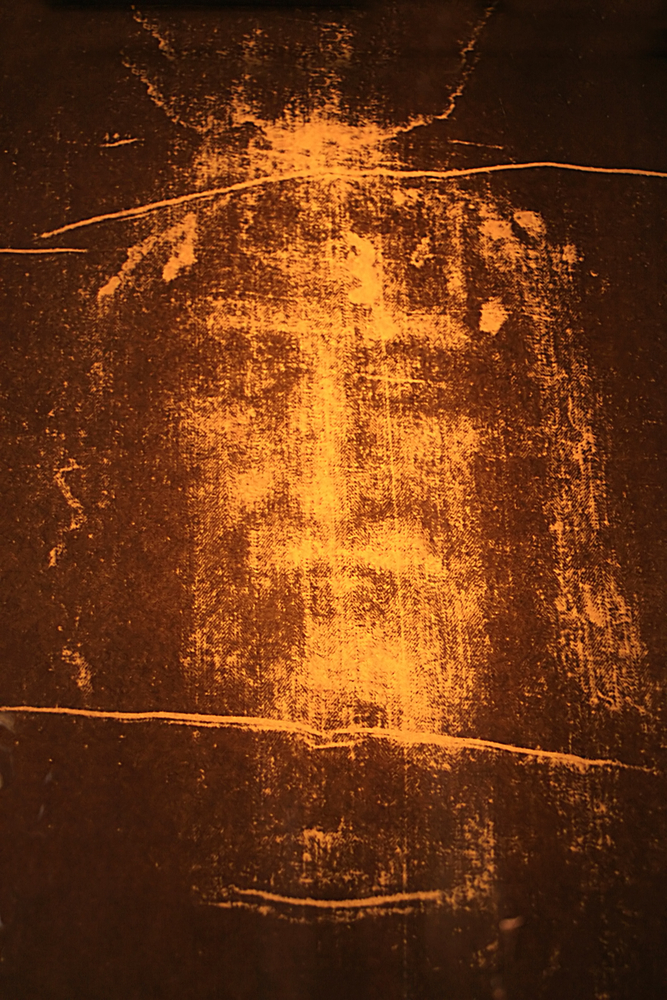
The image itself remains one of the Shroud’s most intriguing features. First pH๏τographed in 1898 by Secondo Pia, the image appeared strikingly detailed in negative — creating the impression of a pH๏τographic negative centuries before pH๏τography was invented. Subsequent studies found the image resides only on the outermost fibers of the cloth and contains three-dimensional information correlated to body-cloth distance.

Despite decades of research, no universally accepted explanation for the image formation has emerged. Hypotheses range from medieval artistic techniques and chemical reactions to natural processes involving burial conditions. Experimental attempts using heat, pigments, and radiation have reproduced some — but not all — of the Shroud’s characteristics.
As for the bloodstains, several studies have identified components consistent with human blood, including hemoglobin and serum albumin. Yet questions remain regarding the extent of degradation, contamination, and interpretation of biochemical markers.
So did the DNA findings “shock Christians”?

For many believers, the Shroud’s spiritual significance does not depend solely on laboratory results. For skeptics, the presence of mixed DNA confirms centuries of handling rather than miraculous preservation. The genetic data neither proves nor disproves authenticity — it simply reflects the artifact’s long exposure to humanity.
What the 2015 study truly revealed is not a hidden supernatural code, but a biological record of contact. The Shroud, whatever its origin, has been touched by countless hands across continents and centuries.
Its fibers carry a history of devotion, curiosity, and controversy.
In the end, the Turin Shroud remains suspended between faith and science — a relic whose mystery persists not because of a single DNA sequence, but because definitive answers continue to elude both sides of the debate.


