“Anti-Christ Pastors?” Viral Video Sparks Explosive Debate Over Doctrine and Truth
A controversial video is rapidly gaining traction online after making serious accusations against several high-profile pastors, including T.D.Jakes, Gino Jennings, Matthew Stevenson, Brandon Jacobs, and others.
The central claim is striking: that these leaders are promoting false doctrine and, in doing so, leading people away from what the speaker considers the true Christian faith.
At the heart of the argument is a long-standing theological divide—one that centers on the nature of God.
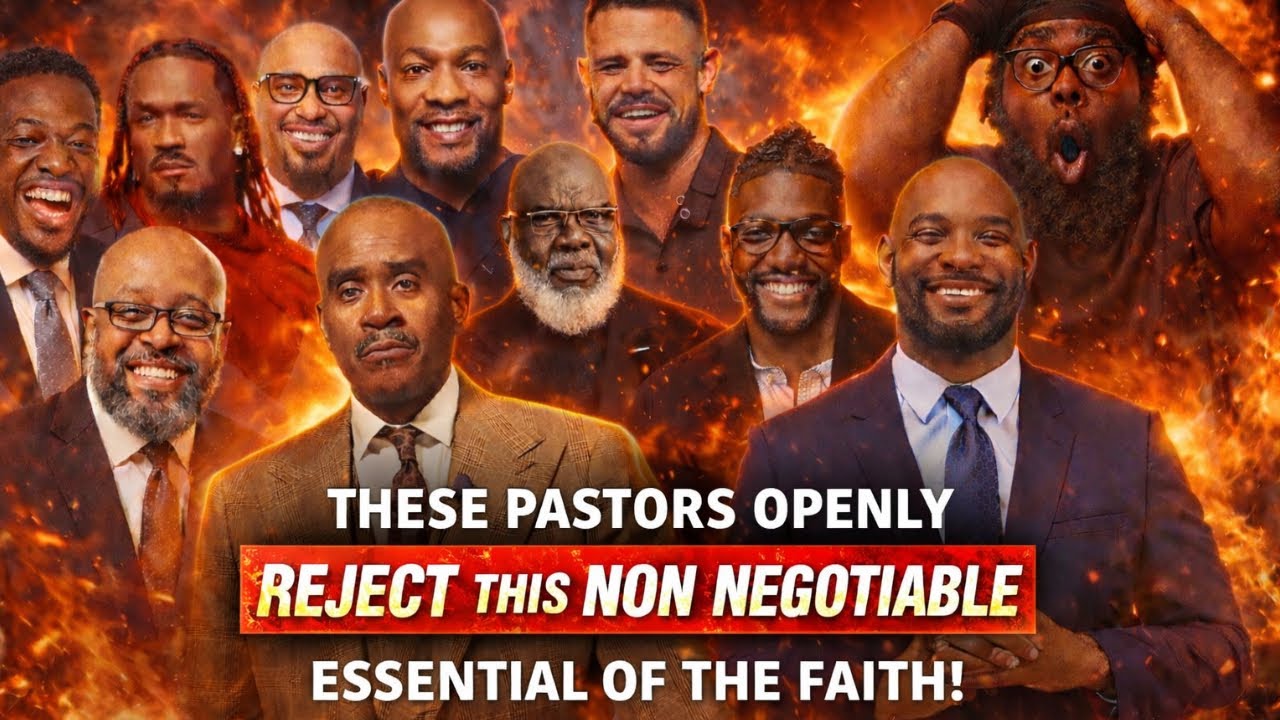
The video’s creator insists that certain foundational beliefs are “non-negotiable” within Christianity.
These include the doctrine of the Trinity, the full divinity and humanity of Jesus Christ, salvation by grace, and the authority of scripture.
According to this perspective, any teaching that deviates from these essentials is not simply in interpretation—but a complete departure from the faith itself.
This is where the controversy intensifies.
A major focus of the critique is something known as “Oneness theology,” a belief system that emphasizes the absolute unity of God, often rejecting the traditional concept of the Trinity as three distinct persons.

Instead, proponents describe God as one being who reveals Himself in different modes or manifestations—Father, Son, and Holy Spirit.
The video strongly opposes this view, arguing that it distorts the idenтιтy of God as presented in scripture.
It points to various biblical pᴀssages that appear to distinguish between the Father, Son, and Holy Spirit, presenting them as interacting in ways that suggest personal distinction rather than mere roles or expressions.
For critics of Oneness theology, this distinction is crucial.
They argue that if the nature of God is misunderstood, it affects every other aspect of belief—from salvation to the idenтιтy of Jesus.
However, supporters of Oneness theology see things differently.
They often emphasize verses that highlight the oneness of God and the fullness of divinity in Jesus Christ.
For them, the idea that God is one is not just a theological detail—it is a foundational truth that must be protected.
They argue that their interpretation preserves strict monotheism and aligns with the language of scripture.
This disagreement is not new.
In fact, debates over the nature of God date back to the early centuries of Christianity, long before modern denominations existed.
Councils, creeds, and theological writings have all attempted to define and clarify these concepts, yet discussions continue to this day.
What makes the current situation unique is the platform.
Through social media and YouTube, these debates are no longer confined to seminaries or church gatherings—they are public, immediate, and often highly emotional.
The video in question uses strong language, labeling certain teachings as heretical and even going so far as to question the spiritual standing of those who promote them.
This kind of rhetoric has drawn both support and criticism.
Some viewers applaud the boldness, believing that clear lines must be drawn when it comes to core doctrines.
They see the video as a necessary defense of truth in a time when, in their view, confusion is spreading.
Others, however, are concerned about the tone and approach.
They argue that while theological disagreement is important, labeling individuals in extreme terms can lead to division rather than understanding.
They caution that complex doctrinal issues require careful discussion, not just sharp condemnation.
Another layer to the controversy involves how these pastors communicate their beliefs.
Many of the clips featured in the video show preachers using pᴀssionate, metaphorical, or simplified language to explain deep theological concepts.
Critics argue that this can lead to confusion or misinterpretation, especially when dealing with something as complex as the nature of God.
Supporters counter that effective communication often requires translating complex ideas into relatable terms, and that not every sermon is meant to be a detailed theological lecture.
As the debate continues, one thing becomes clear: this is about more than just a few pastors or a single video.
It reflects a broader struggle within Christianity—how to define essential truth, how to handle disagreement, and how to balance conviction with humility.
In an age where anyone can broadcast their views to millions, these questions are becoming increasingly urgent.
Whether one agrees with the video’s conclusions or not, it has succeeded in doing one thing: forcing people to think more deeply about what they believe—and why.
And in a conversation as significant as this, that may be the most important outcome of all.


