The Shroud of Turin remains one of the most debated and intensively examined artifacts in human history, standing at the intersection of belief, skepticism, and scientific inquiry.
For centuries, the linen cloth bearing the faint image of a bearded man has inspired devotion among many Christians while provoking doubt and scrutiny from scholars and skeptics alike.
In recent years, renewed scientific attention and public debate have once again brought the shroud into the global spotlight.
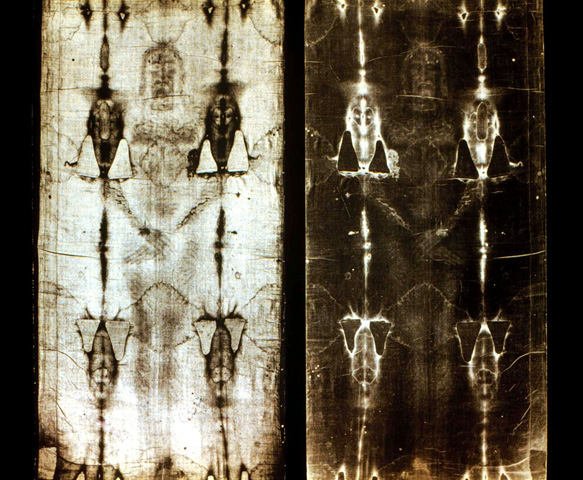
The artifact itself is a long linen cloth, measuring over fourteen feet in length, preserved today in Turin, Italy.
It displays the front and back image of a man who appears to have endured Roman crucifixion.

Visible markings include puncture wounds on the wrists and feet, numerous scourge marks across the body, and injuries consistent with carrying a heavy wooden beam.
These details closely align with historical descriptions of crucifixion practices in the first century Roman world, fueling claims that the cloth once wrapped the body of Jesus of Nazareth.
Supporters of the shroud’s authenticity argue that it is not merely a burial cloth, but evidence of an extraordinary event.
Some researchers contend that the image could not have been formed by paint, dye, or heat, as extensive testing has revealed no pigments, brush marks, or scorch patterns.
Instead, the image exists only on the outermost fibers of the linen, penetrating no deeper than a few microns.
This unusual characteristic has led certain scientists to propose that a brief but intense energy release may have altered the linen fibers at a molecular level.
Among those who once doubted the shroud but later reconsidered their position is Dr Jeremiah Johnston, a Christian scholar who has extensively studied the historical resurrection accounts.
He has stated that his shift in perspective came not from religious sentiment, but from reviewing recent peer reviewed studies involving physics, chemistry, and imaging science.
According to this view, the shroud records not only a d*ath event, but something far more unusual, a transformation moment that left a permanent imprint on the cloth.
Proponents often describe this as a radiation event, an instantaneous release of energy that changed the chemical structure of the linen without burning it.
Experiments attempting to replicate such an image using modern lasers have shown that only extremely high energy bursts, delivered in fractions of a second, could produce similar surface effects.
Even then, researchers acknowledge that current technology cannot fully recreate the image found on the shroud.
Not all experts agree with this interpretation.
Critics argue that extraordinary claims require extraordinary evidence, and they caution against attributing unexplained phenomena to miraculous causes.
Dr Joseph Aseta, a physicist and member of the original Shroud of Turin Research Project, has emphasized that while the shroud is an extraordinary object, its origins remain unresolved.
He has suggested that if the cloth dates to the medieval period, there are plausible explanations rooted in historical textile practices.
One of the central points of skepticism involves radiocarbon dating conducted in 1988.
Samples taken from a corner of the cloth were analyzed by three laboratories, each producing results that placed the shroud’s origin between the thirteenth and fourteenth centuries.
These findings were widely publicized and for many years were considered definitive.
However, subsequent analysis raised concerns about the sampling location, potential contamination, and whether the tested material was representative of the entire cloth.
Later studies suggested that the sampled area may have included repaired or rewoven threads, which could skew dating results.
Scholars reviewing the raw data decades later noted statistical anomalies and inconsistencies that cast doubt on the reliability of the original conclusions.
As a result, some researchers now argue that the radiocarbon dates should be reconsidered rather than accepted as final.
Another point of contention involves the anatomical proportions visible on the shroud image.
Observers have noted that the arms appear unusually long and that the figure’s height varies slightly depending on which side is measured.
Supporters of authenticity explain these features as the result of shoulder dislocation during crucifixion, a documented outcome of Roman execution methods.
Skeptics counter that such distortions could also arise from artistic techniques or the mechanics of image transfer onto fabric.
The debate extends beyond science into historical documentation.
Critics note the absence of any direct mention of a burial cloth bearing an image in the canonical gospels.
This silence, they argue, is difficult to reconcile with the shroud’s alleged significance.
Defenders respond that many early Christian relics were known by different names or kept hidden during periods of persecution, and that absence of mention does not equate to absence of existence.
Historical references to a miraculous image ᴀssociated with Jesus do appear in later writings, including accounts of the Image of Edessa, also known as the Mandylion.
Some scholars propose that this object and the Shroud of Turin may be the same artifact, folded or displayed differently over time.
Manuscript illustrations from medieval Europe, including the Hungarian Pray Codex, depict burial scenes with striking similarities to the shroud’s features, suggesting that knowledge of the cloth may predate its public appearance in France.
Skeptics remain unconvinced.
Authors and commentators from secular perspectives argue that the shroud reflects a strong human desire to believe, particularly among those already inclined toward Christian faith.
They caution against using religious texts to validate physical evidence, pointing out that ancient writings often contain symbolic narratives alongside historical elements.
From this viewpoint, the shroud represents a powerful cultural object rather than definitive proof of supernatural events.
The discussion also touches on the broader reliability of biblical sources.

While many historians agree that Jesus existed and was executed by Roman authorities, they differ sharply on interpretations of resurrection claims.
Some maintain that early followers experienced visions or transformative psychological events, while others accept the accounts as literal history.
The shroud, in this context, becomes part of a much larger conversation about evidence, belief, and interpretation.
Despite decades of research across more than one hundred scientific disciplines and hundreds of thousands of documented hours of study, no consensus has emerged.
The shroud continues to resist simple classification.
It is not a conventional artwork, not a known pH๏τographic process, and not easily explained by natural mechanisms.
At the same time, it lacks the clear provenance and documentation that would conclusively establish its idenтιтy as the burial cloth of Jesus.
For believers, the shroud offers a tangible connection to the central event of Christian faith.
For skeptics, it serves as a cautionary example of how mystery can be amplified by expectation.
For scientists, it remains an unresolved problem, one that challenges existing models and invites further investigation.
What is clear is that the Shroud of Turin occupies a unique place in human history.
It has survived fires, wars, political intrigue, and centuries of debate.
It has been revered, criticized, analyzed, and dismissed, often all at once.
Its image continues to provoke questions that extend beyond the cloth itself, touching on the limits of science, the nature of historical evidence, and the enduring human search for meaning.
As technology advances, new methods may yet shed additional light on the shroud’s origins.
Until then, it remains suspended between faith and doubt, a silent witness to an event that continues to shape civilizations.
Whether viewed as a sacred relic, a medieval creation, or an unsolved scientific puzzle, the Shroud of Turin endures as one of the most compelling and controversial artifacts ever known.


