A Sermon That Sparked Controversy
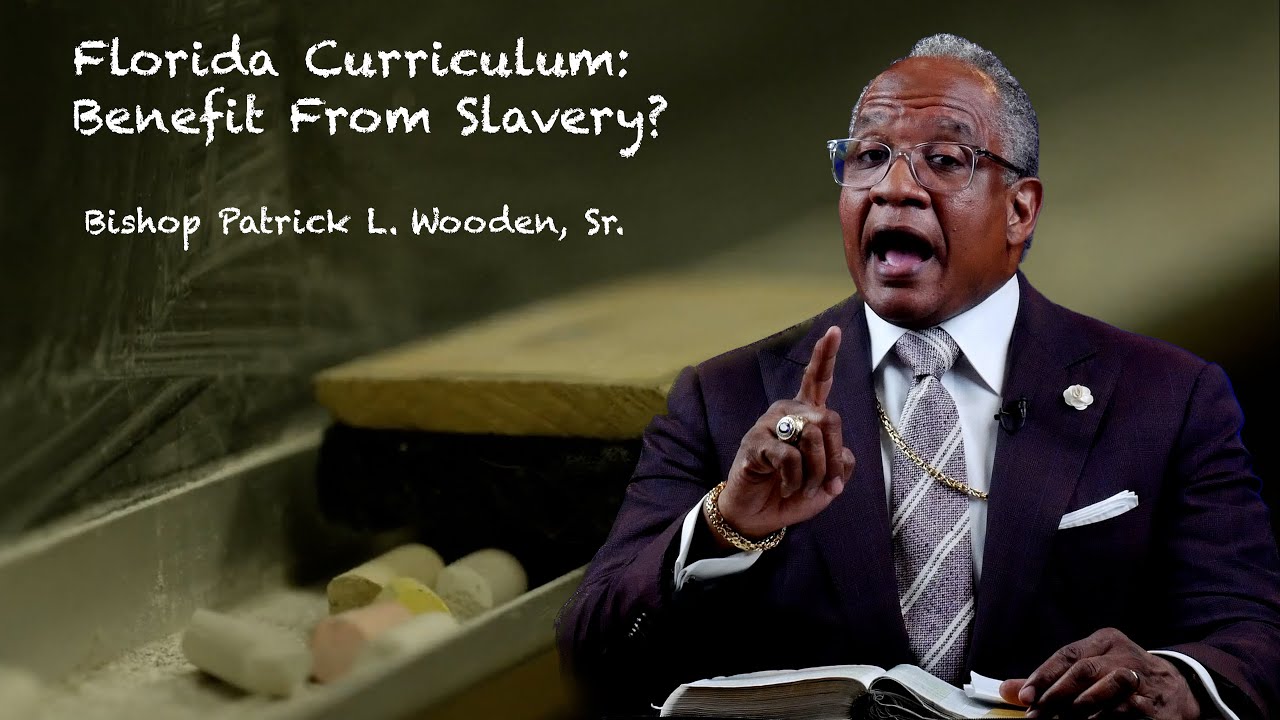
Bishop Patrick Wooden, known for his direct preaching style, recently delivered a message that quickly gained attention far beyond his congregation.
What began as a teaching on loving one’s enemies evolved into commentary on race, political allegiance, abortion, and the transatlantic slave trade.
Wooden prefaced his remarks by acknowledging that some might be offended.

He insisted, however, that his commitment is to biblical principles—even when they provoke discomfort.
“I just go along with the Bible,” he said, emphasizing scriptures that call believers to love their enemies and avoid repaying evil for evil.
That framework shaped the rest of his message.
Wooden expressed concern over what he described as Christians celebrating harm toward ideological opponents.
Referencing the biblical mandate to overcome evil with good, he argued that believers must not become what they claim to oppose.
His central question: If scripture commands love for enemies, should that standard shift based on political disagreement?
For Wooden, the answer was clear.
Christian conduct, he argued, should remain consistent regardless of circumstances.
The most debated portion of the sermon came when Wooden stated that “White folk couldn’t manufacture slaves to sell,” urging listeners to consider the role of African slave traders in the transatlantic slave trade.
Historians widely document that the slave trade involved complex systems in which African intermediaries captured and sold prisoners to European traders.
At the same time, European powers created, financed, expanded, and insтιтutionalized the global system of chattel slavery that followed—building economies on forced labor and codifying racial hierarchy into law.
Wooden framed his point as a challenge: Who bears greater guilt—the buyer or the seller?
The comment drew immediate reactions online.
Some viewers agreed that history should be examined in full complexity, including African participation.
Others argued that such framing risks minimizing the central role of European colonial powers in creating and sustaining the brutal system of racialized slavery in the Americas.
The historical consensus among scholars is that responsibility for the transatlantic slave trade is shared across multiple actors, but that European demand, transportation networks, plantation systems, and legal structures were decisive in shaping the insтιтution as it existed in the Western Hemisphere.
Wooden then transitioned to a discussion of eugenics and abortion.
He referenced Margaret Sanger, the founder of Planned Parenthood, noting her ᴀssociation with early 20th-century eugenics movements—an ideology that sought to control reproduction based on perceived genetic “fitness.”
It is historically documented that some early birth control advocates, including Sanger, engaged with eugenics language common in that era.
However, scholars continue to debate how those views influenced later reproductive health policies and insтιтutions.
Wooden argued that abortion disproportionately affects Black communities and described it as a continuation of racial injustice.
He cited statistics about abortion clinic locations and claimed that the industry specifically targeted Black populations.
Public health data does show disparities in abortion rates that correlate with broader systemic inequalities, including economic access, healthcare access, and structural racism.
Experts note that these disparities are complex and tied to socioeconomic conditions, not solely to intentional targeting.
A significant portion of Wooden’s message questioned political loyalty.
He criticized what he described as uncritical support for policies that align with abortion rights, particularly within the Democratic Party.
Identifying himself as politically unaffiliated, he challenged congregants to evaluate policies through a biblical lens rather than party idenтιтy.
“If we’re going to be saved,” he concluded, “we have to love our enemies.”
For Wooden, the issues of race, abortion, and political alignment ultimately returned to that central spiritual principle.
The intensity of the response stems from several factors:
• Slavery remains one of the most painful chapters in American history, and discussions about responsibility are deeply sensitive.
• Abortion intersects with moral, political, and racial justice debates.
• Linking historical trauma to modern political idenтιтy amplifies emotions on all sides.
Supporters argue that Wooden was encouraging historical honesty and moral accountability across communities.
Critics contend that his framing risks oversimplification and may obscure structural realities.
The sermon highlights an ongoing tension within faith communities: How should churches address political and historical issues? Where is the line between prophetic challenge and political commentary? And how can discussions of race remain truthful without deepening division?
Bishop Patrick Wooden’s remarks have ensured that these questions won’t fade quietly.
Whether one agrees or disagrees, the conversation he ignited underscores the enduring complexity of history—and the challenge of applying faith principles in a politically charged era.


