NAPLES ON THE EDGE: Campi Flegrei Fractures After Relentless Quakes — Is Magma Rising from the Shadows?
The ground beneath Naples has always carried a quiet threat, the kind that lingers in folklore and tourist brochures alike.
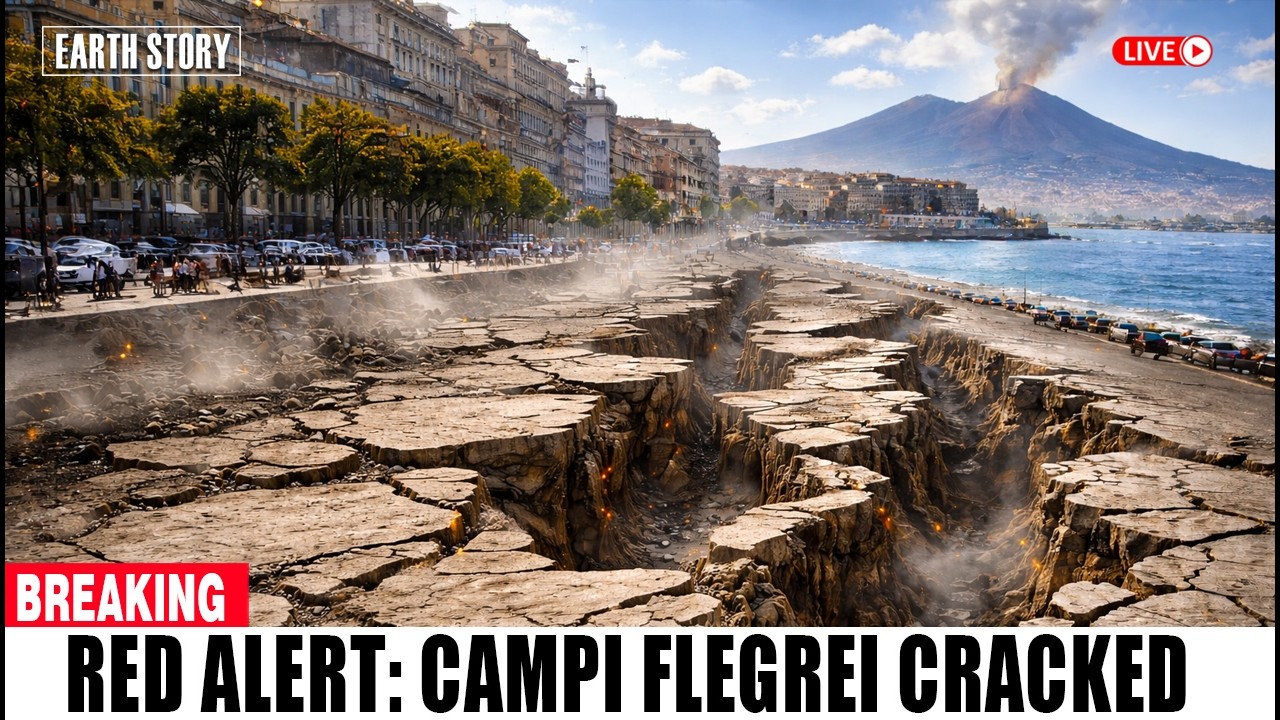
Visitors sip espresso in sunlit piazzas, gaze across postcard waters, and pH๏τograph ancient ruins without fully acknowledging what lies below.
But in recent weeks, the tremors have become harder to ignore.
They arrive in clusters — sharp, shallow jolts that rattle windows in the early hours and send chandeliers into faint, trembling motion.
At first, officials described them as routine.
Then they intensified.
Across the restless expanse of Campi Flegrei, new fractures have reportedly appeared in the earth.
Pavement has split in thin, jagged lines.
Walls have developed hairline cracks that weren’t there before.
Residents speak of low, echoing booms beneath the soil — sounds too deep to be thunder, too persistent to dismiss as imagination.
Scientists refer to the phenomenon as bradyseism, a slow lifting and sinking of the ground driven by subterranean forces.
But that word, clinical and detached, does little to calm the unease spreading through neighborhoods perched above one of Europe’s most volatile volcanic systems.
Data from monitoring stations confirm what many already feel underfoot: seismic activity has surged.
Hundreds of small quakes have been recorded within weeks.
Most are minor in magnitude, barely strong enough to cause structural damage.
Yet their frequency tells a different story.
Swarms of earthquakes often indicate movement below — fluids, gases, or magma adjusting pressure within fractured rock.
Authorities emphasize that movement does not necessarily mean eruption.
The Earth shifts constantly, they remind the public.
Volcanic systems breathe.
But some residents hear a different message in that reᴀssurance: if it breathes, it can also exhale.
Campi Flegrei is not a single towering cone like the iconic volcano that looms nearby.
It is a vast caldera — a sunken landscape formed by ancient, catastrophic eruptions that reshaped entire coastlines.
Its last major eruption occurred in 1538, creating Monte Nuovo in a matter of days.
Historical accounts describe the ground swelling dramatically before bursting open.
The land rose meters within months.
Fishermen watched the sea retreat.
Then fire tore through the earth.
That was nearly five centuries ago.
Today, the swelling has returned, albeit more subtly.
The ground has been rising again over the past years, accelerating in recent months.
Geophysicists measure this uplift in centimeters, sometimes millimeters.
To the untrained eye, such increments seem trivial.
But beneath a caldera, centimeters can signal accumulating pressure across kilometers of rock.
Satellite imagery confirms deformation patterns consistent with magma or gas intrusions at depth.
Some experts argue that the system is adjusting without immediate danger.
Others concede, more cautiously, that the threshold between adjustment and escalation is not always clear.
The distinction, they admit privately, often becomes obvious only in hindsight.
Local authorities have updated emergency preparedness plans.

Evacuation routes have been reviewed.
Siren systems have been tested.
Public briefings repeat a consistent theme: there is no immediate evidence of an imminent eruption.
Yet the phrasing feels deliberate.
“No immediate evidence” leaves space for interpretation.
It does not guarantee stability.
It does not promise calm tomorrow.
Meanwhile, social media has amplified every tremor.
Videos of swaying light fixtures circulate within minutes.
Amateur analysts compare seismic graphs, drawing their own conclusions.
Some claim that magma is rising rapidly toward the surface.
Others insist that the unrest is part of a long-term cycle documented for decades.
Conspiracy threads suggest data is being softened to avoid panic.
Officials reject those accusations firmly.
Transparency, they say, is paramount.
Still, distrust grows in the cracks where certainty cannot reach.
Volcanologists explain that magma does not move like water through a pipe.
It forces its way upward by fracturing surrounding rock, generating earthquakes as it advances.
Increased seismicity can indicate this fracturing process.
However, it can also reflect hydrothermal fluids shifting through existing cracks without magma approaching the surface.
Distinguishing between the two scenarios requires careful analysis of gas emissions, ground deformation, and earthquake depth.
Recent measurements show elevated carbon dioxide emissions in certain zones.
CO₂ can be released by magma at depth, but it can also seep from long-established hydrothermal systems.
Context matters.
Interpretation matters more.
The unsettling reality is that volcanic forecasting remains probabilistic.
Scientists speak in likelihoods, not certainties.
A system can escalate for months and then quiet abruptly.
It can also appear stable until it doesn’t.

The caldera’s last large-scale eruption thousands of years ago was among the most powerful in European history, dispersing ash across vast regions.
That ancient event reshaped ecosystems and human settlements alike.
No one suggests a similar catastrophe is imminent.
But the geological memory remains embedded in the terrain.
In cafés overlooking the bay, conversations have shifted subtly.
Residents who once shrugged at minor tremors now glance at phone alerts with тιԍнтened expressions.
Real estate listings in certain districts show signs of slowing demand.
Insurance inquiries have increased.
Parents quietly review evacuation maps distributed by municipal authorities.
It is not panic — not yet.
It is vigilance, edged with something harder to define.
Some experts argue that raising alarm prematurely could do more harm than the tremors themselves.
Economic consequences, tourism decline, property devaluation — these are tangible risks tied to perception.
Others counter that underestimating volcanic unrest has historically proven costlier.
The debate plays out in academic panels and televised interviews, each side armed with models and projections.
Beneath their measured tones lies a shared acknowledgment: the Earth does not negotiate.
At night, when traffic subsides and the city quiets, the smaller quakes feel larger.
A faint vibration under the mattress.
A subtle creak in the walls.
The human mind fills silence with possibility.
Was that another tremor? Or simply the settling of old stone buildings? Seismographs provide answers hours later.
Sometimes they confirm movement.
Sometimes they show nothing at all.
Emergency drills conducted in recent years have simulated rapid evacuation of hundreds of thousands of residents.
The logistics are daunting.
Narrow roads, dense neighborhoods, limited exit corridors — all must function with precision under pressure.
Officials insist the plans are robust.
Critics question whether theory can withstand real-world urgency.
The truth, as always, would only reveal itself in action.
For now, life continues.
Markets open at dawn.
Ferries depart on schedule.
Tourists pH๏τograph sunsets unaware of the subtle uplift measured beneath their feet.
The caldera does not glow ominously.
It does not rumble continuously.
It waits, as it has waited before.
Geological time stretches far beyond human attention spans.
But seismic swarms compress that vast timeline into days and weeks, forcing a confrontation between patience and apprehension.
Is magma truly rising closer to the surface? Current data cannot conclusively confirm it.
Is the risk higher than it was a year ago? Many scientists cautiously say yes.
Does higher risk equate to imminent eruption? Not necessarily.
The ambiguity is both scientifically honest and psychologically unsettling.

Certainty would be easier — whether reᴀssuring or alarming.
Instead, residents inhabit a gray zone where probabilities shift with each new tremor.
History suggests that Campi Flegrei is capable of dramatic transformation.
Modern monitoring provides unprecedented insight into its behavior.
Between those two realities lies a tension difficult to resolve.
The system may stabilize.
The swarms may fade.
Uplift may plateau.
Or the fractures now etched into pavement could widen, slowly at first, then decisively.
No sirens have sounded.
No ash clouds darken the sky.
Yet beneath the surface, pressure continues its silent negotiation with stone.
The coming weeks will likely bring more data, more briefings, more reᴀssurances layered with caution.
And with each tremor, however small, a question echoes through homes and hallways: is this simply the Earth adjusting… or the first chapter of something far less forgiving?


