MICHIO KAKU SOUNDS THE ALARM AFTER STRANGE 3I/ATLAS PHENOMENON SPARKS FEARS OF AN UNPRECEDENTED OBJECT SWARM HEADED OUR WAY!
Just when humanity thought it could take a quiet afternoon off from existential dread, the cosmos said, “Absolutely not.”
Enter 3I/ATLAS — the latest interstellar object to blaze into headlines — now accused by the internet of doing something straight out of a sci-fi apocalypse: replicating 10,000 times and forming a swarm allegedly “approaching Earth.”
Yes, you read that correctly.
A swarm.
In space.
Approaching us.
Cue dramatic music and at least twelve YouTube thumbnails featuring glowing red circles and the Earth looking mildly concerned.
The hysteria began innocently enough.
Astronomers detected an unusual interstellar object designated 3I/ATLAS.
The “3I” classification simply means it is the third confirmed interstellar object observed pᴀssing through our solar system, following the now-legendary ‘Oumuamua and comet Borisov.
“ATLAS” refers to the asteroid survey system that identified it.
Straightforward.
Calm.
Scientific.
But calm and scientific are not trending keywords.
Within hours, social media accounts began circulating animations of what appeared to be fragments surrounding the object.
Grainy telescope images showed streaks and faint companions.
Headlines mutated at light speed.
“It’s splitting!” “It’s multiplying!” “Self-replicating alien probe confirmed?” Somewhere, a science communicator felt their blood pressure rise.
The phrase “replicated 10,000 times” did not originate from a NASA press conference.
It came from a spectacularly enthusiastic interpretation of observed debris and fragmentation.
When comets or icy interstellar objects approach the Sun, they can shed material.
Jets of gas and dust erupt as ices sublimate.
Pieces break off.
That is called physics.
The internet, however, prefers the word replication.
Suddenly, timelines were flooded with talk of a “swarm formation.”
Dramatic animations showed thousands of glowing dots spiraling toward Earth like a cosmic bee invasion.
One viral post declared, “This is how it starts.”
Another calmly suggested stockpiling canned goods.
And then, inevitably, someone invoked Michio Kaku.
Theoretical physicist and professional bringer-of-cosmic-context Michio Kaku was quoted discussing interstellar objects and the fascinating possibility that advanced civilizations might one day send probes across the galaxy.
He did not declare that 3I/ATLAS was a self-replicating alien fleet.
He did what scientists do: he speculated about possibilities in a general sense.
Unfortunately, speculation plus a dramatic headline equals planetary meltdown.
“Is it alien technology?” asked one influencer, staring intensely into the camera.
“I’m not saying it is.
But I’m not saying it’s not.
” Which is the rhetorical equivalent of lighting a match and walking away slowly.
Let’s breathe.
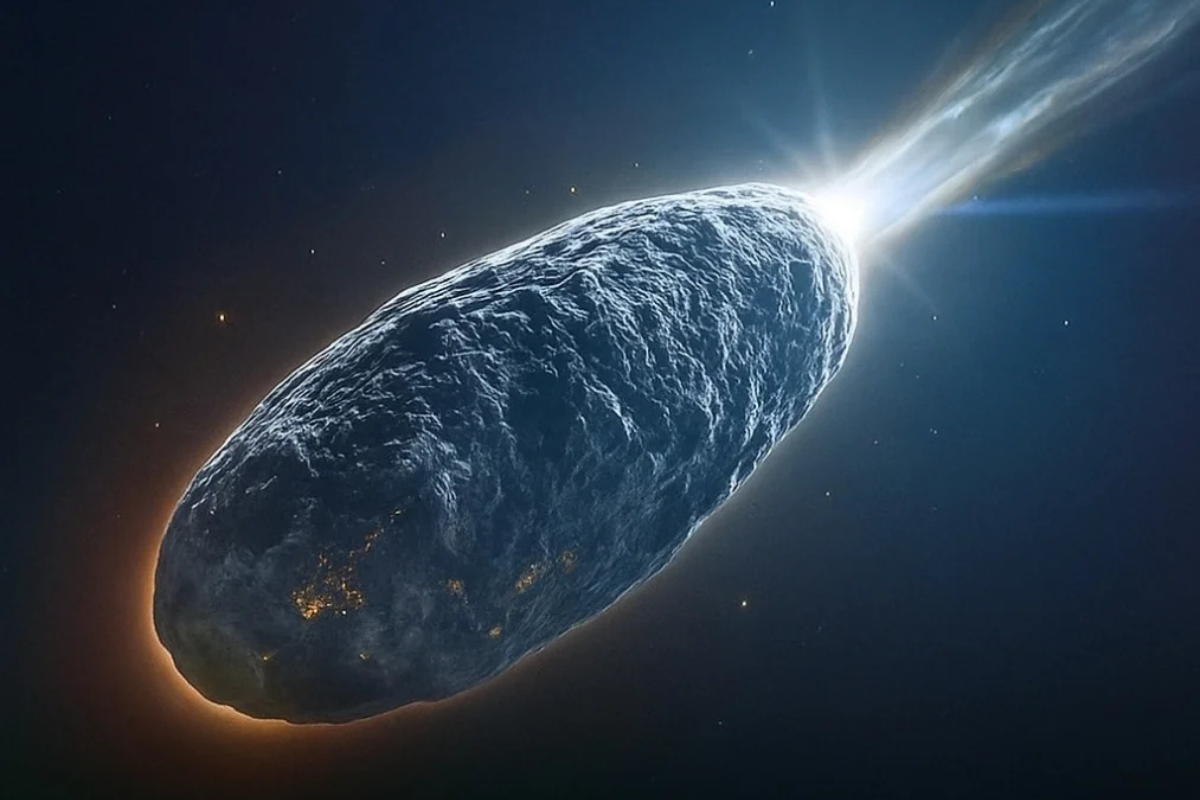
What astronomers actually observed were signs consistent with natural fragmentation.
As an interstellar object travels through the inner solar system, solar radiation and gravitational stress can cause it to break apart.
This has been documented many times with comets.
Sometimes they split into multiple visible fragments.
Sometimes those fragments create dust trails that appear like swarms in long-exposure images.
Ten thousand? That number likely emerged from modeling estimates of particulate debris — not ten thousand independently guided alien drones executing synchronized maneuvers.
But try fitting “likely particulate debris cloud consistent with sublimation dynamics” into a viral headline.
The swarm narrative took on a life of its own.
Comment sections became digital campfires for apocalyptic storytelling.
Some claimed the object was changing trajectory intentionally.
Others insisted its “movement patterns” were unnatural.
In reality, orbital mechanics can look dramatic when animated.
Elliptical paths and perspective distortions are not evidence of intent.
They are evidence of math.
Astronomers, meanwhile, were busy doing the least cinematic thing imaginable: gathering data.
Spectroscopy.
Light curves.
Velocity calculations.
They analyzed its hyperbolic trajectory — the telltale sign of an interstellar origin.
They measured its speed relative to the Sun.
They ᴀssessed whether any fragments posed risk to Earth.
Spoiler alert: current calculations indicate no collision threat.
But “no collision threat” does not inspire emergency podcasts.
The comparison to ‘Oumuamua was inevitable.

When that cigar-shaped visitor pᴀssed through in 2017, it sparked similar debates.
Its unusual acceleration prompted discussions about outgᴀssing versus exotic explanations.
Serious scientists leaned toward natural causes.
A small but vocal group suggested alien probes.
The universe, it turns out, is very good at producing objects that look weird from far away.
3I/ATLAS joined that tradition.
It arrived with mystery baked in.
Interstellar objects are rare and scientifically precious.
They are literal samples of other star systems.
Studying them offers clues about planetary formation beyond our Sun.
That alone is thrilling.
But the swarm angle? That is pure narrative oxygen.
One particularly dramatic livestream declared, “If it’s replicating, that means intelligence.
” This is a bold leap.
Replication in a biological or technological sense implies structured duplication.
Fragmentation under thermal stress implies rocks behaving like rocks.
Still, the imagery was irresistible.
Graphics designers everywhere enjoyed a banner week.
Then came the twist that fueled another round of excitement: some observations suggested complex fragmentation patterns, not just a clean split into two pieces.
Models showed cascades of debris.
In long-exposure composites, the debris cloud could indeed resemble a swarm.
A natural swarm.
A dust-and-ice swarm.
A very non-sentient swarm.
Enter Michio Kaku again, patiently reminding audiences that the universe is vast, that interstellar travel is theoretically possible, and that we should keep open minds while relying on evidence.
Nuance, unfortunately, is allergic to virality.
The most theatrical interpretations suggested that a self-replicating probe — sometimes referred to in theoretical discussions as a von Neumann probe — could multiply exponentially, creating a swarm.
This concept exists in science fiction and speculative astrophysics.
It does not currently exist in observational evidence tied to 3I/ATLAS.
But once the phrase “von Neumann probe” enters the chat, things escalate quickly.
Financial markets did not crash.
Governments did not issue emergency statements.
Telescopes did not detect coordinated maneuvers.
What happened instead was something far more modern: a meme cycle.
Merchandise appeared within days.
“Welcome Our New Swarm Overlords” T-shirts.
Coffee mugs featuring tiny comet icons.
Someone created a parody account claiming to represent the swarm’s public relations department.
Meanwhile, researchers continued to publish preliminary analyses.
They described volatile composition signatures.
They modeled thermal fragmentation.
They compared brightness variations over time.
Each paper was a reminder that science advances through measurement, not mood swings.
Does the object remain fascinating? Absolutely.

Interstellar visitors are rare.
Each one teaches us something new.
Differences in composition compared to solar system bodies can refine models of star system formation.
Fragmentation behavior can reveal structural integrity and internal composition.
These are not small details.
They are cosmic breadcrumbs.
But breadcrumbs are not invasion fleets.
The idea of a swarm approaching Earth taps into deep cultural anxieties.
From science fiction films to apocalyptic prophecies, we are primed to see patterns in the sky as omens.
A single object is intriguing.
Ten thousand fragments? That feels cinematic.
It feels intentional.
It feels like Act Two.
Yet astronomy is full of events that look dramatic from afar and resolve into perfectly natural explanations up close.
Comet Shoemaker-Levy 9 famously fragmented before colliding with Jupiter in 1994.
No alien engineers required.
Just gravity doing its job.
The Earth, for its part, remains unbothered.
Orbital simulations indicate that 3I/ATLAS and its fragments will pᴀss at safe distances.
The solar system is large.
Space is larger.
Approaching Earth does not mean threatening Earth.
Of course, that nuance did not stop one influencer from staging a “Swarm Countdown.”
A digital clock ticked ominously as background music swelled.
When the predicted “closest approach” occurred without incident, the explanation shifted seamlessly to “They’re observing us.”
If alien probes exist and are observing us, they have chosen a very subtle method involving icy fragmentation and predictable physics.
Which, frankly, would be a masterclass in understatement.
What makes this story compelling is not danger but wonder.
We are witnessing material from another star system interacting with our Sun.
That alone is extraordinary.
The fact that it sheds fragments under solar heating is not a horror plot.
It is thermodynamics.
Michio Kaku’s role in the frenzy highlights a broader issue: when scientists discuss speculative possibilities in general terms, those comments can be spliced into specific narratives.
The line between “in theory” and “in this case” blurs.
Responsible communication becomes essential — and difficult.
In interviews, astronomers have emphasized continued observation.
They aim to refine orbital parameters and composition models.
Telescopes across the globe are collecting data.
No emergency task forces.
No planetary shields.
Just data.
And perhaps that is the real twist.
The universe delivered a spectacular, pH๏τogenic interstellar object with dramatic fragmentation behavior.
The internet turned it into a swarm invasion saga.
Scientists turned it into research papers.
Which version will endure? Likely the quieter one.
Because in a few months, 3I/ATLAS will continue its journey out of the solar system, fragments dispersing into the vastness from which they came.
The swarm headlines will fade.
The memes will retire.
The data will remain.
If there is a lesson here, it may be about scale.
Ten thousand fragments in space are not ten thousand drones in a city skyline.
Distances are enormous.
Objects are tiny relative to planetary scales.
Drama shrinks under measurement.
Still, one cannot deny the thrill.
The idea that something from another star system is briefly visiting ours ignites imagination.
It invites us to look up.
It reminds us that our solar system is not isolated but part of a galactic neighborhood.
Is 3I/ATLAS replicating with intent? No evidence suggests that.
Is it fragmenting in visually striking ways? Yes.
Is that enough to fuel a week of cosmic chaos online? Absolutely.
So the next time a headline screams about swarms and replication, remember this: space is wild enough without adding plot twists.
Interstellar ice and rock hurtling through sunlight is already epic.
We do not need alien pH๏τocopiers to make it interesting.
For now, Earth continues orbiting.
Telescopes continue tracking.
Scientists continue calculating.
And somewhere in the vast dark between stars, fragments of 3I/ATLAS continue their silent, mindless, magnificently natural journey.
Which, in its own understated way, is far more astonishing than any swarm could ever be.


