Earthquakes Beneath the Ice: A Silent Signal of an Ice Age Collapse?
Far beyond the shipping lanes and flight paths of the modern world, where satellite signals skim across an expanse of white that appears lifeless from orbit, something is shifting beneath the ice.
The movement is not visible to the naked eye.
There are no towering plumes of smoke, no roaring fissures splitting the horizon in cinematic fashion.
Instead, there are vibrations — small, frequent, persistent.
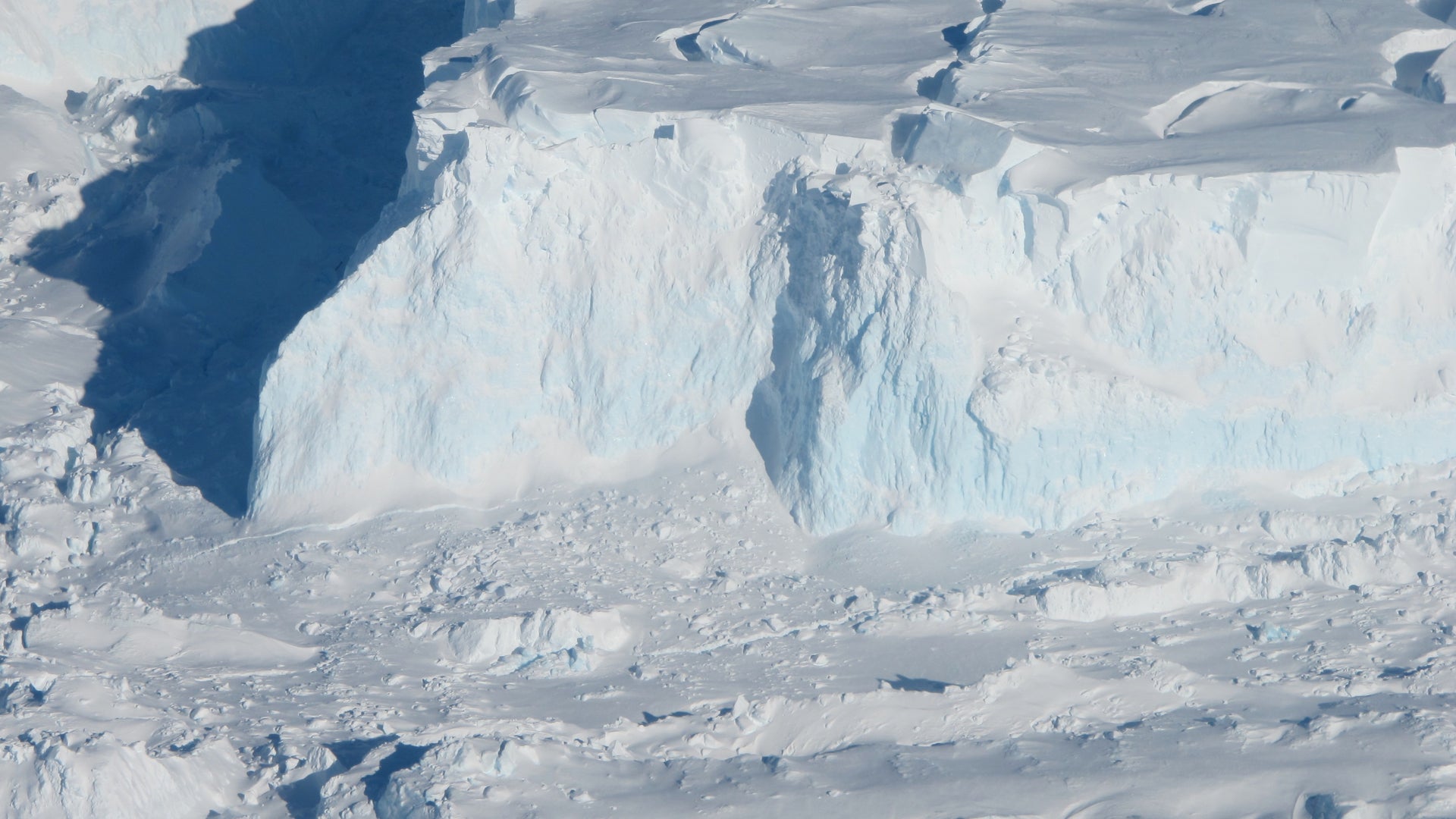
Instruments buried deep in the frozen silence have begun to register tremors beneath Thwaites Glacier, a vast and unstable mᴀss of ice in Antarctica long referred to in scientific circles by a nickname that feels less like metaphor and more like premonition: the “Doomsday Glacier.”
For years, Thwaites has occupied a peculiar space in climate discussions — not entirely collapsing, not entirely stable.
A looming variable.
A threat acknowledged in cautious tones.
It holds enough ice to raise global sea levels by more than half a meter on its own, and far more if its failure destabilizes neighboring ice systems.
That much is documented.
What is less settled is timing.
And timing, increasingly, appears to be the question no one can answer with confidence.
Recent seismic monitoring has detected clusters of icequakes — small fractures deep within the glacier’s body and at its grounding line, where ice meets the ocean floor.
Individually, these tremors are minor.
Collectively, they form a pattern.
Patterns, in polar science, are rarely comforting.
Ice does not collapse like a building.
It weakens.
It thins from below as warmer ocean currents infiltrate hidden cavities.
It fractures internally under mounting stress.
It detaches from the bedrock in increments so subtle they evade public attention.
The process can unfold over decades — until it does not.
The fear among some researchers is not merely that Thwaites is melting.
It is that it may be approaching a structural tipping point, a threshold beyond which retreat becomes self-sustaining and irreversible.
Satellite imagery over the past several years has shown widening crevᴀsses across the glacier’s surface.
Radar measurements have confirmed accelerating flow rates, with certain sections sliding toward the Amundsen Sea faster than historical averages.
Beneath the ice shelf — the floating extension that acts as a brace against inland ice — warm circumpolar deep water continues to circulate.
This water is only a few degrees above freezing, yet that is sufficient.
Ice, especially when fractured, requires little encouragement to yield.
The recent uptick in seismic activity has not yet been classified as catastrophic.
There has been no official declaration of imminent collapse.
But the language used in scientific briefings has shifted in tone.
Where once there were projections extending comfortably into the next century, there are now acknowledgments of uncertainty compressed into decades.
Some models suggest the ice shelf could fragment within years if structural weakening accelerates.
Others argue that the system may oscillate before reaching any dramatic failure.
Between those interpretations lies a narrow corridor of ambiguity — and ambiguity, in matters of planetary stability, is rarely neutral.
One of the more unsettling aspects of Thwaites is its geometry.
Large portions of the glacier rest on bedrock that slopes downward inland.
In practical terms, this means that as the grounding line retreats, thicker ice becomes exposed to ocean water, increasing buoyancy and promoting further retreat.
This feedback loop is known as marine ice sheet instability.
It is not speculative; it is grounded in glaciological physics.
The debate centers on how rapidly it might unfold.

Seismic data complicates the picture.
Icequakes can signal fracturing ᴀssociated with normal seasonal change.
They can also indicate deeper mechanical failure.
The distinction requires careful interpretation.
Yet some glaciologists have noted that the frequency and clustering patterns observed in recent months resemble stress redistribution events — the type that occur when a system approaches critical strain.
Publicly, researchers emphasize caution.
Privately, some acknowledge concern.
A collapse of Thwaites’ ice shelf would not instantly drown coastal cities.
The ocean responds on scales of years to decades.
But once an ice shelf disintegrates, it removes a ʙuттress.
Inland glaciers accelerate.
Sea level rise projections shift upward.
Infrastructure plans drafted under conservative ᴀssumptions begin to look outdated.
It is worth noting that Thwaites does not exist in isolation.
It is part of the West Antarctic Ice Sheet, a broader system that itself is considered vulnerable.
Should Thwaites destabilize fully, it could exert a destabilizing influence on adjacent glaciers such as Pine Island.
The phrase “domino effect” is often avoided in official discourse, perhaps because it feels too cinematic.
Yet interconnected ice systems are not immune to chain reactions.
Skeptics argue that alarmism clouds objective analysis.
They point to past projections that overstated near-term impacts.

They emphasize that ice sheet dynamics are complex and that collapse scenarios often ᴀssume worst-case ocean warming trajectories.
These counterarguments are not without merit.
Science evolves through revision and correction.
However, it is equally true that ice loss in West Antarctica has consistently outpaced earlier expectations.
In the remote silence of Antarctica, no one hears the tremors except machines.
There are no crowds gathering along icy cliffs.
No dramatic footage dominates evening broadcasts.
The process is incremental.
Data points accumulate in spreadsheets and seismic logs.
Yet the absence of spectacle does not equate to stability.
There is also the broader context of atmospheric and oceanic change.
The Southern Ocean has absorbed a disproportionate share of global heat trapped by greenhouse gases.
Wind patterns have shifted.
Ocean currents have intensified.
These changes funnel warmer water toward vulnerable ice shelves.
Thwaites sits directly in the path of these subsurface flows.
Some researchers have deployed autonomous underwater vehicles beneath the ice shelf, mapping cavities and measuring melt rates in situ.
The imagery returned from these missions reveals sculpted ceilings of ice, carved by currents that were once weaker.
Channels snake upward into the glacier’s underside, allowing warm water to penetrate farther inland than previously measured.
These are not hypothetical processes; they are documented observations.
The question is not whether Thwaites is changing.
It is how close those changes are to a threshold.
There are scenarios in which the glacier continues its gradual retreat over centuries, contributing steadily but manageably to sea level rise.
There are also scenarios — less comfortable to articulate — in which a rapid disintegration of the ice shelf triggers accelerated inland flow within a matter of years.
The seismic activity now being recorded does not definitively select between these paths.
It does, however, suggest that internal stresses are redistributing.
Perhaps the most unsettling dimension is the mismatch between geological timescales and political ones.
Ice sheets evolve over millennia.
Infrastructure budgets operate on five-year cycles.
Coastal zoning laws rarely account for nonlinear collapse dynamics.
If Thwaites crosses a tipping point, the decision will not be subject to referendum.
The phrase “point of no return” is often criticized for oversimplifying gradual processes.

In glaciology, thresholds are rarely single moments; they are ranges of instability.
Yet the concept remains relevant.
Once a grounding line retreats past a critical ridge, re-advancement becomes unlikely without significant cooling.
Current global temperature trajectories offer little evidence of imminent reversal.
Some climate negotiators prefer to frame sea level rise in centimeters per decade.
It is a manageable metric.
Concrete numbers.
Linear charts.
But ice sheets do not always respond linearly.
They fracture, calve, and reorganize.
When Larsen B Ice Shelf collapsed in 2002, it did so over weeks after years of thinning.
Few predicted the exact timing.
Satellite images captured the aftermath — a shattered mosaic of ice fragments where a solid platform had stood.
Thwaites is orders of magnitude larger.
It would be inaccurate to claim that catastrophe is guaranteed.
It would also be inaccurate to suggest that stability is ᴀssured.
What remains is tension — measurable in micrometers of vertical displacement and fractions of a degree in ocean temperature.
Tension recorded as faint seismic pulses beneath kilometers of ice.
There is a temptation to view Antarctica as distant, insulated from immediate consequence.
Yet the ocean is a connective medium.
Meltwater does not respect borders.
A meter of sea level rise reshapes coastlines across continents, alters storm surge dynamics, and forces adaptation decisions that reverberate economically and socially.
For now, the tremors continue.
They are not headline-grabbing earthquakes.
They are signals.
Whether they represent background noise in a dynamic system or the early stages of structural failure remains under analysis.
In scientific conferences, phrases such as “increased basal melting,” “grounding line retreat,” and “mechanical weakening” circulate with clinical precision.
Outside those rooms, the implications feel less abstract.
The ice at Thwaites has persisted through countless climate cycles.
It has advanced and retreated before.
What distinguishes the present era is the rate of forcing — atmospheric carbon concentrations rising at speeds unmatched in ice core records spanning hundreds of thousands of years.
No siren will sound if a threshold is crossed.
There will be no single day marked on calendars as the moment the glacier committed to collapse.
Instead, there will be datasets revised upward, models recalibrated, and coastal planners quietly adjusting projections.
Somewhere beneath the frozen surface, stress fractures propagate.
Seawater circulates in darkness.
Instruments log each tremor with impartial accuracy.
Whether these signals will one day be recognized as the opening chapter of a profound transformation — or as fluctuations in a system that ultimately stabilizes — is not yet determined.
What is certain is this: the ice is no longer silent.


