The girl stood at the edge of town with nothing but a wool blanket, a small sack of cornmeal, and the clothes on her back. She was 11 years old, small for her age, with dark braided hair and eyes that had seen things no child should see. Behind her, the people of Brierwood, Wyoming, watched from their doorways and windows, their faces hard with the particular cruelty that fear wears when it pretends to be righteousness. No one waved. No one called out a kindness. The Reverend Josiah Witmore had pronounced her a liar and a disturber of the peace, and the town had agreed that she must go. Her crime was simple. she had told them the truth.
‘The winter is coming early,’ she had said, standing in the general store 3 days prior, her voice carrying the strange certainty that had always unnerved the adults around her. ‘It will be the worst winter anyone has ever seen. The snow will bury the houses. The cold will kill the cattle. You must prepare now or many will die.’ The storekeeper had laughed. The women had whispered, and Reverend Witmore, who considered himself the moral authority of Brierwood, had declared that the child was either possessed by demons or simply wicked, spreading fear for the devil’s amusement. No child could know such things, he had thundered from his pulpit. This is the work of darkness. The girl must be cast out before her corruption spreads. And so they had cast her out. On September 29th, 1886, with 6 weeks of autumn still ahead, and the aspens just beginning to turn gold, they had sent an 11-year-old girl into the wilderness with nothing but a blanket and a handful of cornmeal. Her name was Alma Jessup, and she did not look back as she walked away. looking back was for people who had something to return to. She had never had much of anything. Her mother had died birthing her, and her father, a trapper named Silas Jessup, who spent more time in the mountains than in any town, had raised her in the wild places where the Wind River Range met the sky. He had taught her to read the land, to understand the animals, to see the signs that nature provided for those patient enough to observe. He had shown her how the thickness of a caterpillar’s coat predicted winter’s severity, how the height of beaver dams indicated coming snow depth, how the behavior of elk and deer revealed what the cold months would bring. Silas had died when Alma was nine, taken by a grizzly in a canyon above the Sweetwater. She had found his body 3 days later, following the ravens, and had buried him herself in a grave she dug with his own hunting knife. Then she had walked to Brierwood, the nearest settlement, hoping to find some kind of life among people.
Brierwood had not known what to make of her. a wild child who appeared from the mountains, who spoke of her ᴅᴇᴀᴅ father without tears, who knew things about weather and animals that no child should know. She was unsettling in ways the town’s people could not articulate. They had taken her in reluctantly, pᴀssing her from household to household, no family willing to keep her for long. She worked for her keep, scrubbing floors, mending clothes, tending livestock. But she never fit, never softened, never became the grateful orphan they expected her to be. What she became instead was a prophet they refused to hear. She had warned them about the flash flood in the spring of 85, and they had ignored her, and three horses had drowned in Willow Creek. She had told them about the early frost that August, and they had dismissed her, and the Herrian family had lost their entire vegetable garden. Each time she spoke, they found reasons not to listen. She was strange. She was fanciful. She was a child who could not possibly understand the things she claimed to understand. When she warned them about the winter of 1886, they decided they had heard enough.
But Alma had not lied. She had observed. In August, she had noticed the beaver dams on the upper creek, built higher than any she had ever seen, the animals working with a desperate urgency that spoke of deep instinct. In September, she had seen the elk moving down from the high country a full month early. their coats already thick, their behavior nervous. The woolly bear caterpillars were almost entirely black. The squirrels were gathering with a frenzy that suggested they knew something the humans did not. Her father had taught her to read these signs. He had taught her that the animals always knew. And the animals were saying that death was coming. Now walking away from the town that had rejected her, Elma did not waste energy on anger or grief. She had learned young that such emotions were luxuries the wilderness did not allow. Instead, she turned her mind to the only question that mattered, how to survive. She walked north toward the foothills where her father had sometimes taken her, where the sandstone cliffs rose from the sagebrush flats, and the rock was soft enough to carve, but hard enough to last. She walked for 2 days, eating her cornmeal sparingly, sleeping under her blanket in the shelter of fallen logs, until she found what she was looking for. The cliff face rose 40 ft above a small valley where a spring emerged from the rocks. The stone was red gold sandstone layered and fractured with a natural overhang that provided shelter from rain and snow. More importantly, there was a crack in the rock, a natural fissure that ran back into the cliff, wide enough for a small body to squeeze through, leading to a cavity within the stone that was perhaps 10 ft deep and 8 ft wide. It was not a home, not yet, but it could become one. Elma began to carve.
She had her father’s knife, the same blade that had dug his grave, and she had the knowledge he had given her. She knew that sandstone could be worked with patience, that each day’s labor would remove another inch of rock, that the cavity could be widened and shaped into something livable if she simply refused to stop. The first week was the hardest. Her hands blistered, then bled, then hardened into calluses that would never fully soften. She scraped and chipped and carved, widening the entrance, deepening the interior, shaping the stone into walls and floor and ceiling. She worked from dawn until her arms could no longer lift the knife, then slept in the growing cavity and rose to work again. She gathered materials as she found them. ᴅᴇᴀᴅf fall branches from the valley floor became fuel for a fire pit she carved near the entrance with a natural chimney crack that drew the smoke upward and out. Dry grᴀss became bedding. Flat stones became tools, scrapers and hammers and crude chisels that allowed her to work faster than the knife alone permitted. She foraged as her father had taught her, pine nuts from the nearby trees, rose hips from the wild bushes along the creek, roots that could be roasted in the coals. She set snares for rabbits using techniques Silas had shown her when she was barely old enough to walk. The rabbits provided meat and fur, fur that she scraped and cured and saved. knowing that winter would demand warmth she did not yet possess. By October, the cavity had become a room 12 feet deep, 10 ft wide, 7 ft tall at the peak. The walls were smooth where she had carved them, the floor level and clean. The fire pit worked perfectly, warming the space with remarkable efficiency as the stone absorbed and radiated heat. A small storage al cove held her growing supplies. Dried rabbit meat, forage nuts, and roots. Bundles of firewood stacked тιԍнт against the back wall.
By November she had expanded further. A second chamber, smaller, served as a stable for the wild mustang she had captured and gentled. a done mare she named Whisper for the soft sounds the horse made when Elma approached. The mayor’s body heat added warmth to the entire cave system, and her presence provided something Alma had not expected to need, companionship. She also built a door. Logs from fallen aspens lashed together with strips of rawhide fitted into a frame she had carved into the stone entrance. The door could be sealed from within, creating an insulated barrier against wind and snow. Behind it, the cave remained warm, even as the temperatures outside began their ᴅᴇᴀᴅly descent. The first snow fell on November 12th, 6 weeks earlier than usual. It fell heavy and wet, accumulating quickly, driven by a wind that seemed to cut through everything it touched. The animals Elma had observed in August had been right. The worst was coming. She watched from her cave entrance as the snow piled higher, and she felt no satisfaction in being proven correct. She felt only sorrow for the people of Brierwood, who had not listened, who had not prepared, who were about to learn what her father had always known. The wilderness did not care about human arrogance.
If Wild West Retribution has become part of your week, consider joining the channel membership. Just a couple dollars a month keeps these stories coming. Links below and hit that hype ʙuттon if you haven’t already. Now, back to the story. The winter of 1886 to87 descended on Wyoming territory with a fury that would become legend. Storm after storm rolled down from Canada, burying the land beneath snow that accumulated not in inches but in feet. The temperature dropped to 40 below zero and stayed there for weeks. The wind never stopped, a constant howling presence that drove the cold through every crack and gap in every structure that stood against it. In Brierwood, 20 mi south of Alma’s cliff, the disaster unfolded exactly as she had predicted. The cattle died first. The ranchers who had laughed at the wild girl’s warnings watched their herds freeze in the draws and coolies. The animals too weak from the early snows to find food, too exposed to survive the cold that followed. The Heragan ranch lost 400 head in a single week. The Mercer spread, the largest in the district, lost over a thousand. The beef that had been the foundation of Brierwood’s economy, ceased to exist.
Then the food ran out. The general store, which had seemed adequately stocked in October, was empty by Christmas. The families who had entered winter with confidence found their larders depleted by January. The hunters who ventured out to find game returned empty-handed. The deer and elk had moved to lower elevations weeks before, and the rabbits had burrowed so deep that even experienced trappers could not find them. By February, Brierwood was starving. The first death was old Ezekiel Harrigon, patriarch of the ranching family, who had survived 50 Wyoming winters, but could not survive this one. He died in his bed with his family around him, his body simply giving out from cold and hunger and the despair of watching everything he had built disappear. The children began to sicken next. Without adequate food, their small bodies could not fight the illnesses that winter brought. The Henderson baby died of fever. The Poke twins, age six, developed coughs that would not stop. The doctor had no medicine. The parents had no food. And the prayers that Reverend Whitmore offered seemed to fall on deaf heaven. It was young Thomas Mercer, 14 years old and desperate, who remembered the girl. “The Jessup child,” he said to his father, during a family council held around a fire that was consuming the last of their furniture. The one Reverend Whitmore sent away. She said she knew how to survive in the mountains. She said her father taught her. She was a liar, his father replied. But the words lacked conviction. Everything the girl had predicted had come true. The early winter, the killing cold, the death of the cattle. She had seen it all, and they had cast her out for speaking it. If she survived, Thomas said, she might know where to find food. She might have shelter. She might. He trailed off, unable to complete the thought. She might save us, he did not say. The people who sent her into the wilderness to die.
A search party was organized. Five men on the strongest remaining horses carrying what little food could be spared. riding north toward the foothills where someone remembered that old Silus Jessup had once trapped. They did not expect to find the girl alive. They expected to find a frozen body, a small tragedy to add to the larger catastrophe, but they had to know. They had to see. They found her on the third day following a thin trail of smoke that rose from a cliff face they had pᴀssed a hundred times without noticing. The cave entrance was almost invisible. A dark gap in the red gold stone sheltered beneath an overhang protected by a wooden door that fit so perfectly into the rock that it seemed to have grown there. The smoke emerged from a crack above, rising in a thin, straight line that spoke of a fire burning efficiently within. Thomas Mercer approached the door and knocked. It opened to reveal a girl who should have been ᴅᴇᴀᴅ. She was thin but not starving. Her face wind burned but healthy. Her dark eyes holding the same unsettling certainty that had always made the adults of Brierwood uncomfortable. She wore a coat of rabbit fur sтιтched together with rawhide and her hands were calloused with the particular roughness of someone who had worked stone. Behind her, the men could see a cavern of impossible comfort. Carved walls, a fire burning in a stone pit, stacks of firewood, bundles of dried meat, a horse knickering softly in an adjoining chamber. She had built a home inside the mountain. She had survived what should have killed her. “You came,” Elma said. It was not a question. Thomas found his voice. “We came. We” He stopped, unable to find words for what they had done, what they needed, what they were asking. “The town is starving,” Elma said. She did not make them beg. “How many are left?” “112. Mostly women and children now. The men.” Thomas’s voice cracked. “Some of the men went out looking for food and didn’t come back.” Elma was silent for a long moment, looking past the search party toward the snow-covered valley toward the south where Brierwood lay dying. She was 11 years old, and the people who had called her a liar and cast her out were now dependent on her mercy. “There is a valley 3 mi east of here,” she finally said. “The elk winter there, my father showed me years ago. The snow is not as deep because of how the cliffs block the wind. If your hunters go there, they will find game.” She paused. “And there are caves in these cliffs, not carved like mine, but natural, large enough to shelter families. I can show you where they are. The stone holds heat. People can survive there until spring if they are willing to work.” Thomas stared at her. “you would help us after what we did.” Elma’s expression did not change. “My father taught me that the wilderness does not care about grudges. It only cares about who is prepared and who is not.” She stepped back from the door. “Come inside. Warm yourselves. Then we have work to do.”
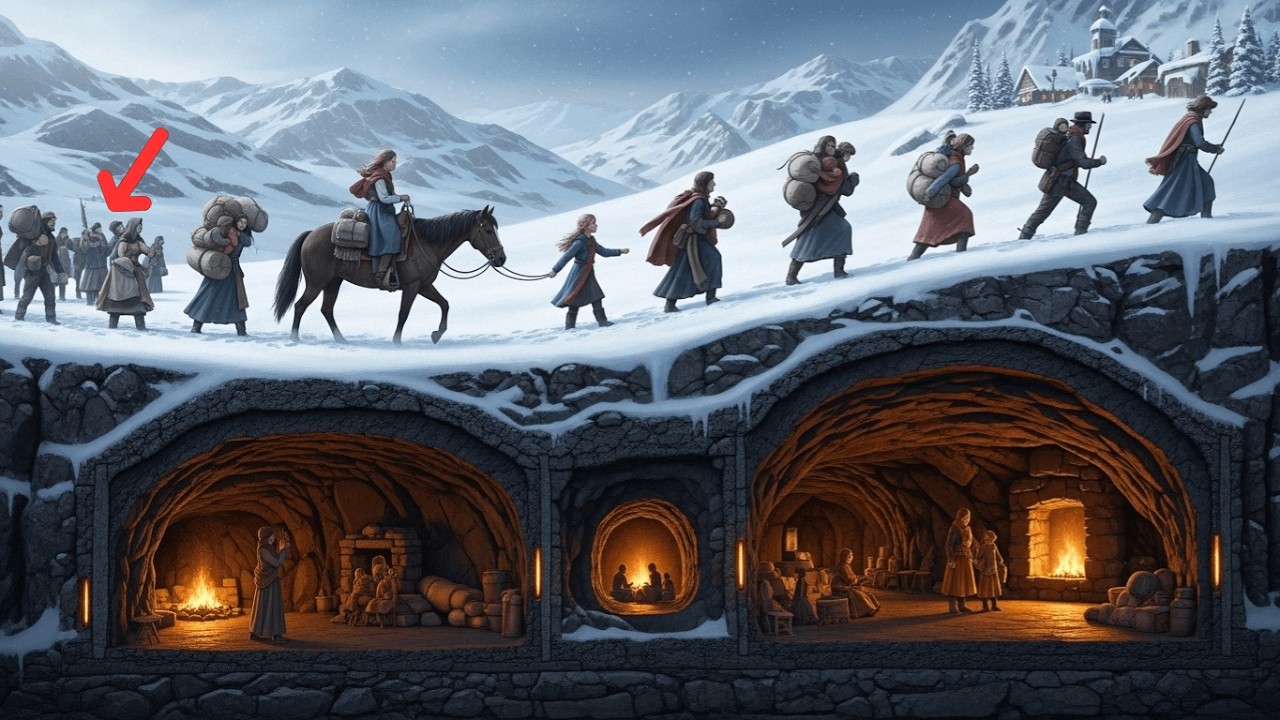
The evacuation of Briarwood began 3 days later. Elma led them herself, riding whisper at the head of a column of desperate refugees, women carrying infants, children stumbling through snow drifts, men hauling whatever supplies they had managed to save. She guided them through the pᴀsses her father had shown her along trails that were invisible to anyone who did not know the land, to the network of caves and sheltered valleys where survival was possible. She organized them with an authority that no one questioned. Families were ᴀssigned to caves based on their size and the number of children they had. Hunting parties were formed and directed to the elk valley where they found game exactly as she had promised. Foraging teams learned to dig for the roots and nuts that she showed them. Food sources they had walked past a thousand times without recognizing. She taught them everything. How to seal a cave entrance against drafts. How to build a fire that heated stone rather than just air. How to smoke meat so it would last for months. How to read the weather signs that indicated when it was safe to venture out and when it was death to try. The knowledge that Silas Jessup had spent a lifetime accumulating pᴀssed to his daughter was now distributed to an entire community. 89 people survived the winter in those caves. 23 had died in Brierwood before the evacuation and three more perished during the journey north, but 89 lived, including all 17 children under the age of 10. because an 11-year-old girl they had cast out as a liar had carved a home in the stone and then shared everything she knew. Reverend Witmore was not among the survivors. He had refused to join the evacuation, declaring that he would not follow a child he had condemned, that God would provide for the righteous where the devil’s servant could not. They found his body in April, frozen in the church where he had preached against the girl who had tried to save him.
The gathering came in May when the snow had finally retreated and the survivors had returned to what remained of Brierwood. They ᴀssembled in the open air. The church was too full of memories to reckon with what had happened. Thomas Mercer, who had led the search party that found Alma, spoke first. He was 15 now, aged beyond his years by a winter that had taken his father and two of his uncles. “We sent a child into the wilderness to die,” he said, his voice steady, despite the tears on his face. “We called her a liar when she told us the truth. We cast her out because she made us uncomfortable. Because she knew things we didn’t understand, because it was easier to blame her than to listen.” He turned to Elma, who stood apart from the group, whispers rains in her hand, her carved stone home visible on the distant cliffs. “Alma Jessup saved us. Every one of us standing here owes our life to a girl we treated as less than human. I don’t know how to make that right. I don’t know if it can be made right. But I know that we owe her more than words can say.” Others spoke. The mothers whose children had survived. The hunters who had found game where she directed them. The families who had sheltered in caves she had shown them. One by one they acknowledged what had happened. the cruelty, the exile, the impossible forgiveness that had followed. When the testimonies were finished, Alma walked forward. She was still small, still young, still carrying the strange certainty in her eyes that had always unsettled those around her. But something had changed. The adults no longer looked away when she met their gaze. They looked at her directly as if seeing her for the first time.
“My father told me once that the mountains do not judge,” she said. “They do not care if you are rich or poor, good or wicked, young or old. They only care if you are prepared. He said that people are different, that people judge and hate and fear what they do not understand. But he also said that people can learn, that they can change.” She looked around at the faces of those who had survived. “I do not forgive what you did. Forgiveness is not something I know how to give, but I am glad you lived. I am glad the children lived. And if you want to learn what I know, how to read the land, how to prepare for what is coming, how to survive when the world turns cold, I will teach you,” she paused. “My father said the mountains have no mercy, but we do not have to be like the mountains. We can choose to be different.”
The town of Brierwood was rebuilt, but it was never the same. The cattle industry that had sustained it was broken, and the community that rose from the ashes was smaller, humbler, more careful. They diversified their food sources. They built stronger shelters. They stockpiled provisions against the winters they now knew could come without warning. Elma did not return to live among them. She stayed in her cliff home, expanding it over the years into a complex of chambers that could shelter 30 people if needed. She became a guide for those crossing the mountains, a teacher for those who wanted to learn the old skills, a living reminder that the wilderness demanded respect. She never married, but she was never alone. Children from Brierwood came to learn from her. First a few, then dozens over the years. Young people who wanted to understand what she understood, who were willing to spend weeks in the mountains absorbing the knowledge that Silas Jessup had pᴀssed to his daughter. They called themselves Alma’s students, and they spread across the territory, carrying her teachings wherever they went. The phrase ‘listening to the animals’ entered the vocabulary of the Wyoming rangeands. It meant paying attention to the signs that nature provided, trusting the warnings that came from sources others might dismiss. It was spoken with quiet respect, as if the speaker remembered what had happened to those who failed to listen. Alma Jessup lived in her cliff home for 63 years, pᴀssing in the winter of 1949 at the age of 74. She had outlived everyone who had cast her out. Everyone who had called her a liar, everyone who had learned too late that an 11-year-old girl had known more about survival than all of them combined. She was buried beside her father in the grave she had dug with his knife when she was 9 years old. The knife itself was pᴀssed to her most dedicated student who pᴀssed it to theirs, a chain of knowledge that continues to this day. The cliff home still exists, protected now as a historical site, maintained by descendants of the students she taught. Visitors come to see the carved chambers, the fire pit, the stable where Whisper once stood. They come to understand how a child survived what should have killed her and then chose to save the people who had tried to let her die. Above the entrance, carved in letters that Alma added sometime in the years after the great winter is an inscription that visitors often pH๏τograph. ‘The mountains told me. I told you. Now we both know.’ Her father Silas, who had taught her to listen when no one else would, would have recognized the truth in every


