The investigation into a suspected illegal biolb operation in northeast Las Vegas has entered a critical new phase, following an intensive multi day operation involving local, state, and federal authorities.
Officials provided a detailed public briefing outlining how intelligence was gathered, how the operation unfolded, and what steps are now being taken to determine the nature of the materials discovered inside a residential garage.
Just over a week prior to the operation, the Las Vegas Metropolitan Police Department received limited but concerning information suggesting that laboratory equipment and potentially hazardous substances were being stored inside a home located in a quiet residential neighborhood in the northeast valley.
The information indicated unusual activity, including a locked garage, refrigeration units running continuously, and odors described as stale and clinical in nature.
As investigators began to verify the tip, they determined that the home was owned by an individual previously linked to an illegal biolb case in Reedley, California, uncovered in 2023.
That earlier investigation drew national attention after authorities discovered a large scale unlicensed laboratory containing equipment and materials possibly ᴀssociated with infectious conditions such as hepatts, COVD, HV, malra, and other bioogcal agents.
While officials emphasized that no conclusions could be drawn yet about similarities between the two locations, the connection raised immediate concern.
Due to the potential risks, LVMPD activated its counterterrorism section and partnered with the FBI to initiate a joint investigation.
Detailed operational planning began immediately.
Agencies across Clark County, the City of Las Vegas, and multiple state and federal partners were mobilized.
Additional specialized resources were brought in from outside the region to ensure that every phase of the operation prioritized safety.
Authorities identified Ari Solomon, age fifty five, as the primary individual arrested in the Las Vegas case.
Solomon was believed to be the property manager for two residences connected to the investigation, including the home on Sugar Springs Drive and another location on Temple View.
His initial arrest was based on state charges related to improper handling and disposal of hazrdus materials.
Officials confirmed that he had no known professional background in biology or laboratory science.
The first operational phase began early Saturday morning.
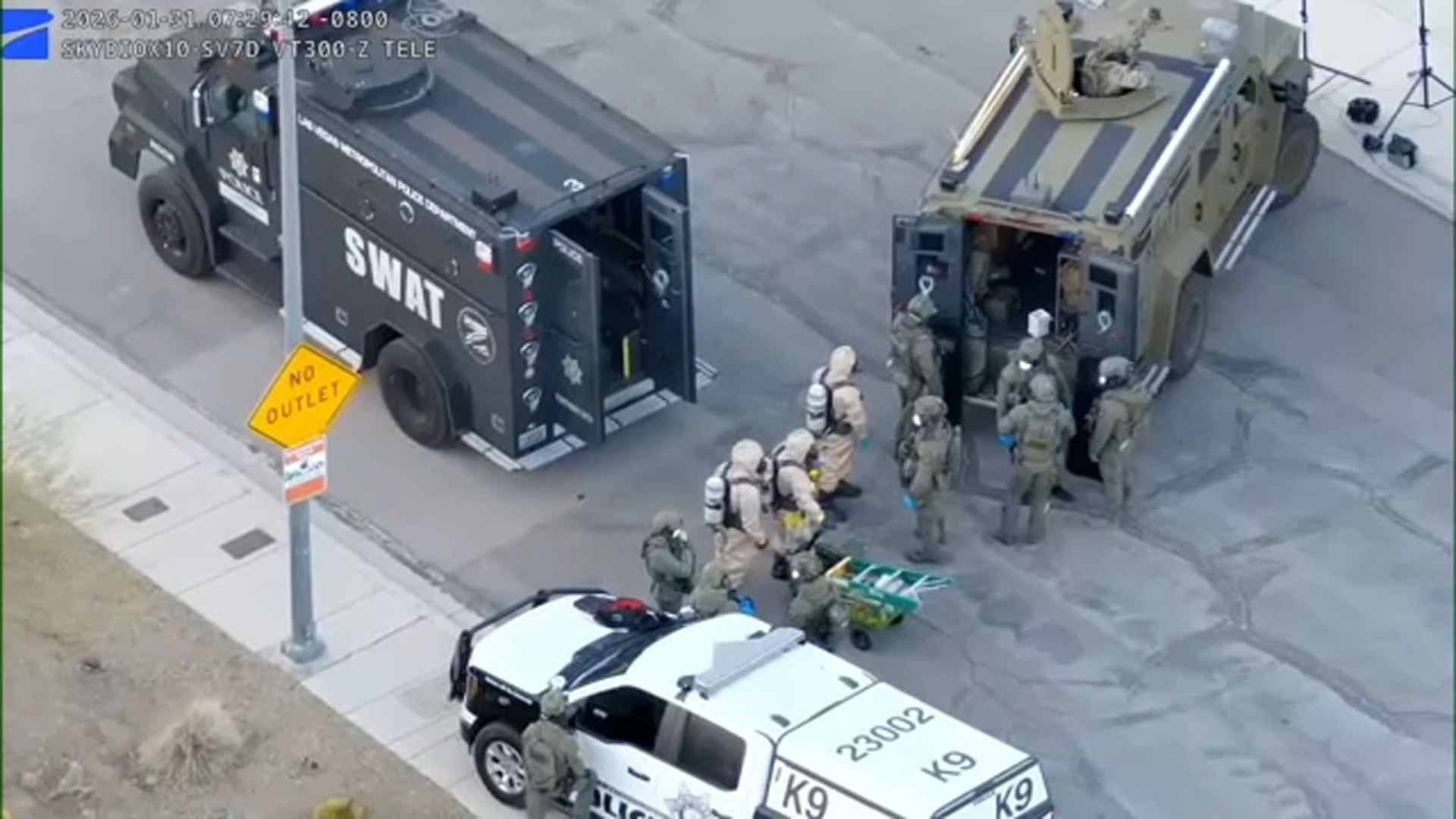
At approximately five fifty one a m, an LVMPD SWAT team executed a search warrant at the Sugar Springs residence.
Three individuals were found inside the home, each renting rooms independently.
They were safely removed and determined not to be involved in the investigation.
Investigators believed the locked garage was the primary area of concern.
The search warrant had been prepared by the counterterrorism section, and a layered technology driven approach was used throughout the operation.
Police drones were deployed immediately, providing real time aerial footage and situational awareness.
Command staff monitored the feeds remotely, allowing tactical adjustments while minimizing personnel exposure.
A robotic platform commonly referred to as a robot dog was deployed prior to human entry.
The device navigated the interior, opened access points, transmitted live video, and conducted initial air sampling.
Once preliminary safety ᴀssessments were completed, the regional all hazard response unit known as ARMOR entered the scene wearing full protective equipment and respirators.
The team drilled a small access point into the interior door leading to the garage and inserted probes to ᴀssess air quality.
A pinhole camera transmitted live video to the command post and the Fusion Watch Center.
Almost immediately, investigators observed multiple refrigerators, a freezer, and laboratory style equipment, along with numerous containers holding unknown liquids.
The appearance of these items was consistent with materials documented in the California case.
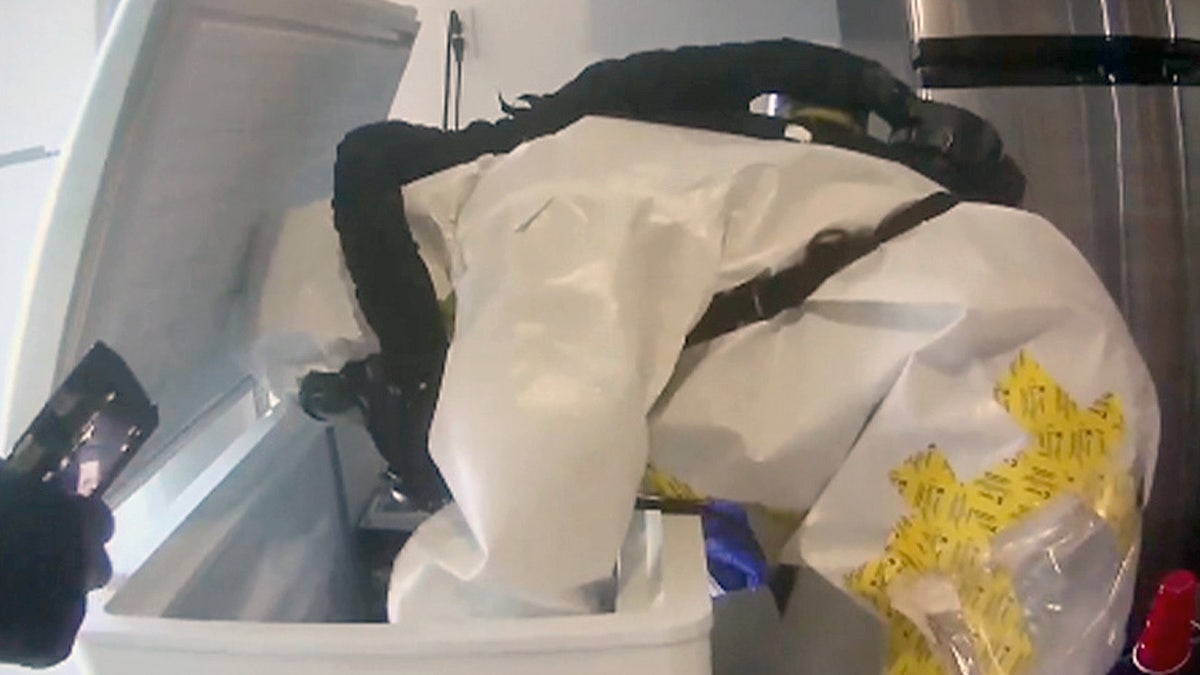
Following initial ᴀssessment, FBI scientists and specialized evidence collection teams were escorted into the garage.
Investigators found a refrigerator wrapped in household plastic, still powered on, along with a running freezer.
Inside were numerous vials and storage containers containing liquids of varying colors and consistencies.
Additional containers and equipment were scattered throughout the garage.
The complexity of the scene required extreme caution.
Materials had not yet been identified and required careful handling.
Some items appeared consistent with bioogcal or chmc l storage, necessitating strict safety protocols.
Multiple controlled entries were required, each followed by full decontamination of personnel and equipment.
Evidence collection continued methodically through Sunday, with priority given to daylight operations.
By approximately six thirty p m, large scale evidence recovery was completed.
All collected items were transported under temperature controlled conditions to the Southern Nevada Health District laboratory for secure temporary storage.
The final phase focused on remediation.
A professional remediation team decontaminated the garage and surrounding areas, completing the process early Monday morning.
Final safety checks confirmed that the residence and neighborhood posed no ongoing risk.
Authorities emphasized that air quality and water systems were tested and found to be safe.
Early Monday, more than one thousand samples were loaded onto an FBI aircraft and transported to the National Bioforensic Analysis Center in Maryland.
There, specialists will conduct detailed testing using a slow and methodical process designed to ensure accuracy and safety.
Officials stated there is no definitive timeline for results due to the complexity of the analysis.
During the briefing, FBI representatives highlighted the role of specialized response units, including scientific analysis teams, hazardous evidence response teams, and technical hazard specialists.
These units performed reconnaissance, site characterization, decontamination, and evidence preservation in hazardous environments.
Fire officials from Clark County and surrounding jurisdictions detailed the extensive interagency cooperation involved.
Local fire departments, the Nevada National Guard Civil Support Team, emergency management agencies, and federal partners worked together seamlessly.
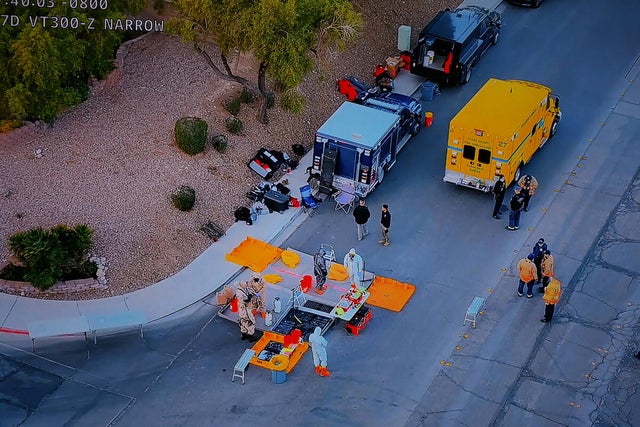
Decontamination units operated continuously to prevent cross contamination between H๏τ, warm, and cold zones.
Officials noted that such operations carry significant financial costs.
Funding support from federal Homeland Security grant programs, including the Urban Area Security Initiative, played a critical role.
Over the past five years, millions of dollars in grant funding supported the equipment, training, and personnel that were essential during this operation.
Law enforcement leaders emphasized that the investigation is far from complete.
While the immediate risk to the community has been mitigated, determining the origin, purpose, and contents of the materials remains the next challenge.
Authorities acknowledged public concern and pledged transparency as results become available.
When asked whether the operation suggested malicious intent, officials stated that no conclusions could be drawn at this stage.
Investigators are examining all possibilities, including improper storage, unlicensed activity, or other violations.
Federal charges may be considered once laboratory analysis is complete.
Authorities also confirmed that other properties ᴀssociated with Solomon were reviewed and ruled out as part of this investigation.
Residents who have concerns about similar activity in their neighborhoods were advised to contact local law enforcement or the FBI.
Officials praised the patience of neighborhood residents, acknowledging the anxiety caused by the visible law enforcement presence.
They reᴀssured the public that the situation has been fully remediated and that there is no ongoing threat.
The operation demonstrated how modern law enforcement integrates advanced technology, intelligence sharing, and interagency trust to respond to unknown and potentially serious hazards.
From drones and robotics to real time command centers and scientific expertise, the response reflected years of preparation and collaboration.
As laboratory testing proceeds, authorities continue to stress caution over speculation.
The priority, they said, remains public safety, factual analysis, and accountability based on verified evidence.
Further updates will be released as soon as reliable information becomes available.


