ANCIENT DNA MYSTERY: Oldest Mummies Challenge What We Know About Human Origins
A chilling and captivating claim is spreading across the internet.
That the oldest mummies ever discovered carry DNA that does not match any living human.
The idea is as unsettling as it is fascinating.
A genetic signature disconnected from modern humanity.
A lost lineage.
A forgotten branch of our species.
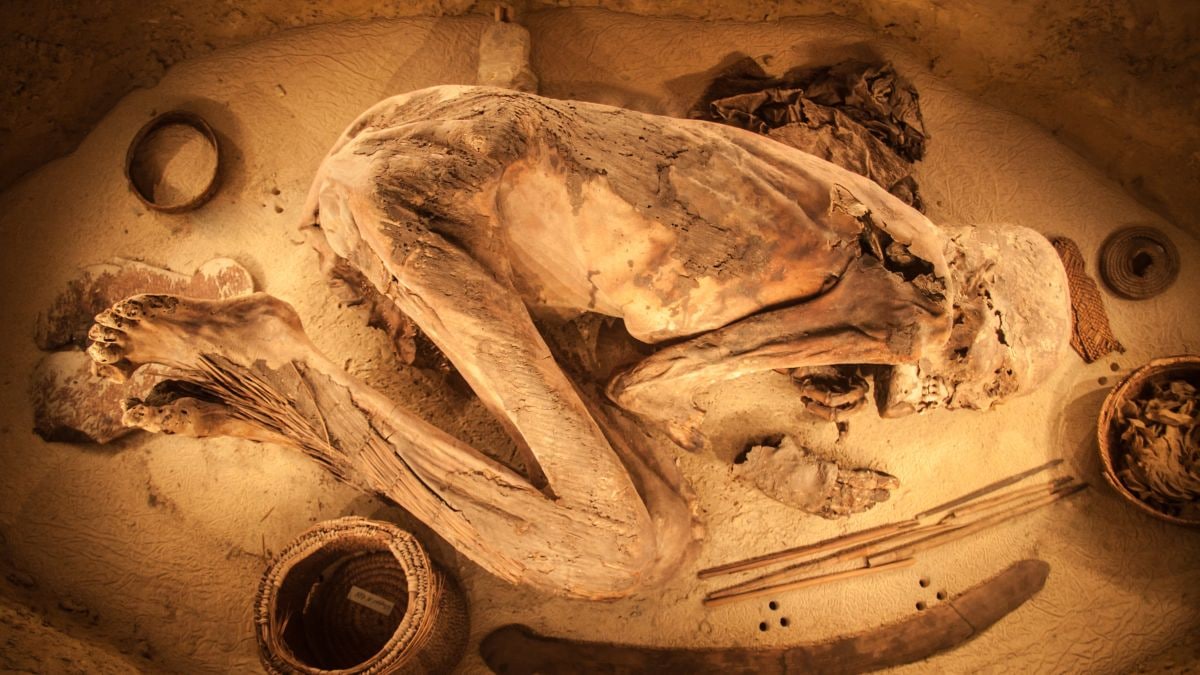
But as researchers examine the claim more closely, a more nuanced and scientifically grounded picture begins to emerge.
Because while ancient DNA can indeed reveal surprising differences, it does not necessarily mean what the headlines suggest.
Some of the oldest known mummies come from regions such as the arid coastal deserts of Chile and Peru, where natural conditions have preserved human remains for thousands of years.
Among these are the Chinchorro mummies.
Dating back over 7,000 years.
Long before the more widely known mummies of ancient Egypt.
These remains provide a rare opportunity to study early human populations in remarkable detail.
Through the lens of modern genetics, scientists can extract and analyze fragments of DNA preserved within these ancient bodies.
What they often find is not a complete mismatch with modern humans.
But variation.
Differences shaped by time, migration, and isolation.
Human populations have evolved continuously.
Genes change.
Traits adapt.
Groups separate and later reconnect.
Over thousands of years, these processes can create genetic profiles that look very different from those of people living today.
This is where the misunderstanding begins.
When scientists say that ancient DNA does not closely match modern populations, they are usually referring to the absence of a direct, one-to-one comparison.
Not the absence of connection entirely.
In reality, all modern humans share common ancestry.
The differences observed in ancient mummies reflect branches of that shared lineage.
Some of which have diminished.
Others that have blended into larger populations over time.
There are also technical challenges involved in analyzing ancient DNA.
Degradation.

Contamination.
Incomplete sequences.
All of these factors can complicate results.
Making ancient genetic material appear more distinct than it truly is.
Researchers must carefully reconstruct sequences.
Compare them against extensive databases.
And account for potential errors.
Even then, conclusions are often expressed in terms of probability rather than certainty.
Another important factor is population extinction.
Some ancient groups simply no longer exist in a distinct form.
Their genetic signatures may not appear in modern populations because those populations have either disappeared or been absorbed into others.
This can create the impression of a “missing” match.
When in fact it is a natural outcome of human history.
The narrative that these mummies represent something entirely separate from humanity is not supported by current scientific evidence.
Instead, they highlight the diversity and complexity of early human populations.
A diversity that is often simplified in modern discussions.
Yet the fascination remains.
Because discoveries like these challenge ᴀssumptions.
They remind us that human history is not a straight line.
But a web of migrations.
Interactions.
Adaptations.
And changes that span tens of thousands of years.
For researchers, these ancient remains are invaluable.
They offer insights into diet.
Health.

Environment.
And cultural practices.
Beyond genetics, they tell stories of how people lived.
How they survived.
How they adapted to some of the harshest environments on Earth.
As new technologies continue to improve, more ancient DNA will be analyzed.
More connections will be identified.
More gaps will be filled.
But with each discovery, new questions will also arise.
That is the nature of science.
Not to provide final answers.
But to deepen understanding.
The claim that the oldest mummies possess DNA unlike any living human may capture attention.
But the reality is far more meaningful.
They are part of the same human story.
A story that is far richer.
Far more complex.
And far more interconnected than any single headline can convey.
Because in the end, what these mummies reveal is not something alien or separate.
But something profoundly human.
A reminder that we are all connected to a past that is still being uncovered.
Layer by layer.
Gene by gene.
Across the vast expanse of time.


