Shannon Lee Speaks: The Truth Behind Bruce Lee’s Legacy
More than fifty years after Bruce Lee’s sudden death, his presence still looms large over global pop culture. He remains a symbol of strength, discipline, and fearless individuality. Yet according to his daughter, Shannon Lee, much of the world only knows half the story.
In recent years, Shannon has taken on a deeply personal mission: to set the record straight about who her father truly was. Through her book In My Own Process and a series of interviews, she has offered something rare—an intimate portrait of Bruce Lee not just as a martial arts legend, but as a complex human being.
“My mom will say that guy that you see in the movies is actually who he was,” Shannon once explained. But she quickly adds that audiences often saw only the warrior, not the “warrior poet.” It’s that quieter, more thoughtful side she feels has been overshadowed by decades of mythmaking.

Over time, a harsher narrative began to circulate online—one portraying Bruce Lee as constantly angry, arrogant, and difficult. Shannon has firmly pushed back against that image.
She acknowledges that her father had intensity and could be frustrated, especially when facing racial barriers in Hollywood during the 1960s and early 1970s. But she insists his confidence was frequently misread.
“He believed in himself,” she has suggested in various conversations. “And people mistook that for arrogance.”
Bruce Lee’s journey was anything but easy. Born Lee Jun-fan in 1940 in San Francisco while his parents were touring with a Cantonese opera company, he grew up primarily in Hong Kong. His childhood included wartime hardship during the Japanese occupation and later, as a teenager, frequent street fights that worried his parents.

Martial arts became both discipline and direction.
Under the guidance of Ip Man, he studied Wing Chun, eventually blending techniques into what would become Jeet Kune Do—his revolutionary philosophy of combat that emphasized adaptability and self-expression.
But Shannon emphasizes that martial arts were only one dimension of her father’s idenтιтy.
While studying at the University of Washington, Bruce immersed himself in philosophy, drama, psychology, and poetry. His notebooks reveal reflections on both Eastern and Western thinkers—from Lao Tzu and Buddhist teachings to Plato and David Hume.

For Bruce, fighting was a metaphor for life. He believed in fluidity, rejecting rigid systems in favor of what he famously described as being “like water.” His poetry—often free-form and introspective—revealed vulnerability, doubt, and deep self-examination.
Shannon was only four years old when her father died in July 1973 at the age of 32. Officially, his death was ruled as cerebral edema caused by a reaction to pain medication. Over the decades, alternative theories have surfaced, ranging from heatstroke to electrolyte imbalance, and even neurological conditions.
Despite ongoing speculation, no definitive alternative explanation has replaced the original ruling.
While Shannon does not claim to have new forensic answers, she focuses instead on preserving the integrity of her father’s life. She remembers not the movie sets or global fame—but warmth, playfulness, and safety.

“I remember how he made me feel,” she has said. “Loved. Protected.”
That emotional memory fuels much of her work today.
After losing her brother Brandon Lee in a tragic on-set accident in 1993, Shannon’s sense of responsibility deepened. Brandon, who had followed in their father’s footsteps as an actor, died at just 28 after a prop gun malfunctioned during filming of The Crow. The devastating loss marked the second time the family had endured sudden tragedy.

In recent years, Shannon has advocated for stricter safety standards in filmmaking, particularly regarding firearms on movie sets.
Following the fatal 2021 shooting of cinematographer Halyna Hutchins on the set of Rust, Shannon publicly called for mandatory safety reforms and questioned why real firearms remain necessary in modern productions.
Beyond advocacy, Shannon serves as CEO of the Bruce Lee Family Company and president of the Bruce Lee Foundation.
Through educational programs like Camp Bruce Lee, she works to bring her father’s philosophy to younger generations—not merely as martial arts instruction, but as a framework for confidence, self-discovery, and resilience.
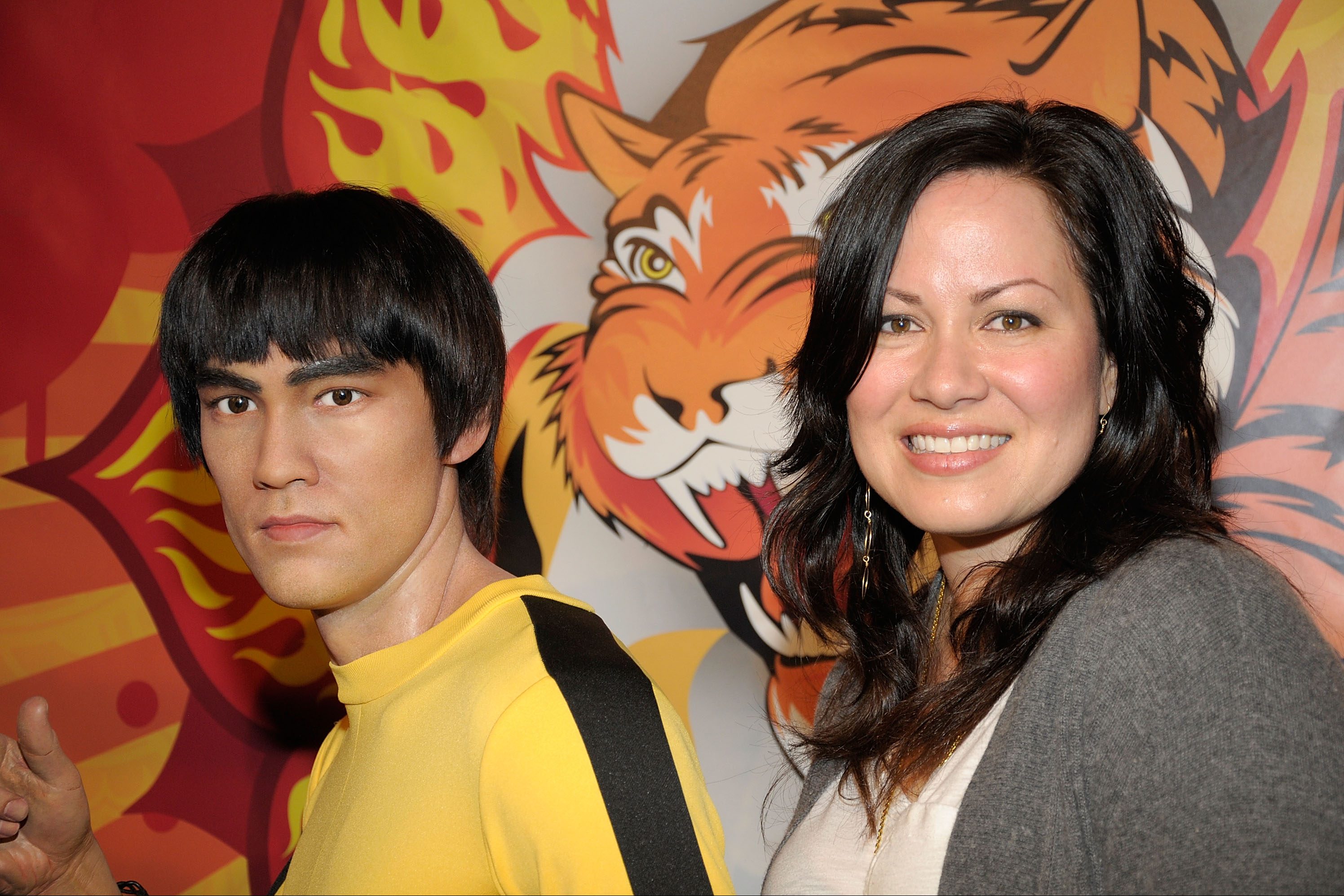
She has also produced projects that continue his creative vision, including the television series Warrior, inspired by an idea Bruce originally developed decades earlier.
The show, set in 1870s San Francisco, explores the struggles of Chinese immigrants—an issue that deeply resonated with Bruce’s own experiences navigating idenтιтy and representation in America.
Bruce Lee’s influence remains undeniable. Time magazine named him one of the 100 most important people of the 20th century. He shattered stereotypes of Asian men in Western media, presenting instead an image of strength, intelligence, and pride. His films ignited a global martial arts movement and changed Hollywood forever.

But for Shannon, legacy isn’t about box office numbers or cultural rankings. It’s about protecting the humanity behind the icon.
“He wasn’t a myth,” she has implied through her work. “He was a man.”
A man who wrestled with self-doubt and ambition. A thinker who scribbled poetry in notebooks. A father who played with his children. A visionary who believed in breaking boundaries—physical, cultural, and philosophical.
By stepping forward now, Shannon Lee isn’t simply revisiting the past. She is reclaiming it. And in doing so, she invites the world to see Bruce Lee not just as a legend frozen in time—but as a multidimensional human being whose ideas still flow, like water, into the present.


