Hoover Dam’s $6 Billion Gamble Failing—ᴅᴇᴀᴅ Pool at 895 Feet Could Cut Power to 25 Million Americans
There exists a number that could plunge millions of Americans into darkness overnight: 895 feet.
This figure represents the critical level at which Lake Mead reaches what engineers refer to as “ᴅᴇᴀᴅ pool.”
At this juncture, the Hoover Dam ceases to generate power entirely.
No turbines will spin, no water will flow, and the repercussions will ripple across seven states, impacting 25 million people.
Currently, the monumental $6 billion investment aimed at averting this catastrophe is failing.
What makes this situation even more frightening is that, although Lake Mead experienced a temporary rise after a few favorable snow seasons, the underlying crisis persists.
Headlines may have declared the crisis over, and politicians may have hailed it as a comeback, but the reality is stark.
More water is consistently leaving this system than the Colorado River can replenish each year, a trend that has continued for over a century.
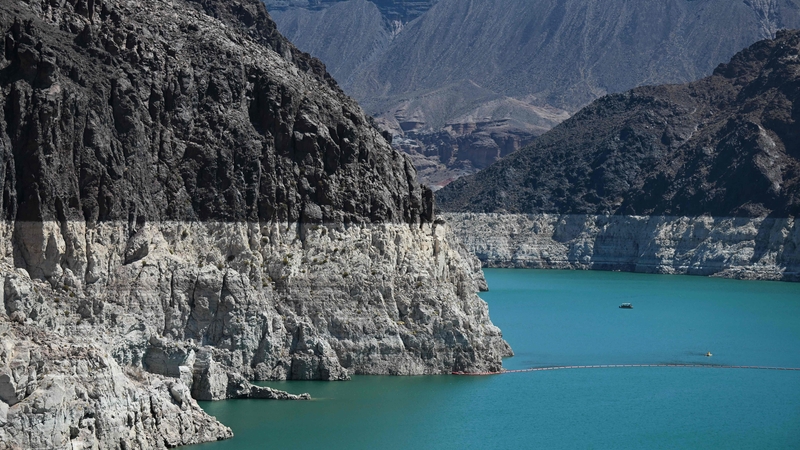
The visible white ring on the canyon walls—a chalky scar observable from space—serves as a constant reminder of this grim reality.
The troubling secret that seven states and the federal government have avoided confronting since 1922 is that the water supply is dwindling, and the question is not if ᴅᴇᴀᴅ pool is coming, but rather who will inform the 25 million people that their water resources are nearly depleted.
To truly understand the significance of this crisis, one must take a drive out of Las Vegas on Highway 93.
This route provides a clear view of the American West’s ongoing struggle with water scarcity.
As you head southeast through the desert, past the glitz of casinos and sprawling developments, the land suddenly drops away, revealing Black Canyon.
The first thing that captures your attention is not the dam itself, but rather the stark white line that runs along both canyon walls.

This chalky scar stretches across miles of dark red rock, a testament to the water that has receded year after year for more than two decades.
This white ring, which rises taller than a ten-story building, is visible even from the Las Vegas Strip on a clear day.
It stands as the largest watermark of a water crisis anywhere on Earth, and it has been growing long before most people even began to pay attention.
Lake Mead, when full, holds approximately 26 million acre-feet of water.
To put this in perspective, one acre-foot is about 326,000 gallons, enough to sustain two average American homes for an entire year.
When the lake is at its full capacity, the water level sits at 1,221 feet above sea level.
However, today, even after recent favorable snow seasons, the lake hovers around 1,070 to 1,080 feet, still about 140 feet below its intended level and barely more than a quarter full.
Once designed to accommodate nine full years of Colorado River flow, Lake Mead now holds closer to just two years’ worth.
In July 2022, the lake dropped to approximately 1,040 feet, the lowest level since its initial filling in the 1930s, inching closer to ᴅᴇᴀᴅ pool than ever before.
At 895 feet, the water can no longer flow through the Hoover Dam on its own, leading to a complete halt in power generation and water supply for millions.
Following the historic low in 2022, a good snowpack in the Rockies temporarily pushed levels back up.
However, headlines proclaiming a recovery were misleading; a 30-foot rise in a lake still 140 feet below full capacity is not a recovery—it’s merely a pause.
The white ring remains, still enormous and still climbing, while the math behind that temporary rise has not changed at all.
Back in November 1922, leaders from seven states convened in Santa Fe, New Mexico, to divvy up one of the American West’s most valuable resources: water from the Colorado River.
Herbert Hoover, then Secretary of Commerce and future president, presided over the meeting.
The plan was straightforward: ᴀssess the annual flow of the Colorado River and allocate it fairly among the states dependent on it—Arizona, California, Colorado, Nevada, New Mexico, Utah, and Wyoming.
They divided up 16.5 million acre-feet per year, with 7.5 million allocated to the upper basin states and the same amount to the lower basin states, plus an additional 1.5 million promised to Mexico by treaty.
Everyone left satisfied, but the agreement was built on a significant flaw.
The flow data used during this allocation came from an unusually wet period in history, leading to inflated expectations about the river’s capacity.
Climate researchers at UCLA later analyzed over a millennium of tree-ring data and found that the Colorado River’s true average flow is closer to 12 to 13 million acre-feet per year.
In dry years, the river carries less than 10 million acre-feet.
This means the compact promised 25 to 30% more water than the river could realistically provide, setting the stage for a century-long crisis.
Some scientists had raised concerns about the overly generous estimates, but the political momentum was too strong to halt.
Seven states had finally reached an agreement, and no one wanted to risk reopening negotiations with smaller numbers.
So, they signed, celebrated, and built entire civilizations atop a promise the river could never fulfill.
For decades, Lake Mead and Lake Powell masked this discrepancy, with stored water compensating for the shortfall.
But that cushion is nearly gone now, and the consequences are becoming increasingly apparent.
The federal government and the states have invested around $6 billion to maintain the system, implementing emergency low-water turbines at Hoover Dam to keep power generation alive as lake levels plummeted.
Infrastructure across the basin has been upgraded, patched, and rebuilt under pressure, but one project stands out: the “third straw.”
Pat Mulroy, who led the Southern Nevada Water Authority for over two decades, recognized the looming crisis and warned anyone who would listen.
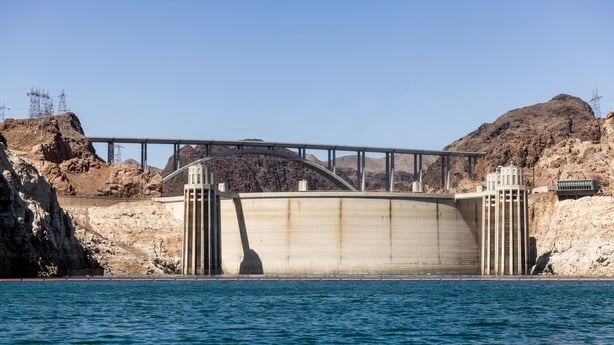
Critics labeled her an alarmist, but she proceeded with the construction of a crucial three-mile tunnel, bored through solid rock beneath Lake Mead at an elevation of roughly 860 feet.
This project, costing $1.4 billion, was completed in 2015 and became the sole reason Las Vegas had running water by 2022.
However, the third straw does not resolve the river’s problems; it merely allows Las Vegas to draw from a diminishing resource.
Understanding the implications of ᴅᴇᴀᴅ pool for 25 million people requires a deeper appreciation of what Hoover Dam represents.
While many view it as a barrier holding back water, it is also one of the most vital power plants in the western United States.
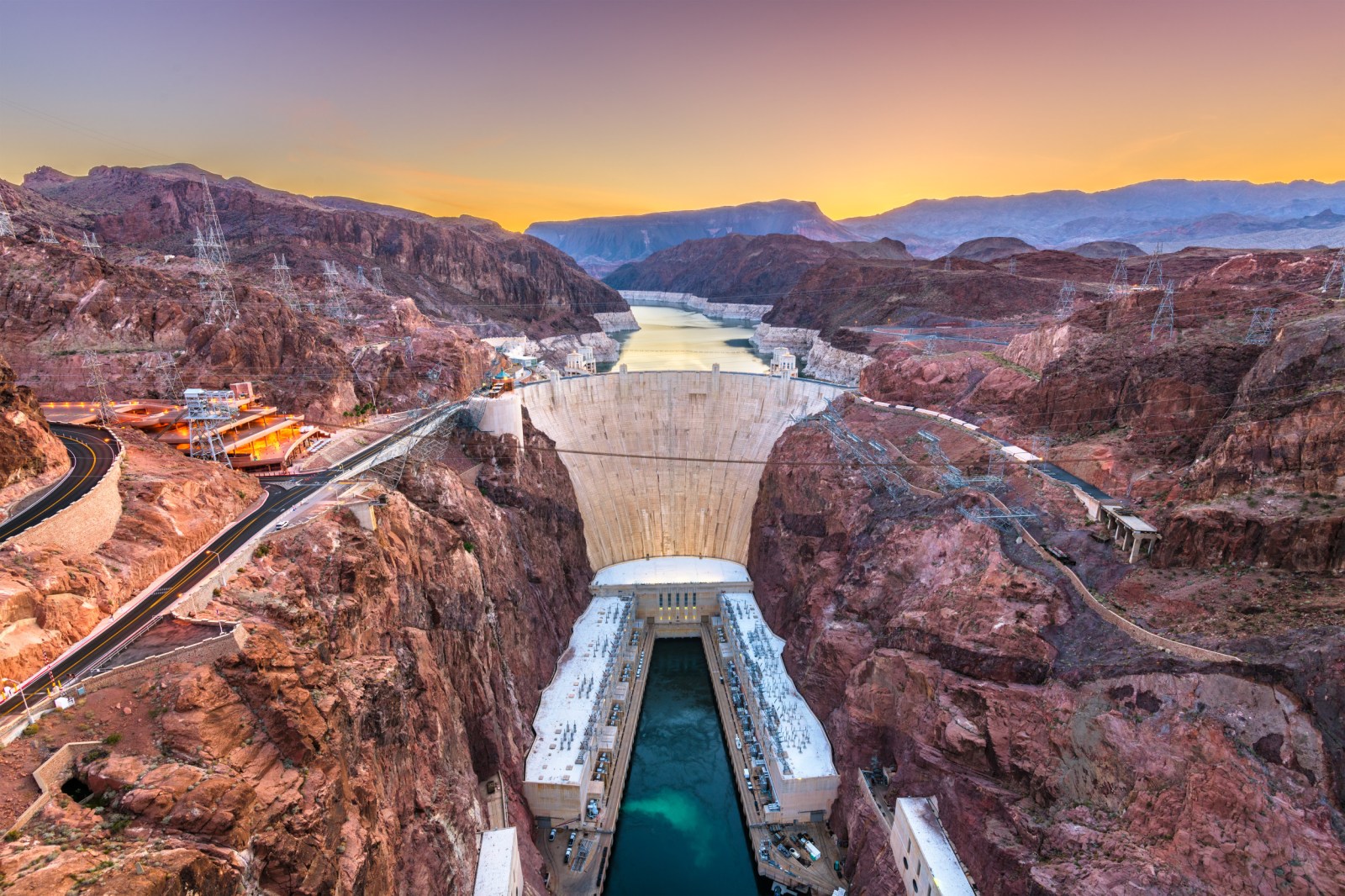
Power plants rely on hydraulic pressure, and Hoover Dam was completed in 1935, towering 726 feet tall and 660 feet thick at its base.
It was a monumental feat of engineering, constructed during the Great Depression, employing thousands of workers under extreme conditions.
The dam generates electricity through hydraulic head, where water falls from the lake’s surface through mᴀssive intake towers and crashes into turbines at the bottom.
The higher the lake sits, the more forcefully the water hits the turbines, producing more electricity.
At full capacity, Hoover Dam generates approximately 2,800 megawatts of electricity, enough to power about 1.3 million homes across Nevada, Arizona, and Southern California.
For decades, this power was reliable and inexpensive, but as lake levels dropped, every foot lost diminished the force driving the turbines.
By 2022, Hoover Dam’s output had already plummeted by 25% to 40%.
In response, the Bureau of Reclamation hastily installed emergency low-water turbines, smaller units designed to extract power from reduced pressure, just to keep the dam operational.
This iconic power plant was relying on backup equipment to function.
Additionally, the water intake issue remains largely unaddressed.
The original pipes supplying Las Vegas were designed for a lake that remained above 1,000 feet.
As water levels approached that threshold, the intakes risked drawing in air instead of water, posing a serious problem for a city of 2.2 million residents that relies on Lake Mead for about 90% of its drinking water.
At 895 feet, the turbines cease entirely, halting water flow and plunging the Southwest into darkness.
This crisis is not theoretical; it has already manifested for countless families who lack the financial and political clout of the cities built on Colorado River water.
In Pinal County, Arizona, south of Phoenix, farmers witnessed their water supply vanish almost overnight when the federal government declared a shortage in 2022.
The Central Arizona Project Canal, which transports Colorado River water across 336 miles of desert, became a lifeline for farms and cities.
But those with the lowest priority water rights were the first to face cuts.
Fields that had long produced cotton, alfalfa, and grain turned to parched earth.
One farmer, Will the Lander, reported losing over a thousand acres of farmland, a devastating blow for families who had cultivated the same land for generations.
The AK Chin Indian community, a tribal nation in Pinal County, also experienced cuts to their water supply, an especially painful reality for a community that fought for decades to secure their water rights.
As Lake Mead receded, it began to reveal what had been hidden beneath the surface—barrels containing human remains from the 1970s and 1980s, and a World War II-era landing craft that had rested undisturbed for nearly 80 years.
Each discovery made headlines, but they all conveyed a singular message: the water is lower than ever before and continues to decline.
The clock is ticking, as the rules governing Colorado River water distribution during shortages are set to expire in 2026.
When that time arrives, the seven state governments and the federal government must negotiate a new agreement, a process that is likely to be the most contentious water dispute in American history.
The upper basin states—Colorado, Wyoming, Utah, and New Mexico—are drawing a firm line, arguing that they have never fully utilized their allocated water rights.

They refuse to be penalized for the lower basin states consuming more than their fair share.
Conversely, the lower basin states—California, Arizona, and Nevada—hold the largest cities, the most influential agricultural operations, and the greatest political leverage.
California, in particular, consumes more Colorado River water than any other state.
Arizona has already faced significant cuts in recent years, while Nevada has invested billions in water conservation efforts but still faces pressure to reduce its allocations further.
Every state has valid points, yet the river remains indifferent to their arguments.
Moreover, Mexico, which is often overlooked in these discussions, is legally guaranteed 1.5 million acre-feet of Colorado River water annually through a 1944 treaty.
This agreement cannot simply be disregarded because the math has become uncomfortable.
Meanwhile, Lake Powell, the second largest reservoir in the country, located upstream on the Utah-Arizona border, is following Lake Mead’s downward trajectory.
In 2022, the Bureau of Reclamation made emergency water releases from Flaming Gorge in Wyoming, over 400 miles upstream, to maintain the Glen Canyon Dam’s minimum operating level.
Both Lake Mead and Lake Powell are in crisis, and the federal government is scrambling to manage water between two sinking ships.
To visualize what ᴅᴇᴀᴅ pool truly means for 25 million people, consider the implications: Hoover Dam falls silent.
The turbines stop spinning.
The power output that Nevada, Arizona, and Southern California have relied upon for nearly a century vanishes completely.
No alternative power plants are poised to fill this void, leading to unprecedented disruptions across the region.
Las Vegas loses its primary water supply, and even the third straw, the emergency tunnel costing $1.4 billion, has its limits.
A lake at 895 feet pushes the deepest intake to its threshold.
For a city of 2.2 million people that relies on Lake Mead for 90% of its drinking water, there is no viable backup plan.
Downstream, the Imperial Valley will lose its water allocation, jeopardizing 700,000 acres of farmland responsible for two-thirds of America’s winter vegetables.
This loss will send shockwaves through grocery supply chains across the nation.
A water emergency in the desert Southwest will escalate into a food price crisis in every American city.
The dam itself will endure, constructed from 5 million cubic yards of concrete embedded into the volcanic rock of Black Canyon.
Engineers designed it to outlast the country that built it.
However, a dam without adequate water behind it is no longer functional infrastructure; it becomes a mere monument.
The $6 billion spent on emergency turbines, intake tunnels, and system upgrades provided a temporary reprieve, but it did not solve the underlying issues.
Every favorable winter slows the decline, yet none have closed the gap.
The Colorado River continues to deliver less water than the states are legally enтιтled to receive.
The mega drought persists, and the white ring on the canyon walls continues to climb, marking each year of inaction as a scar etched into the rock.
895 feet is no longer just a prediction; it is a direction.


