Danger Beneath the Waves: The Silent War in the Strait of Hormuz
Far from the spectacle of fighter jets and missile strikes, another kind of warfare unfolds in silence beneath the ocean’s surface.
In the narrow waters of the Strait of Hormuz, one of the most strategically vital chokepoints on Earth, sea mines remain a persistent and dangerous threat—capable of disrupting global trade with startling efficiency.
Though often ᴀssociated with conflicts of the past, sea mines have never lost their relevance.
In fact, they are among the simplest yet most effective naval weapons ever devised.
Cheap to produce and easy to deploy, they present a uniquely complex challenge even for the most advanced naval forces in the world.
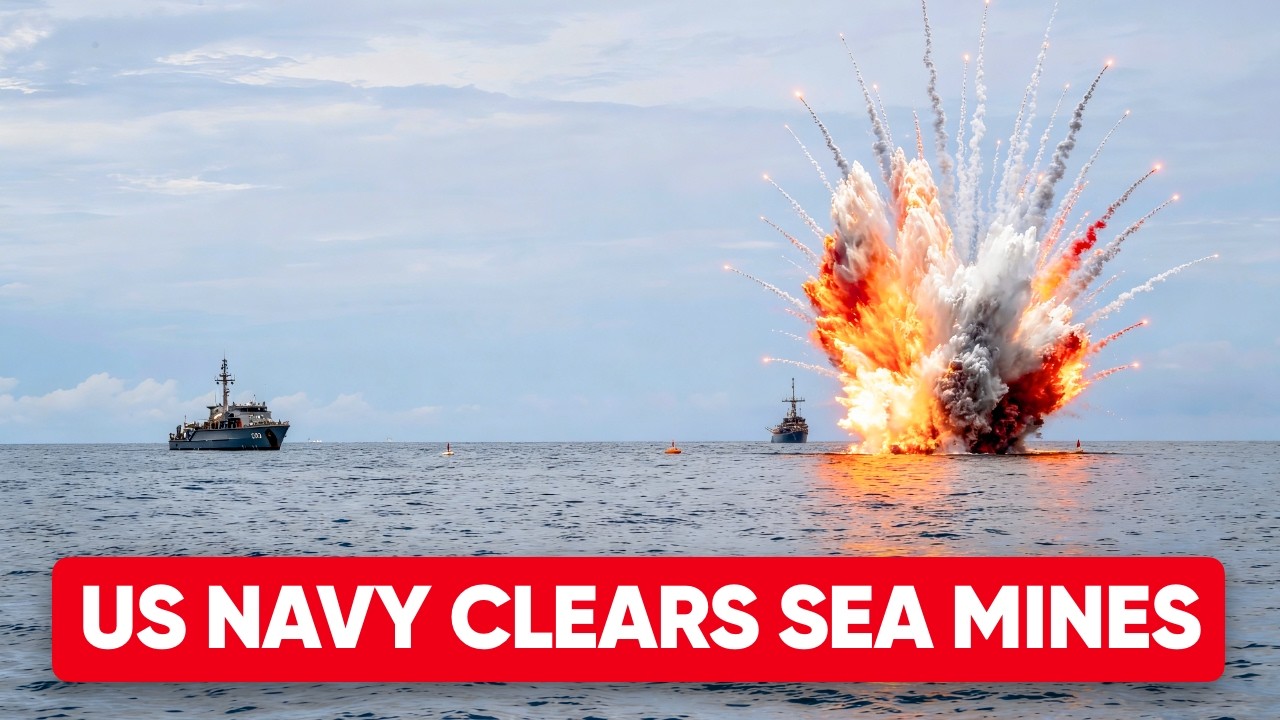
Some mines drift just below the surface, tethered to the seabed, waiting for an unsuspecting ship to pᴀss overhead.
Others lie silently on the ocean floor, equipped with sensors that detect changes in magnetic fields, vibrations, or acoustic signatures.
When triggered, they detonate with devastating force, often striking the most vulnerable part of a vessel—below the waterline.
For naval commanders, this creates a nightmare scenario.
Unlike missiles or aircraft, sea mines do not announce their presence.

They wait patiently, invisible and unpredictable.
This threat becomes even more serious in the Strait of Hormuz.
The shipping lanes here are remarkably narrow—just a few miles wide in each direction.
A handful of strategically placed mines could effectively halt the flow of oil and commercial goods, sending shockwaves through the global economy.
To counter this danger, the United States Navy has spent decades refining one of the most intricate forms of maritime warfare: mine countermeasures.
At the heart of these operations are specialized vessels like the Avenger-class mine countermeasures ships.

Unlike heavily armed destroyers, these ships are designed with a completely different priority—stealth in the magnetic sense.
Built using materials such as wood layered with fiberglᴀss, they minimize their magnetic signature to avoid triggering mines.
Moving slowly and deliberately, these ships scan the ocean floor using high-resolution sonar.
The images produced reveal the underwater landscape in remarkable detail.
Operators study these visuals carefully, searching for anomalies—objects that do not belong.
But finding a potential mine is only the beginning.
Once a suspicious object is identified, remotely operated vehicles are deployed.
These underwater drones descend cautiously, transmitting live video back to the ship.
Sometimes the object turns out to be harmless debris.
But when it is a mine, the tension rises instantly.
The robot approaches with precision and places a small explosive charge beside the device.
Then it retreats.
Moments later, a controlled detonation sends a burst of energy through the water—neutralizing the threat.
One mine is gone, but the operation continues, often with many more still hidden nearby.
Mine clearance is not limited to ships alone.
The U.S. Navy also employs powerful airborne ᴀssets such as the MH-53E Sea Dragon helicopter.
Mᴀssive and unmistakable, this aircraft plays a critical role in sweeping large areas of ocean.
Flying low over the water, the helicopter tows specialized equipment beneath the surface.
Some systems use sonar to detect mines, while others mimic the magnetic and acoustic signatures of large ships.
This can deliberately trigger mines from a safe distance, causing controlled explosions far from actual vessels.
The process, however, is anything but safe.
Helicopter crews must maintain steady flight over potentially hostile waters, often in regions where tensions are high.
In such environments, the threat is not only from the mines themselves but also from opposing forces.
Fast attack boats, particularly those operated by Iran’s naval units, pose a significant risk.
These small, agile vessels are designed for rapid movement and swarm tactics.
Armed with rockets, machine guns, and sometimes anti-ship missiles, they can quickly approach mine-clearing units in the confined waters of the strait.
To reduce this risk, U.S. forces have increasingly focused on prevention.
Rather than dealing with mines after they are deployed, efforts are made to target the vessels and infrastructure used to lay them.
By disrupting these operations early, the overall threat can be significantly reduced.
Still, not every mine requires advanced technology to eliminate.
When floating mines are spotted, sailors may resort to direct fire—using heavy machine guns or deck-mounted weapons to destroy them.
These moments are chaotic and loud, a stark contrast to the otherwise methodical nature of mine warfare.
Ultimately, the objective is not to remove every mine from the sea.
That would be an endless task.
Instead, naval forces aim to create safe corridors—carefully cleared and continuously monitored channels through which commercial ships can pᴀss.
Once these corridors are established, another phase begins: escort operations.
Warships accompany civilian vessels, forming protective convoys as they navigate the narrow strait.
Aircraft patrol overhead, and surveillance systems remain on constant alert.
Despite these measures, the tension never fully disappears.
Each journey through the Strait of Hormuz carries an underlying uncertainty.
A single undetected mine or a sudden encounter with hostile forces could change everything in an instant.
In this silent and painstaking battle, victory is not measured in dramatic explosions or visible dominance.
It is measured in safe pᴀssage—in ships that cross the strait without incident, in trade routes that remain open, and in dangers that are neutralized before they are ever seen.


