Granite, Arsenic, and Lost Machines: Rethinking Ancient Egypt’s Engineering
Few achievements of the ancient world inspire as much awe as the stonework of Egypt. From the colossal granite blocks of the pyramids to the intricately carved sarcophagi and temple columns, the precision and durability of these monuments remain astonishing. Yet a persistent debate continues to swirl around one fundamental question: how were such hard stones cut and shaped thousands of years ago?
Granite, one of the primary materials used in many Egyptian monuments, ranks around 6 to 7 on the Mohs scale of hardness. Copper, the metal traditionally ᴀssociated with early Egyptian tools, ranks around 3. On the surface, this appears contradictory. How could a softer metal effectively cut a significantly harder stone?

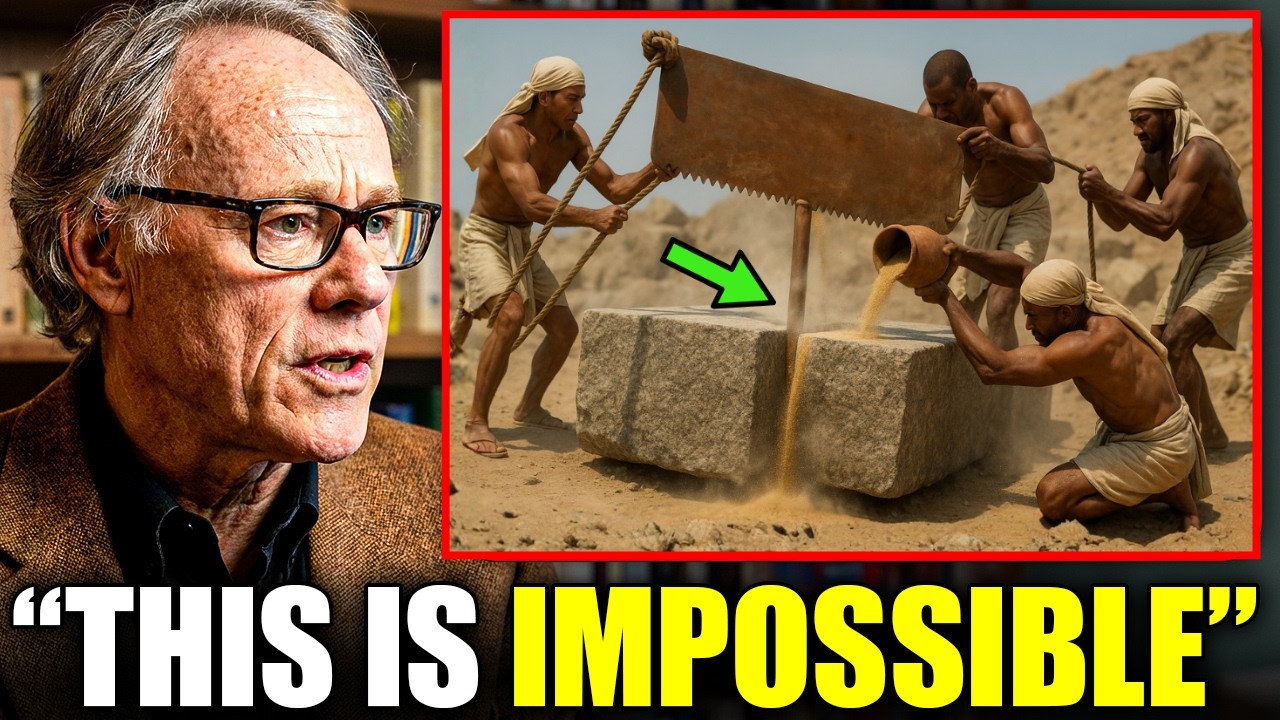
Mainstream archaeology offers a well-established explanation. Copper tools, combined with abrasive materials such as quartz sand, were used to grind and shape stone.
In this method, the copper does not do the cutting directly; instead, it acts as a carrier for the harder sand particles, which abrade the granite over time. Experimental archaeology has demonstrated that such methods can work, though they require patience, labor, and organization.
However, alternative researchers argue that certain artifacts raise additional questions. Among the most discussed are granite drill cores discovered in Egypt in the late 19th century by archaeologist Flinders Petrie.
These cylindrical remnants, left behind by tubular drilling, display spiral striations—marks that suggest rotational cutting. Some engineers have analyzed these spirals and proposed that the penetration rates implied by the markings appear surprisingly efficient.

Critics of the conventional explanation claim that the smoothness of certain granite surfaces and the sharpness of interior angles suggest more advanced tooling than simple abrasion.
They argue that if sand-based grinding were solely responsible, surfaces might show more irregular wear patterns.
One alternative hypothesis centers on metallurgy. It is well known that ancient Egyptians used copper and later bronze. But another alloy—arsenical copper—predates widespread tin bronze in some regions.
When copper is alloyed with small amounts of arsenic, it becomes significantly harder and more durable than pure copper. Archaeological evidence confirms that arsenical copper was used in parts of the ancient Near East and Egypt.
Proponents of this theory suggest that tools made from arsenical copper could have been stronger than traditionally ᴀssumed. Because arsenic is toxic, the production of such alloys would have required skill and may have been limited to specialized craftsmen. If true, this could partially explain how more durable cutting tools were produced.
However, most archaeologists maintain that even hardened copper alloys would not approach the hardness of iron or steel and would still rely heavily on abrasives to work granite efficiently. Moreover, evidence of large-scale machine tools—such as lathes or milling systems capable of industrial precision—has not been found in the archaeological record.
This brings us to one of the most debated artifacts in alternative history discussions: the so-called “Schist Disc of Sabu,” discovered in 1936 at Saqqara. Carved from schist, a brittle metamorphic stone, the object features a central hub and three curved lobes. Some observers argue that its design resembles a mechanical impeller. Others interpret it as a ceremonial object or symbolic vessel. Egyptologists generally do not classify it as proof of advanced machinery, but its unusual shape continues to spark speculation.
Another recurring claim is that earlier Egyptian stonework appears more precise than some later examples, suggesting a decline in craftsmanship over time. Conventional historians attribute such differences to changes in political stability, available labor, economic resources, and artistic priorities rather than the loss of secret technology.

It is important to note that no conclusive archaeological evidence currently supports the existence of high-speed industrial machines in ancient Egypt. No metal machine frames, standardized mechanical components, or documented technical schematics have been uncovered.
The prevailing scholarly view holds that ancient Egyptian engineering, while extraordinary, was achieved through sophisticated organization, skilled labor, incremental experimentation, and clever use of available materials.
Still, the debate itself reveals something valuable.

Ancient Egyptian civilization was far more technically capable than earlier generations of scholars once believed.
Quarrying, transporting, and precisely shaping multi-ton granite blocks required logistical brilliance and refined craftsmanship. Even if achieved through abrasive methods and manpower, the scale and coordination remain remarkable.
The enduring fascination with alternative explanations—lost alloys, secret formulas, vanished machines—reflects both the mystery of deep antiquity and our tendency to underestimate ancient ingenuity. Whether through patient abrasion or metallurgical innovation, the builders of Egypt accomplished feats that still command respect today.
Rather than diminishing their achievements, the discussion underscores a central truth: the ancient world was neither primitive nor simplistic.
It was inventive, experimental, and often more technically nuanced than modern ᴀssumptions allow.
The granite still stands.
The drill cores still bear their spirals.
The debate continues—not because the past is unknowable, but because it challenges us to examine evidence carefully, question ᴀssumptions responsibly, and remain open to discovery without abandoning rigor.


