Into the Depths: What the Bismarck’s Wreck Really Reveals
On May 27, 1941, after one of the most dramatic pursuits in naval history, the German battleship Bismarck slipped beneath the waves of the North Atlantic.
For decades, historians debated a central question: was she sunk by British gunfire and torpedoes, or scuttled by her own crew to prevent capture?
Nearly half a century later, deep-sea exploration would begin providing answers.
The Bismarck was no ordinary warship.
Commissioned in 1940, she displaced more than 41,000 tons and carried eight 15-inch guns capable of firing shells weighing nearly a ton.

In May 1941, she and the heavy cruiser Prinz Eugen attempted to break into the Atlantic to attack Allied shipping lanes.
During that breakout, Bismarck sank HMS Hood, pride of the Royal Navy, in a catastrophic explosion that killed all but three of her 1,418 crewmen.
The British response was relentless.
After days of pursuit and a torpedo strike that jammed Bismarck’s rudders, British battleships HMS Rodney and HMS King George V closed in.
On the morning of May 27, they unleashed sustained fire at close range.
By mid-morning, the German ship was a burning wreck.
She rolled over and sank, taking more than 2,000 men with her.
From the beginning, two narratives emerged.
British accounts emphasized the overwhelming firepower that battered the ship into submission.
German survivors, however, testified that scuttling charges were set and seacocks opened to ensure the ship would not be captured.
For decades, without physical access to the wreck, the debate persisted.
That changed in 1989 when oceanographer Dr. Robert Ballard — already famous for discovering the тιтanic — located the Bismarck resting upright at a depth of about 15,700 feet (4,790 meters).
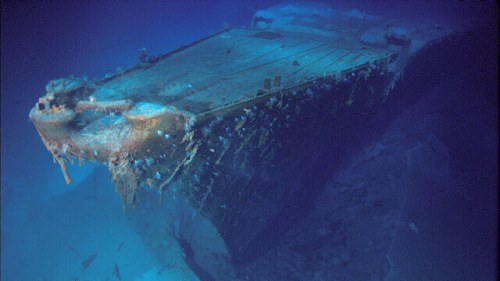
The ship lay remarkably intact on the seabed, her mᴀssive hull largely preserved by the cold, high-pressure environment.
Ballard’s team observed something significant: there were no obvious, mᴀssive breaches along the main armored belt that would alone explain rapid sinking from external shellfire.
While the superstructure was heavily damaged, the lower hull appeared comparatively intact.
Ballard suggested that scuttling likely played a decisive role in the ship’s final descent.
In 2002, filmmaker and deep-sea explorer James Cameron led a more detailed survey using advanced remotely operated vehicles (ROVs).
His team documented damage patterns more closely, including torpedo hits and structural failures.
Cameron’s analysis concluded that although British fire had devastated the ship’s upper works and rendered her combat ineffective, internal flooding — likely accelerated by deliberate scuttling — was critical in causing her to sink.
Subsequent expeditions, including privately funded surveys using increasingly sophisticated ROVs, have further mapped the wreck.

Some vehicles have navigated interior pᴀssages where structural collapse allows access.
However, the idea that perfectly preserved paper documents were recovered or read in legible detail inside the admiral’s suite is not supported by credible published expedition reports.
At nearly 5,000 meters deep, the wreck sits in extreme pressure and saltwater conditions.
While cold temperatures can slow deterioration, paper exposed to seawater for decades typically degrades.
Metal structures, while surprisingly intact, show signs of corrosion and biological colonization.

Exploration teams have documented artifacts, but no verified archive of preserved wartime documents has been publicly presented through peer-reviewed research or official maritime archaeological releases.
What has been confirmed is this: physical evidence strongly supports that Bismarck was both crippled by British firepower and deliberately scuttled by her crew.
The torpedo strike from aircraft launched by HMS Ark Royal jammed the rudders, sealing the ship’s fate strategically.
The final battleship bombardment destroyed her command structure and heavy guns.
German engineering officers then likely accelerated sinking to prevent capture.

Rather than a cover-up, historians today generally accept a combined explanation.
British gunnery and torpedoes rendered Bismarck a wreck; German scuttling ensured she would not survive long enough to be boarded.
As for alleged secret technologies or classified breakthroughs hidden aboard? While Bismarck incorporated advanced fire-control systems and heavy armor for her era, there is no credible evidence that her sinking concealed revolutionary systems unknown to Allied intelligence.
Much of her design was studied postwar through sister ships, captured documents, and naval analysis.
The enduring fascination with Bismarck stems not from conspiracy, but from the scale of the drama.

In less than a week, the Atlantic witnessed the destruction of Britain’s most iconic battlecruiser and Germany’s most powerful battleship.
More than 3,400 sailors died across both ships.
Today, the wreck is recognized as a maritime war grave.
Modern expeditions operate under ethical guidelines, emphasizing documentation rather than disturbance.
Advances in deep-sea robotics continue to refine our understanding of the final battle, but the broad outline of events is no longer a mystery.

The cameras that reached Bismarck’s depths did not uncover a buried diplomatic scandal or a hidden technological secret.
What they revealed instead was something more human: a colossal warship broken by overwhelming force, its steel hull still bearing silent witness to one of World War II’s most consequential naval encounters.
Sometimes the truth beneath the ocean floor is not a dramatic reversal of history — but a clearer confirmation of it.


