Mount Etna’s Flank Fracture: What’s Really Happening — And What It Means
Mount Etna, Europe’s most active volcano, has once again captured global attention after reports of a significant fracture opening along its eastern flank. Monitoring instruments recorded rapid ground deformation, horizontal displacement, and unusual seismic patterns. Dramatic headlines followed, suggesting the mountain is “breaking apart in real time.”
The reality is more nuanced—but still scientifically important.
Etna’s eastern flank has long been known to move gradually toward the Ionian Sea. This slow motion, called flank creep, has been documented for decades. GPS stations typically record millimeter-scale movement per month.

During this recent episode, however, multiple monitoring systems detected accelerated displacement. Ground stress sensors exceeded normal thresholds. GPS stations showed lateral (sideways) motion instead of the typical upward inflation ᴀssociated with magma rising vertically. Satellite radar (InSAR) data revealed phase loss in areas of rapid surface movement.
The key shift was directional. Instead of simply swelling from magma pressure, parts of the volcano appeared to be pulling apart horizontally.
That matters.
Volcanoes are not solid monoliths. They are built from layers of lava, ash, and sediment, often resting on weaker materials. Beneath Etna’s eastern side lie clay-rich and hydrothermally altered layers that act as natural slip planes.

When magma intrudes laterally—moving sideways instead of erupting upward—it can force open cracks like a hydraulic wedge. This doesn’t always lead to eruption. Instead, it can destabilize structural supports inside the volcano.
Scientists become particularly attentive when rock transitions from gradual deformation to tensile fracture—meaning it is being pulled apart faster than it can elastically adjust.
However, “fracture” does not automatically mean imminent collapse.
Comparisons have been made to Mount St. Helens (1980) and Anak Krakatau (2018), where flank failures preceded dramatic events. Those examples are important reminders that structural instability can sometimes lead to sudden slope collapse.

But Etna is not a simple parallel.
Unlike smaller, steep-sided volcanic islands like Anak Krakatau, Etna is a mᴀssive, broad stratovolcano with a long, well-documented history of flank movement. Studies show its eastern flank has been sliding gradually for thousands of years.
In fact, Etna’s slow gravitational spreading is part of its normal long-term behavior. What scientists are evaluating now is whether this episode represents:
-
A short-term acceleration within a known sliding system
-
A magma-driven deformation pulse
-
Or a transition toward larger-scale instability

As of now, monitoring agencies have raised alert levels to increase surveillance—not to signal an inevitable catastrophic failure.
Reports mention that some simulation models produced inconsistent results. That does not mean scientists are panicking. It reflects the inherent complexity of volcanic systems.
When multiple instruments—GPS, seismic sensors, satellite radar, strain meters—detect unusual alignment, researchers shift from long-term forecasting to short-term scenario planning.
This is standard scientific protocol, not evidence of uncontrolled fear.
The word “terrified” may capture public imagination, but scientific briefings typically use cautious, technical language.

One accurate point: rock does not regain its original strength once fractured at large scales. However, that does not automatically imply runaway collapse.
Volcanic systems frequently undergo cycles of fracturing and stabilization. Fractures can slow, stall, or redistribute stress without escalating into catastrophic failure.
Gravity is always acting on the volcano—but it has been for millennia.
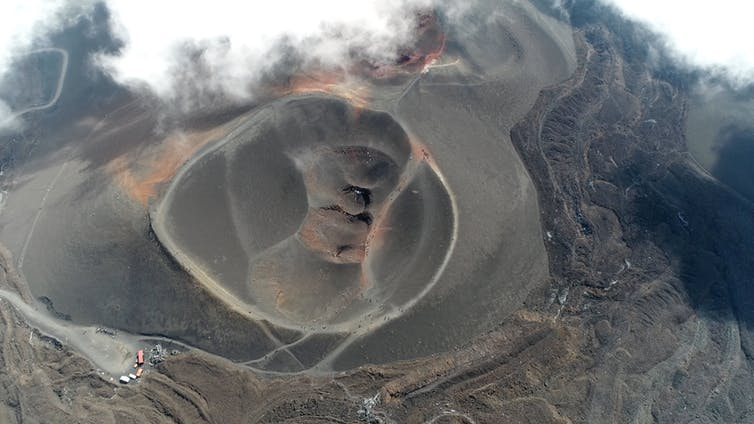
Authorities in Sicily continue close monitoring. Possible outcomes range widely:
-
Movement slows and stabilizes
-
Continued gradual flank sliding
-
Localized landslides
-
Increased eruptive activity
-
Or, in a less likely but more serious scenario, larger-scale slope failure
At present, there is no confirmed indication of imminent catastrophic collapse.

Etna remains active—but activity is not new for this volcano.
Mount Etna is one of the most instrumented volcanoes in the world. The fact that scientists detected this fracture quickly is a sign of how advanced modern monitoring has become.
Volcanoes are dynamic systems. Episodes of accelerated deformation are serious and deserve attention. But they must be interpreted within geological context—not viral framing.
The mountain is not “shattering overnight.” It is undergoing measurable structural adjustment within a system that has always been moving.
The true story is not panic.
It is vigilance.


