Ambae Volcano Didn’t Just Erupt — It Poisoned the Sky, Buried a Civilization in Ash, and Turned a Living Island into a Silent Exile Zone… Now It’s Rumbling Again
Far out in the South Pacific, in the island nation of Vanuatu, there is a place that does not look like a battlefield.
There are no craters from bombs, no shattered skyscrapers, no sirens wailing through concrete streets.
And yet, for thousands of people, it became unlivable almost overnight.
The name of that place is Ambae Island — and at its center rises the restless cone of Ambae Volcano.
Officials describe it in measured terms: an active stratovolcano with a history of periodic eruptions.
Scientists refer to magma chambers, sulfur dioxide emissions, ash plumes reaching several kilometers into the atmosphere.
But those technical phrases do not capture what residents saw when the mountain changed its mood.
They remember the sky turning a permanent gray.
They remember ash falling not like snow, but like something heavier, something that clung to skin and lungs.
They remember the silence that followed — not peaceful silence, but the kind that makes you aware of every breath.
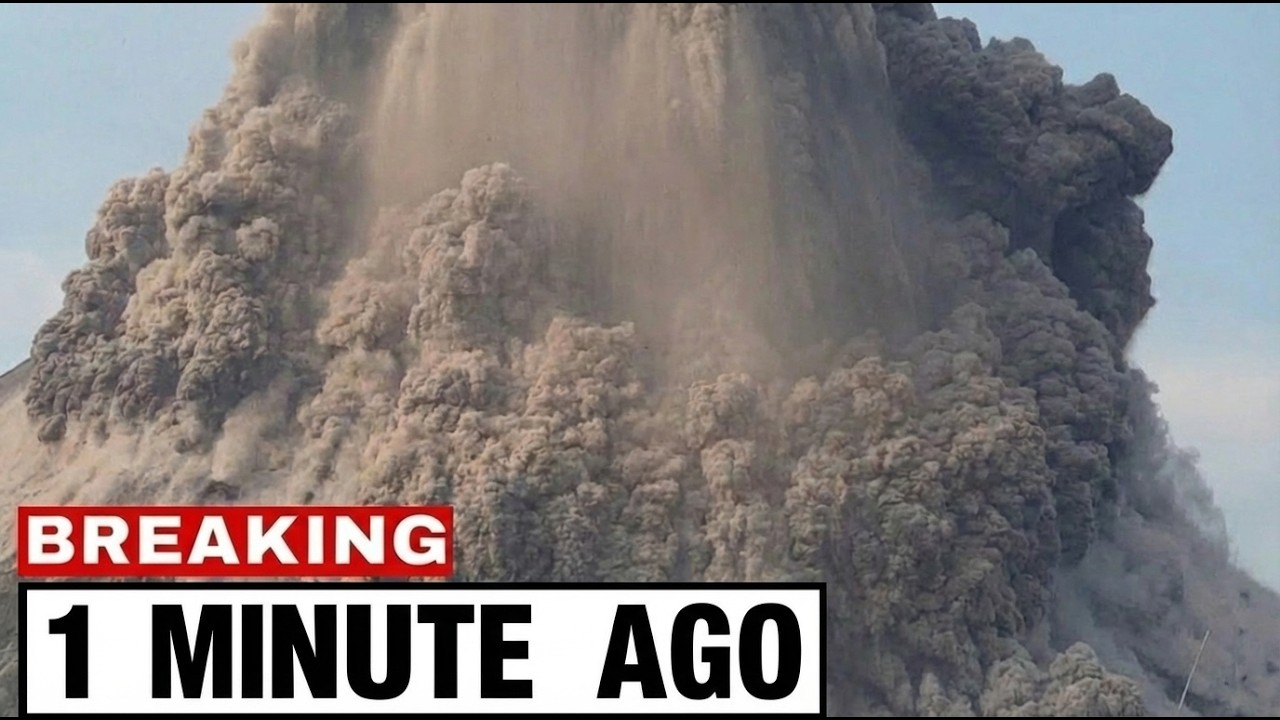
When Ambae erupted in 2017 and again in 2018, it did not produce the kind of cinematic lava flows that dominate disaster footage.
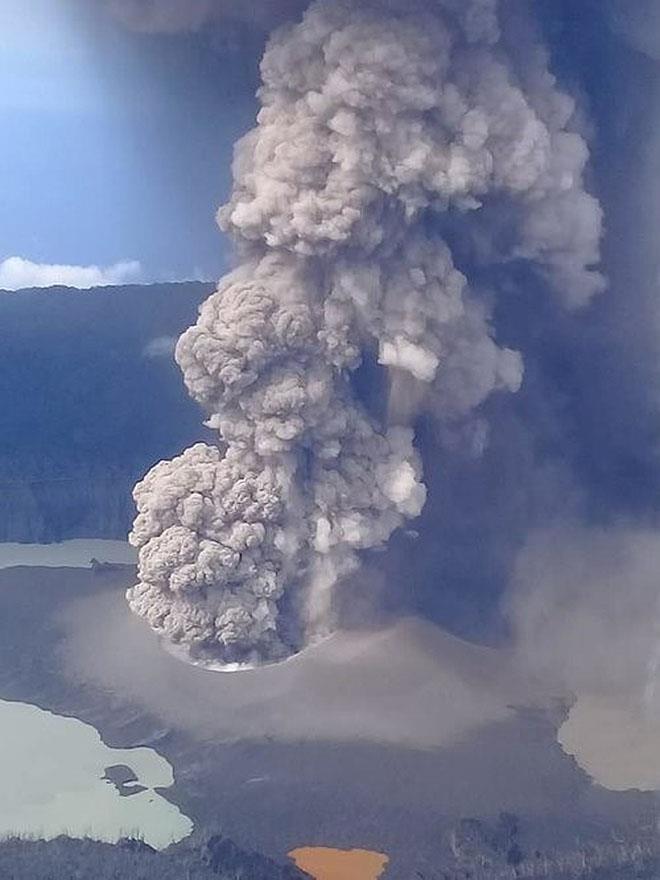
Instead, it launched thick columns of ash and gas high into the air.
The plume drifted across the island, settling onto roofs, gardens, water tanks.
Crops that had fed families for generations began to fail.
Taro leaves blackened.
Coconut palms sagged under the weight of abrasive dust.
Rainwater, once collected and trusted, turned acidic.
Wells were contaminated.
It was not a single explosive moment.
It was a slow erasure.
The government eventually made a decision that, on paper, sounded temporary: evacuate the entire island.
Roughly 11,000 people were told to leave their homes.
They were transported to neighboring islands, including parts of Espiritu Santo, where emergency shelters and host communities struggled to absorb the sudden influx.
Authorities emphasized safety.
The language was clinical.
“Precautionary measures.” “Short-term displacement.” “Monitoring ongoing.”
But displacement has a way of stretching beyond its original timeline.
Weeks became months.
Months blurred into years for some families.
The land they left behind was not destroyed by fire.
It was simply coated in something that made survival uncertain.
Houses stood where they had always stood.
Churches remained upright.
But gardens — the backbone of subsistence life — had been smothered.
Water sources required testing and treatment.
The familiar rhythms of planting and harvesting were disrupted.
Satellite images showed a thick gray veil covering large portions of Ambae.
International observers called it one of the most significant volcanic crises in the Pacific in recent years.
Aid agencies delivered supplies.
Geologists installed monitoring equipment.
Life elsewhere continued.
Headlines moved on.
And yet, beneath the surface of the island, something continued to shift.
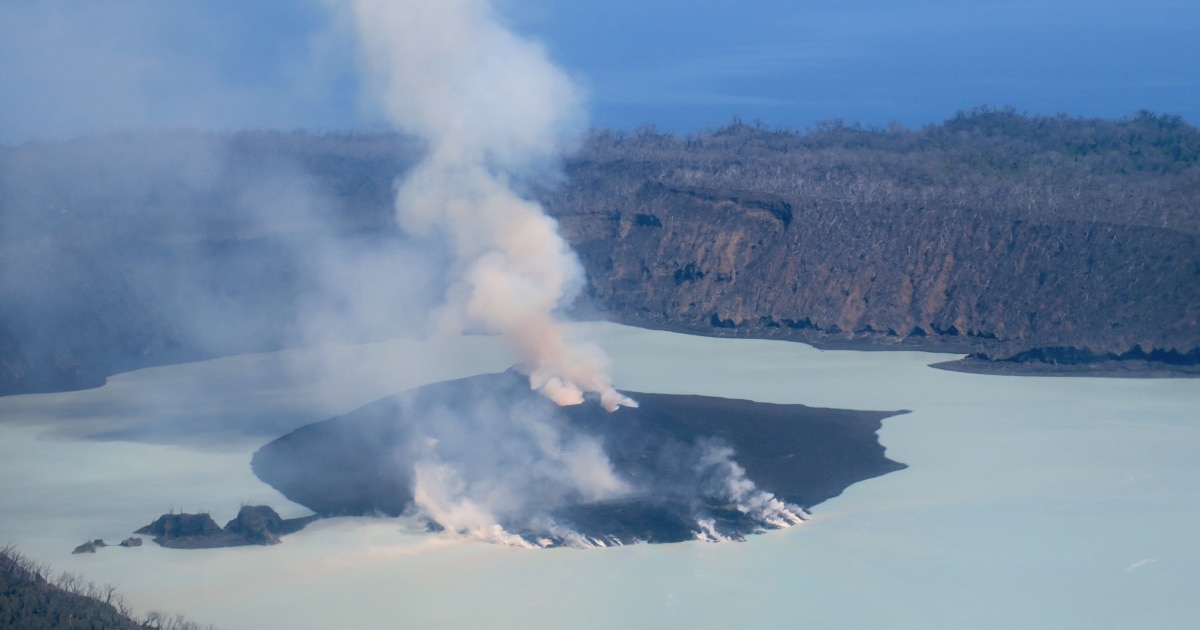
At the heart of Ambae Volcano lies Lake Voui, a crater lake whose color has been known to change from deep blue to milky green, depending on volcanic activity below.
Crater lakes are not pᴀssive bodies of water.
They are sensitive indicators of subterranean unrest.
Variations in temperature, chemistry, and gas emissions can signal that magma is moving, that pressure is building.
In the months following the major eruptions, scientists noted fluctuations that were difficult to ignore.
Gas emissions spiked.
Seismic tremors persisted.
The official reports were cautious.
There was no declaration of imminent catastrophe.
But the monitoring data did not return entirely to baseline either.
For residents who eventually returned to parts of the island, the landscape felt altered.
Ash does not disappear simply because headlines fade.
It lingers in soil composition, in roofing materials, in the faint metallic taste that sometimes accompanies rainfall after an eruption.
Some families chose not to go back at all.
Others returned because the alternative — permanent exile — felt worse.
They rebuilt gardens.
They repaired roofs.

They reopened schools.
Life resumed, at least outwardly.
But the mountain remained.
Volcanoes operate on timescales that do not align with political terms or funding cycles.
They do not respond to press conferences.
Ambae has erupted before in recorded history, and geological evidence suggests it has done so many times over centuries.
To scientists, this is not unusual.
It is part of the island’s natural evolution.
To residents, however, the difference between “natural cycle” and “existential threat” is not academic.
In recent months, monitoring agencies in Vanuatu have reported renewed seismic activity beneath Ambae.
The tremors are not necessarily violent, but they are persistent.
Instruments detect low-frequency quakes that often accompany magma movement.
Gas measurements show variability.
None of this guarantees a major eruption.
None of it rules one out either.
The ambiguity is what unsettles people.
There is a pattern familiar to communities living in the shadow of volcanoes.
At first, every tremor triggers alarm.
Over time, repeated warnings that do not culminate in disaster create fatigue.
Residents learn to live with uncertainty.
They watch the mountain the way coastal communities watch the tide — aware that calm can change quickly.
But Ambae carries a recent memory that is hard to dilute.
It is one thing to know, abstractly, that a volcano can erupt.
It is another to have packed your belongings into boats, to have left ancestors’ graves behind, to have watched ash bury the land that defined your idenтιтy.
For some islanders, the 2017–2018 evacuations felt less like a temporary safety measure and more like a rehearsal for something larger.
Scientists emphasize that modern monitoring provides early warning capabilities.
Seismic networks, gas sensors, satellite imagery — these tools reduce the likelihood of complete surprise.
Yet even the most advanced systems cannot predict exact timelines.
They can identify trends.
They can estimate probabilities.
They cannot say with certainty, “On this day, at this hour, the mountain will erupt.”
This gap between data and certainty leaves room for speculation.
Social media posts occasionally amplify rumors of secret reports or unpublicized risk levels.
Officials deny withholding information.
Transparency statements are issued.
Still, in communities shaped by displacement, trust can be fragile.
There is also a broader context that complicates the story.
Vanuatu is among the countries most vulnerable to climate change.
Rising sea levels, intensifying cyclones, and coastal erosion already strain infrastructure and livelihoods.
When a volcanic crisis overlaps with these challenges, the burden multiplies.
Relocation due to ashfall is not just about geology; it intersects with land rights, cultural continuity, and economic survival.
Some analysts quietly ask a question that rarely appears in official briefings: What happens if Ambae experiences an eruption more severe than the last, at a time when regional resources are stretched thin? Would another full evacuation be sustainable? Would displaced residents have viable long-term options?
These are not predictions.
They are scenarios.
But scenarios, once imagined, have a way of influencing perception.
Standing on Ambae today, one might see children playing, gardens sprouting green once more, church bells ringing as they did before.
The island is not a wasteland.
It is inhabited, resilient, alive.
Yet the volcano at its center emits faint plumes on certain mornings, thin streaks against the tropical sky.
They dissipate quickly.
They look almost harmless from a distance.
Appearances can mislead.
Volcanologists often describe stratovolcanoes like Ambae as capable of shifting behavior with limited external warning.
A period of moderate ash emissions can escalate if magma interacts explosively with groundwater or the crater lake.
Pressure dynamics deep underground are influenced by factors that are not always directly observable.
In plain terms, stability is provisional.
It would be simplistic to portray Ambae as a villain and the islanders as victims in a static drama.
The relationship is more complex.
The volcano created the island in the first place.
Its eruptions over millennia built the very soil that sustains agriculture.
Fertility and danger are intertwined.
The same processes that enrich the land can render it temporarily uninhabitable.
Still, the memory of forced evacuation lingers.
For those who experienced it, the phrase “temporary relocation” carries a shadow.
The next sequence of tremors is not just a geological event; it is a psychological trigger.
Each report from monitoring agencies is parsed carefully.
Each official statement is weighed for tone as much as content.
At present, there is no confirmed declaration of a major impending eruption.
Alert levels fluctuate within established frameworks.
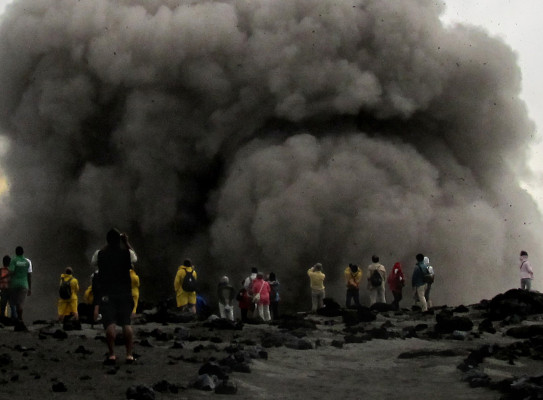
Scientists continue to analyze data.
Life continues on the island.
And yet, the ground beneath Ambae is not entirely quiet.
Whether the current rumblings represent a routine adjustment in the volcano’s internal system or the prelude to a more forceful episode remains uncertain.
That uncertainty is the defining feature of the story.
It resists clean conclusions.
It refuses dramatic closure.
Perhaps the most unsettling aspect is not the possibility of ashfall or evacuation.
It is the reminder that entire communities can be uprooted not by war or politics, but by forces that operate beyond negotiation.
An island can remain visible on maps while becoming temporarily unlivable in practice.
A homeland can be intact structurally and compromised environmentally.
Ambae has done it before.
It could, in theory, do it again.
For now, instruments continue to record faint vibrations.
Scientists continue to publish cautious updates.
Residents continue to farm, to fish, to rebuild routines under a watchful mountain.
There is no dramatic explosion at this moment.
No towering ash column dominating global headlines.
Just a volcano that has already proven its capacity to empty an island — and a population that knows, perhaps better than anyone, how quickly normalcy can dissolve into gray.


