Night of Fire: Iranian Missile Waves Shake Israel, Iron Dome Struggles to Hold the Sky
The Middle East held its breath as waves of Iranian missiles streaked across the night sky toward Israel, triggering air-raid sirens and lighting up the skyline of Tel Aviv in a dramatic escalation of the growing regional war.
What began as another tense evening quickly transformed into a moment of chaos as Israel’s famed missile defense network, including the Iron Dome system, struggled to intercept a mᴀssive barrage launched from Iranian territory and allied positions across the region.
Residents of Tel Aviv described the terrifying moment when the sky erupted in flashes of light as interceptors raced upward to meet incoming projectiles.
For several minutes, the city became a battlefield in the air.
Bright streaks of missile trails crisscrossed the sky while thunderous explosions echoed across the coastal metropolis.
Despite the rapid response of Israel’s defense systems, several missiles penetrated the defensive shield and struck areas near the city, sending shockwaves through residential neighborhoods and igniting fires in multiple locations.
The barrage is believed to be part of Iran’s retaliation following Israeli and allied strikes on Iranian military installations and strategic facilities earlier in the conflict.
Since the outbreak of hostilities, both sides have exchanged increasingly powerful attacks, transforming what was once a shadow conflict into an open confrontation between two of the region’s most powerful militaries.
Iranian state media claimed the missile strikes were aimed at strategic Israeli targets, including military bases, air defense infrastructure, and facilities connected to the Israeli defense establishment.
Some reports suggest that long-range ballistic missiles capable of traveling over 1,000 kilometers were used in the attack.
One such missile, known as the Khorramshahr, can carry a warhead weighing nearly two tons and travel distances of up to 2,000 kilometers, making it capable of striking deep inside Israel from Iranian territory.
The scale of the attack appeared designed to overwhelm Israel’s defensive systems through what military analysts call “saturation strikes.
” Instead of launching a small number of missiles, Iran fired multiple waves of projectiles and drones simultaneously, forcing Israeli defenses to intercept dozens of threats at once.
While the Iron Dome and other layers of Israel’s defense network successfully destroyed many incoming missiles, no system is perfect.
Even Israeli officials acknowledge that interception rates typically range between 80 and 90 percent, meaning that some missiles inevitably slip through.
When those missiles do penetrate the shield, the consequences can be devastating.
In recent attacks, missiles struck residential areas in central Israel, damaging buildings and causing casualties.
In one reported incident, a missile hit a residential block near Tel Aviv, killing at least one person and injuring dozens more as emergency crews rushed to rescue victims trapped beneath rubble.
Across the city, the psychological impact of the barrage was immediate.
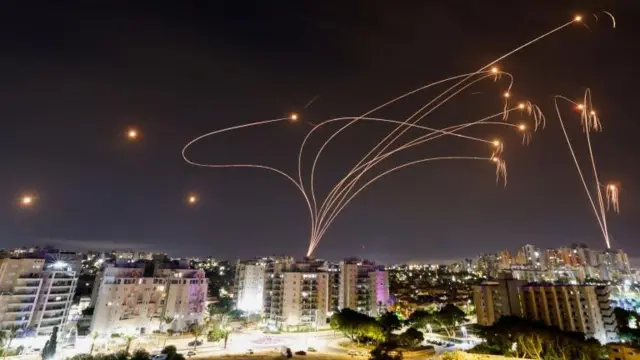
Millions of Israelis rushed into bomb shelters as sirens sounded repeatedly throughout the night.
Parents grabbed children, businesses shut down, and highways briefly emptied as citizens followed emergency instructions to seek protected areas.
The constant wail of warning sirens has become an unsettling soundtrack for daily life during the conflict.
Witnesses reported seeing fragments of intercepted missiles falling through the air like burning debris.
Some fragments crashed into streets and buildings, causing additional damage even when the warheads themselves were destroyed mid-air.
Firefighters battled several blazes sparked by falling debris while medical teams treated the wounded.
According to early damage ᴀssessments, thousands of incidents of destruction have been reported across Israel during the missile campaign, with a significant portion occurring in the Tel Aviv metropolitan area.
Entire apartment buildings have been left shattered, and windows across large sections of the city were blown out by the shockwaves of nearby explosions.
Despite the damage, Israeli officials emphasized that the country’s multi-layered defense system prevented far greater destruction.
The Iron Dome intercepts short-range rockets, while more advanced systems such as David’s Sling and the Arrow intercept long-range ballistic missiles outside the atmosphere.
Working together, these systems create one of the most sophisticated air defense networks in the world.
Still, the sheer volume of missiles launched by Iran has pushed the system to its limits.
Military experts say the strategy is clear: overwhelm the defenses by launching so many projectiles that some inevitably reach their targets.
This tactic has been used in previous conflicts, but the scale of the current barrage represents a dramatic escalation.

International observers fear that the conflict could spread beyond Israel and Iran, drawing in other regional powers and threatening global stability.
Several countries in the Middle East have already raised their security levels, while global markets reacted nervously to the possibility that the war could disrupt oil supplies and maritime trade routes.
Meanwhile, diplomatic efforts to halt the fighting have struggled to gain traction.
Leaders from multiple nations have called for restraint, warning that continued escalation could ignite a wider regional war.
Yet both Iran and Israel remain defiant, each insisting that their actions are necessary for national security.
Back in Tel Aviv, as dawn began to break over the Mediterranean coast, the city slowly emerged from shelters to ᴀssess the damage.
Smoke still rose from several neighborhoods, and shattered glᴀss littered the streets.
Emergency crews continued searching through damaged structures while residents tried to comprehend the scale of the attack.
For many in Israel, the missile barrage marked a turning point.
The war that once seemed distant had now reached the heart of the country’s largest urban center.
And as new sirens threatened to sound at any moment, one question echoed across the region: how far will this conflict go before the world finds a way to stop it?


