MINUTES OF RAIN, HOURS OF CHAOS: THE NIGHT Minas Gerais STOPPED BREATHING
In the early hours before dawn, when most of the lights in Minas Gerais had already gone dark, the rain intensified without ceremony.

It did not arrive with a cinematic thunderclap or a dramatic warning broadcast.
It simply continued — steady, insistent, almost methodical.
By the time residents of Juiz de Fora realized that the sound against their rooftops had shifted from ordinary rainfall to something heavier, something unnervingly sustained, the streets below were already transforming.
At first, it looked manageable.
Water pooled at curbs.
Storm drains gurgled.
Cars slowed but continued moving.
Then, almost imperceptibly, the rhythm changed.
The drains stopped swallowing.
The gutters reversed direction.
What had been runoff became accumulation.
Within minutes, familiar intersections disappeared beneath opaque brown currents reflecting distorted streetlights.
The city’s topography — gentle slopes, compact neighborhoods, hills layered with homes — began working against itself.
Emergency lines started ringing.
Social media filled with short, shaky videos: a backyard wall collapsing, a refrigerator floating through a kitchen, a hillside trembling before surrendering.
In one widely shared clip, a resident’s voice can be heard whispering, not shouting, as if volume might provoke the storm further.
“It’s not stopping,” the voice says.
The camera shakes.
The screen cuts to black.
Authorities would later describe the rainfall as “intense and concentrated.” Meteorologists referenced atmospheric instability and seasonal patterns.
Yet what unfolded in Juiz de Fora and, not long after, in Ubá did not feel like a routine weather event.
It felt orchestrated — not by design, perhaps, but by a sequence of vulnerabilities that had been quietly ᴀssembling for years.
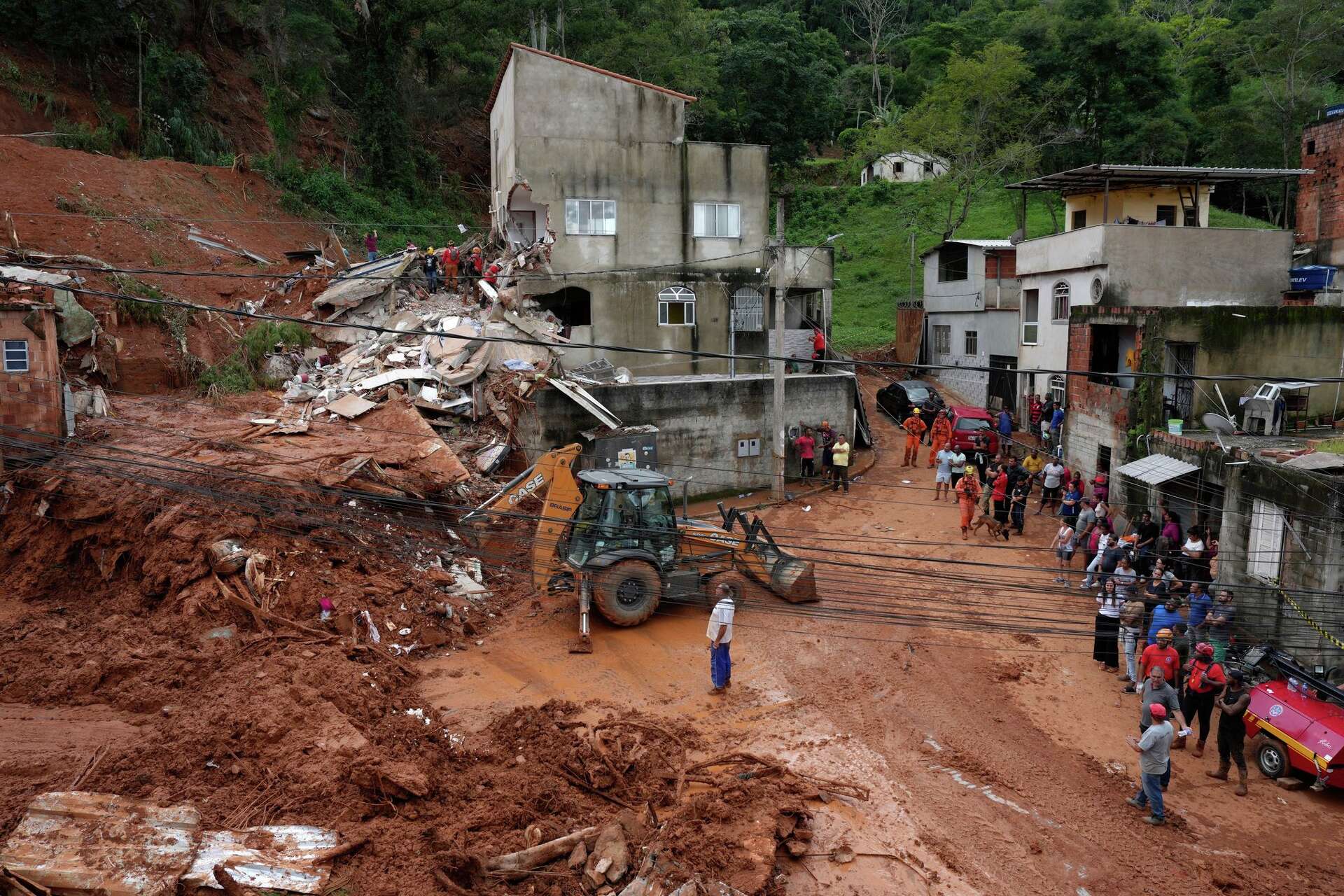
In hillside districts, the first landslides arrived without warning sirens.
Entire sections of earth gave way in low, grinding waves.
Residents described a sound “like furniture being dragged across the sky.
” Mud poured downward, swallowing fences, gardens, and in some cases, the lower floors of homes.
By the time rescue teams reached certain neighborhoods, the geography itself had changed.
What had once been a street corner was now an unrecognizable slope of debris and fractured masonry.
Power outages spread block by block.
In the dark, the rain sounded louder.
Without streetlights, it was impossible to tell where asphalt ended and floodwater began.
Drivers abandoned vehicles mid-road.
Families climbed to upper levels, clutching phones with dwindling battery percentages.
In some areas, mobile networks faltered, isolating pockets of residents from both authorities and each other.
Officials urged calm.
They confirmed flooding.
They acknowledged landslides.
They deployed response teams.
But as the night extended into a gray, waterlogged morning, the scale of paralysis became difficult to contain in cautious language.
Key roads were impᴀssable.
Public transportation stalled.
Schools and businesses announced closures.
Hospitals shifted to emergency protocols.
What was initially described as “localized flooding” expanded into something broader — a disruption that touched nearly every layer of civic life.
And yet, beneath the official updates, a more unsettling conversation began circulating among residents.
ScreensH๏τs of prior weather advisories were reposted and scrutinized.
Some claimed warnings had been issued earlier in the week about soil saturation and drainage overload.
Others insisted that maintenance requests for clogged storm systems had gone unanswered for months.
The tone of these exchanges was not uniform.
Some posts were angry.
Others were speculative.
A few were strangely quiet, as if the authors feared being too explicit.
Infrastructure in Minas Gerais has long existed in tension with its terrain.
Hillside construction, dense urban pockets, and aging drainage systems create a delicate balance even in moderate rainfall.
Urban planners have acknowledged the challenge for years.
Budget constraints, expansion pressures, and competing priorities complicate mitigation efforts.
None of this is secret.
None of it is particularly sensational.
And yet, when water began to rise faster than response teams could reach certain districts, these known constraints took on a different weight.
In Ubá, residents described watching cracks appear in walls before hearing the deeper rumble of soil movement.
One family reported feeling their house tilt slightly before the ground beneath a neighboring property collapsed entirely.
They evacuated seconds before mud filled their living room.
“It didn’t feel like a storm,” one resident said later.
“It felt like the earth deciding something.”
Emergency crews worked through unstable terrain, wary of secondary collapses.
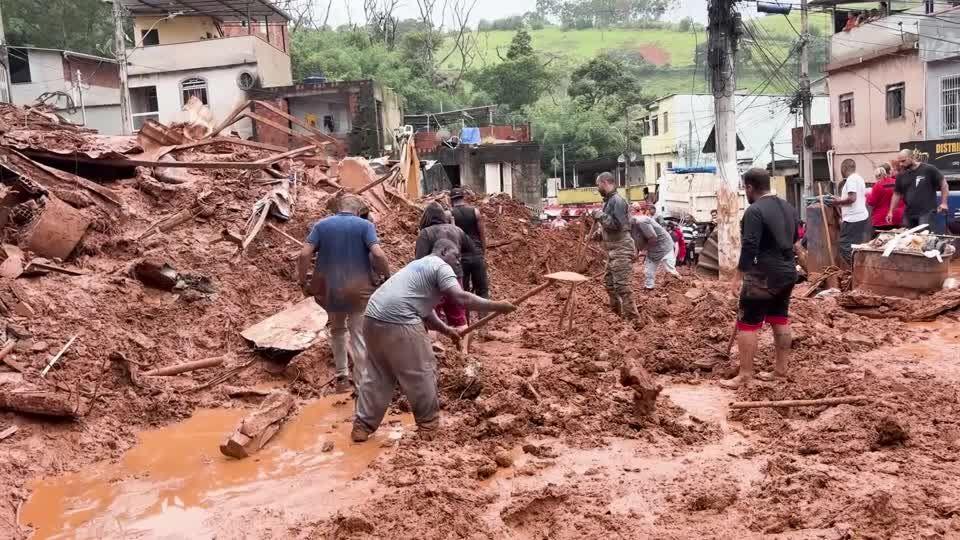
Each landslide risked triggering another.
The rain, though less intense by midday, continued in intermittent bursts, enough to keep soil heavy and unpredictable.
Helicopters hovered where visibility allowed.
Volunteers formed human chains to move debris by hand.
In some areas, access was only possible on foot.
The official casualty figures, updated in careful increments, were met with a mix of relief and suspicion.
Relief that the numbers were not higher.
Suspicion that the full toll — material, psychological, infrastructural — would take far longer to calculate.
Insurance ᴀssessors began their surveys.
Engineers inspected retaining walls and drainage canals.
Politicians issued statements emphasizing solidarity and resilience.
But there was an undercurrent that did not align neatly with press releases.
Residents pointed to newly developed areas on former green slopes.
They referenced construction projects that altered runoff patterns.
They shared before-and-after images of neighborhoods built upward and outward over the past decade.
None of these posts consтιтuted proof of negligence.
Yet together, they formed a collage of doubt.
If rainfall was the trigger, what had made the trigger so sensitive?
Meteorological data confirmed that precipitation levels were high.
Not unprecedented, but concentrated.
Climate researchers have repeatedly warned that extreme weather events are becoming more frequent and more intense across parts of Brazil.
The science is neither fringe nor obscure.
However, translating broad climatic trends into specific urban safeguards is a slow process.
Slower still when budgets are strained and competing crises demand attention.
In Juiz de Fora, some residents began documenting drainage outlets that appeared blocked even after water levels fell.
Others filmed sediment-choked channels that should have diverted runoff away from residential clusters.
City officials promised investigations.
They emphasized that ᴀssessments were ongoing and cautioned against drawing premature conclusions.
The phrase “premature conclusions” appeared often in official communications.
Meanwhile, families sifted through mud-caked belongings.
Schools postponed reopening.
Small business owners calculated losses in silence.
In the hills above the city, fresh scars of exposed earth cut through green vegetation like open wounds.
From a distance, the landscape looked altered in subtle but undeniable ways — a slope slightly steeper, a tree line interrupted, a cluster of houses reduced to uneven foundations.
There were also quieter stories.

An elderly man rescued from a partially collapsed home.
Neighbors who shared generators.
Strangers who opened their doors to displaced families.
These accounts circulated alongside the more contentious narratives, complicating any single interpretation of what had occurred.
Still, a lingering question persisted: was this simply a severe weather event intersecting with difficult geography, or had cumulative oversight amplified its impact?
Urban growth in Minas Gerais has accelerated over recent decades.
Informal housing, formal development, infrastructure retrofits — all layered atop one another.
Each decision rational at the time.
Each compromise understandable in context.
Yet disasters rarely result from a single factor.
They emerge from intersections.
Rain meets terrain.
Terrain meets construction.
Construction meets maintenance schedules.
Maintenance meets budget allocations.
And somewhere in those intersections, risk accumulates.
In Ubá, municipal representatives stated that drainage systems were designed according to existing standards.
Critics countered that standards themselves may be outdated in an era of shifting climate patterns.
Engineers cautioned that even well-maintained systems can fail under extreme conditions.
Environmental advocates argued that deforestation and soil compaction in surrounding areas may have intensified runoff.
None of these explanations cancel the others.
Instead, they overlap in uneasy layers.
As the days pᴀssed, the visual drama of rushing water gave way to the slower, less visible process of accountability.
Committees were proposed.
Audits suggested.
Federal ᴀssistance discussed.
The language became procedural, almost antiseptic.
Yet for those who watched water creep up their staircases in the early hours of that night, the memory remains visceral.
There is something inherently unsettling about floods and landslides.
Fire announces itself.
Wind can be heard building.
But water, especially in urban environments, often advances quietly until it is too late.
Soil shifts beneath foundations without spectacle.
A crack widens.
A slope gives way.
The transformation is both sudden and cumulative.
In Minas Gerais, the rain has stopped.
The skies have cleared intermittently, revealing bright sunlight over neighborhoods still marked by mud lines halfway up exterior walls.
Children step carefully around debris piles.
Workers in reflective vests measure gradients and mark unstable zones.
Life, as it tends to do, is edging forward.
Yet beneath the visible recovery lies a more ambiguous terrain — one defined by questions that have not fully settled.
How much of the damage was inevitable? How much was preventable? And perhaps most unsettling of all: if similar rainfall returns next season, will the outcome be different?
Officials maintain that lessons are being learned.
Residents are not uniformly convinced.
The hills remain.
The drainage channels remain.
The memory of that night — the relentless rain, the trembling ground, the moment when familiar streets dissolved into opaque currents — remains as well.
Disasters often fade from headlines once the immediate crisis subsides.
Reconstruction becomes incremental.
Attention shifts elsewhere.
But in Juiz de Fora and Ubá, the altered slopes and repaired walls stand as quiet reminders that vulnerability is rarely created overnight.
It accumulates.
It waits.
And sometimes, all it takes is a few unbroken hours of rain to expose everything that had been resting just beneath the surface.


