America’s Lifeline Under Stress: The Mississippi River’s Alarming Changes
For centuries, the Mississippi River has shaped the economy, geography, and history of the United States.
Stretching more than 2,300 miles from Minnesota to the Gulf of Mexico, the river drains about 41% of the continental United States, connecting 31 states and two Canadian provinces into one enormous watershed.
It carries hundreds of millions of tons of cargo every year, supports major cities and ports, and provides drinking water to millions of people.
But in recent years, something unusual—and worrying—has begun to happen.
The Mississippi is reaching water levels that engineers once believed were almost impossible.
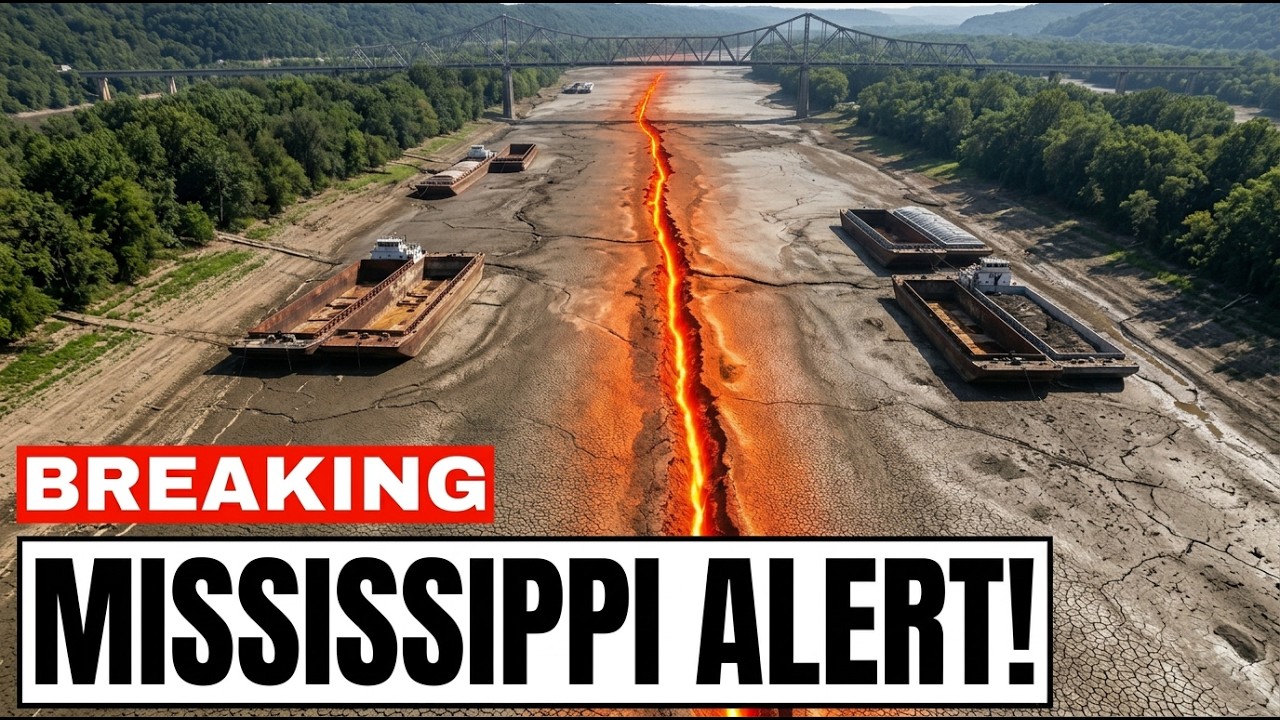
In October 2022, the river near Memphis dropped to –10.81 feet, the lowest level recorded since modern measurements began in 1954.
Just one year later, the record fell again, plunging to –12.04 feet.
Across a 270-mile stretch of the river, multiple gauges recorded their lowest readings ever.
The consequences were immediate.
Barge traffic slowed dramatically as sections of the river became too shallow for safe navigation.
At one point, more than 2,000 barges were stranded or delayed, disrupting the movement of agricultural products, coal, and other critical cargo.

Shipping costs surged as well.
The cost of transporting a single ton of grain jumped from roughly $11 to more than $70, putting enormous pressure on farmers and exporters who depend on the river.
But the low water levels created another threat that many Americans had never considered: saltwater intrusion.
Normally, the powerful flow of the Mississippi pushes Gulf of Mexico saltwater far out to sea.
However, when river flow drops too low, dense saltwater can creep upstream along the riverbed.
In recent years, that saltwater wedge has moved as far as 70 miles inland, threatening drinking water supplies for communities near the river’s mouth.
In some areas, salt concentrations reached 1,600 parts per million, far above the U.S. Environmental Protection Agency’s recommended limit of 250 parts per million for drinking water.
Cities like New Orleans face a particular challenge because their water treatment plants were never designed to remove large amounts of salt.
To slow the advance, the U.S. Army Corps of Engineers has built emergency underwater barriers made from dredged sediment.
These barriers temporarily block the heavier saltwater from moving further upstream—but they are only a short-term solution.
To understand why these problems are emerging, experts point to more than a century of engineering changes along the river.
After the catastrophic Mississippi flood of 1927, the U.S. government launched one of the largest river control projects in history.
Thousands of miles of levees and floodwalls were built to contain the river, while dams and reservoirs were constructed on major tributaries.
These projects dramatically reduced flood damage and allowed cities and industries to expand safely along the riverbanks.
But controlling a river of this size comes with long-term consequences.
When levees prevent the Mississippi from spilling onto its natural floodplain, the river’s current speeds up.
Faster water scours the riverbed and banks, deepening the channel over time.
Meanwhile, large dams along the Missouri River trap enormous amounts of sediment—material that historically flowed downstream to build and replenish the Louisiana coastline.
Before the 20th century, the Mississippi delivered roughly 400 million metric tons of sediment each year to the Gulf Coast.
Today, that number has dropped to around 145 million tons, a decrease of more than 60%.
Without that sediment, coastal wetlands and barrier islands are disappearing.
Louisiana has lost more than 2,000 square miles of land since the 1930s, making it one of the fastest-eroding coastlines on Earth.
Another hidden factor lies beneath the ground.
The Mississippi Embayment Aquifer, a vast underground water system beneath several southern states, has been heavily pumped for agriculture and industry for more than a century.
In some regions, groundwater levels have dropped by over 100 feet.
This depletion can weaken the natural connections between rivers and aquifers, sometimes causing rivers to lose water into the ground rather than receive it.
The Mississippi is therefore being stressed from multiple directions at once—drought, reduced sediment supply, coastal erosion, and groundwater depletion.
Adding to the complexity is one of the most important structures on the river: the Old River Control Structure in Louisiana.
Built in the 1960s, it regulates how much water flows down the Mississippi and how much diverts into the Atchafalaya River.
Without it, the Mississippi would likely take the shorter, steeper route to the Gulf through the Atchafalaya basin.
If that happened, cities like Baton Rouge and New Orleans could lose their position on the main river channel, dramatically reshaping shipping routes and regional economies.
Engineers monitor the structure carefully because of the enormous pressure placed on it during major floods.
In 1973, powerful floodwaters nearly undermined part of the structure by carving a mᴀssive hole beneath it.
Emergency repairs prevented disaster, but the incident revealed how fragile the system could be under extreme conditions.
Today, climate variability is making those extremes more frequent.
Floods that historically occurred once every two decades now appear roughly every few years in some parts of the basin.
At the same time, drought conditions have become more severe and widespread.
These swings between high and low water are forcing engineers to rethink how the Mississippi should be managed in the future.
Despite the alarming headlines, experts emphasize that the river system is not collapsing overnight.
Mᴀssive infrastructure networks still protect cities, control floods, and keep the river navigable.
But the events of recent years serve as a warning.
The Mississippi River is not simply a channel of water—it is a living system shaped by geology, climate, and human engineering.
As those forces continue to change, the strategies used to manage the river must evolve as well.
For a waterway that supports millions of people and a huge portion of the American economy, understanding those changes has never been more important.


