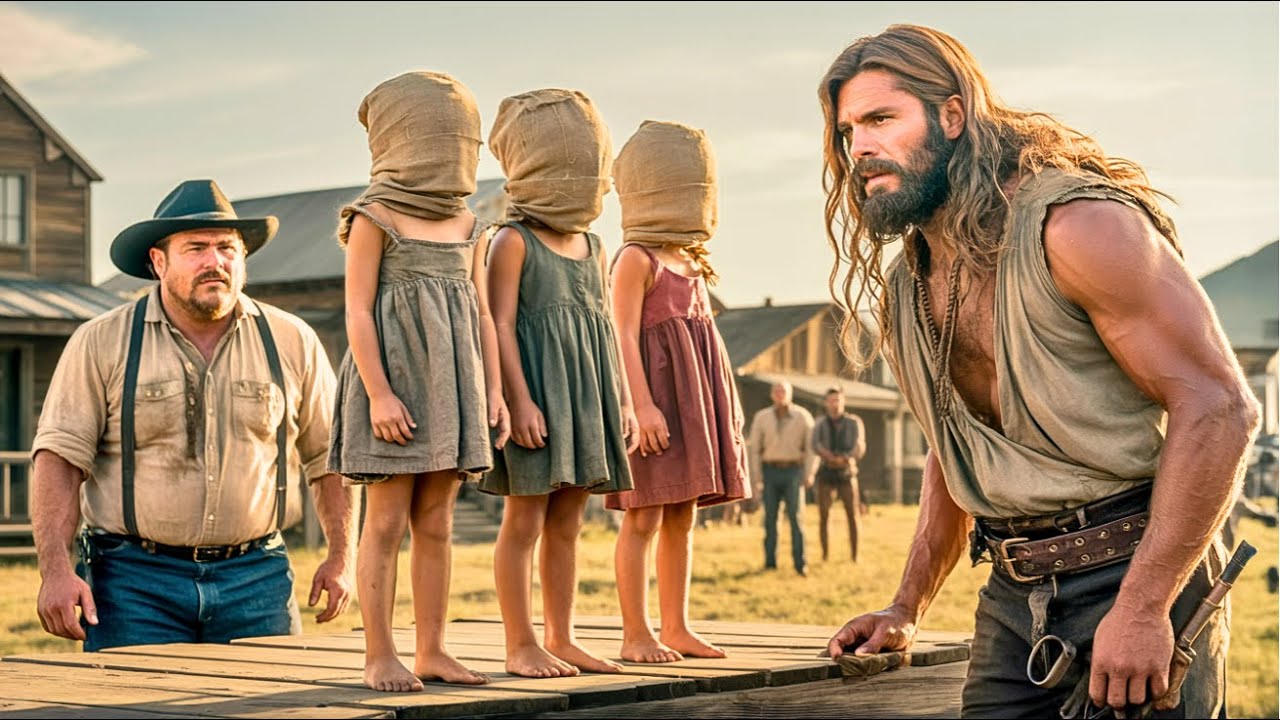
Sometimes the hardest thing in life is watching someone else’s pain and doing nothing about it. That’s exactly what mountain man Josiah Hail faced when he came down from his cabin after 7 years of living alone. He only needed supplies: salt, coffee, bullets, simple things. But in the town square, he found three little girls being sold like cattle. They were sisters, maybe 5 years old, with burlap sacks covering their heads like they were nothing more than property. Through the rough cloth, you could hear them crying, holding hands so they wouldn’t lose each other. The town’s meanest rancher, Vernon Slade, wanted to buy them and split them apart. Everyone was too scared to stop him. Josiah had barely enough money to feed himself through winter. He could have walked away, minded his own business like he had for years. But sometimes a man reaches a moment where staying silent isn’t an option anymore.
The morning sun cast long shadows across the Colorado territory as Josiah Hail made his way down the winding mountain trail for the first time in seven years. His boots, worn thin from countless miles of hunting and trapping, found familiar purchase on the rocky path that led to Cedar Ridge. The leather pouch at his side contained his last coins: enough for salt, coffee, and ammunition if he was careful. Nothing more.
He paused at the overlook where the trail bent sharply downward, offering a clear view of the valley below. Cedar Ridge sprawled along the creek bed like a collection of toy buildings, its weathered storefronts and dusty streets a stark reminder of the world he’d left behind. Smoke rose from a dozen chimneys, carrying the scent of wood fires and breakfast cooking. For most men, it would have been a welcome sight after months of solitude. For Josiah, it felt like descending into a past he’d spent seven years trying to forget.
The weight of his worn leather Bible pressed against his chest from inside his coat pocket. He’d carried it every day since Martha and the children died, though he hadn’t opened it in just as long. Once, those pages had been his guide, his comfort, his very purpose. Reverend Josiah Hail had stood before congregations in three different towns, spreading the word of hope and redemption with the fervor of a true believer. That man felt like a stranger now.
The fever had taken them in the span of a week. First little Samuel, barely 3 years old, then baby Rebecca, and finally Martha herself. She’d fought the longest, tending to the children even as the sickness consumed her own strength. Josiah had prayed harder than he’d ever prayed in his life, promising God anything, everything, if He would just spare his family. But God, it seemed, had other plans.
After the funerals, Josiah had packed what little he could carry and disappeared into the mountains. The cabin he’d built with his own hands sat tucked against a granite cliff, sheltered from the worst winds and hidden from prying eyes. For seven years, he’d lived off the land, hunting deer and elk, trapping beaver and fox, gathering wild herbs and berries. The mountain had become his church, the forest his congregation. It was a hard life, but it was honest. The mountain didn’t make promises it couldn’t keep.
His daily routine had become a meditation of sorts: rise before dawn, check the traps, tend the small garden he’d carved from the rocky soil. In winter, he’d spend long hours by the fire, mending equipment and reading the few books he’d brought—mostly practical volumes on hunting, trapping, and wilderness survival. The Bible remained unopened, a reminder of faith that no longer felt accessible.
But now, necessity had driven him down from his sanctuary. Winter was coming early this year. He could feel it in the way the wind carried frost even in late August. His supplies were running dangerously low, and the small cache of pelts he’d saved might fetch enough coins for the basics he needed to survive another season.
Cedar Ridge had changed in his absence, though not for the better. Where once it had been a thriving mining town, now it wore the look of a place slowly dying. Half the storefronts stood empty, their windows dark and dusty. The people he pᴀssed on the street moved with the cautious shuffle of folks who’d learned to keep their heads down. Children played in the shadows rather than the open squares, and conversation stopped abruptly when strangers approached.
The reason for this transformation became clear as Josiah tied his horse to the hitching post outside Henderson’s general store. A mᴀssive man in an expensive suit emerged from the bank across the street, flanked by two hired guns whose hands never strayed far from their weapons. Vernon Slade commanded attention without demanding it. His presence alone seemed to shrink the world around him.
Slade owned the largest ranch in three counties, built on land acquired through methods that didn’t bear close examination. He controlled the water rights, the grazing permits, and most of the town council. What Vernon Slade wanted, Vernon Slade got, and woe to anyone foolish enough to stand in his way. The people of Cedar Ridge had learned this lesson well.
Josiah pushed through the door of Henderson’s store, a small bell announcing his arrival. The proprietor, a thin man with kind eyes and prematurely gray hair, looked up from his ledger with surprise.
“Well, I’ll be blessed,” old man Henderson said, his voice carrying genuine warmth. “Josiah Hail, as I live and breathe. Thought you might have froze to death up there in the mountains.”
“Not yet,” Josiah replied, managing a slight smile. “Though winter’s coming early this year.”
Henderson nodded knowingly. “Feel it in my bones, too. What can I do for you?”
Josiah placed his small bundle of pelts on the counter. “Need to trade these for supplies. Salt, coffee, ammunition if you’ve got it.”
The storekeeper examined the furs with an expert eye, running his fingers through the thick beaver pelts and testing the softness of the fox skins. “Fine quality, as always. You always did have a gift for the trapping.”
As Henderson calculated the value, Josiah’s attention was drawn to voices outside—a crowd gathering in the town square. Through the window, he could see people forming a circle around a raised platform that hadn’t been there when he’d arrived.
“What’s all the commotion?” he asked.
Henderson’s expression darkened. “Auction day, though it ain’t the kind of auction decent folks should have to witness.”
“What kind of auction?”
The older man’s hands stilled on the pelts. “The Wittman family—good people, ran the orphanage on the hill. Both took sick with the consumption last month. Left behind three little girls. Triplets, no more than 5 years old. Sweet as angels, they are.”
Josiah felt something cold settle in his stomach. “And they’re being auctioned?”
“County says they can’t afford to keep ’em. Got to find ’em homes. And the only way to guarantee someone will take responsibility is to make it official-like. Of course, everybody knows who’s got the only real money around here to bid.”
Through the window, Josiah could see Vernon Slade approaching the platform, his expensive boots clicking on the wooden planks. Even from a distance, there was something predatory in the man’s movements, like a wolf circling wounded prey.
“Slade wants them?” Josiah asked, though he already knew the answer.
Henderson nodded grimly. “Says he needs workers for his ranch. Plans to split them up, send each one to a different part of his operation. Claims it’ll build character, teach ’em independence.”
The cold in Josiah’s stomach turned to ice. He’d heard stories about Slade’s workers—people who went to his ranch and were rarely seen in town again. The man treated human beings like livestock, and now he wanted to get his hands on three innocent children.
“Ain’t nobody going to bid against him?” Josiah asked.
“With what money? And even if they had it, you think they’d risk crossing Vernon Slade? The man owns half the county and has the other half too scared to breathe sideways.”
Outside, the auctioneer, a nervous little man who kept glancing at Slade for approval, began calling for the crowd’s attention. The three little girls stood on the platform, burlap sacks over their heads like they were nothing more than grain to be sold. Through the rough cloth, Josiah could hear their quiet sobs, and something inside his chest began to crack.
“How much for the pelts?” he asked, his voice тιԍнт.
Henderson looked at him with concern. “Josiah, these are prime furs. Worth maybe $40, all told. But that ain’t near enough to—”
“How much? $40. But son, you can’t be thinking what I think you’re thinking. Slade’s got ten times that much money, and he don’t take kindly to being crossed.”
Josiah was already reaching for his coins, adding them to the payment for his furs. “Give me what I can get for everything. All of it.”
“But the supplies you needed—”
“Forget the supplies.”
Henderson stared at him for a long moment, then slowly shook his head. “You always were too stubborn for your own good, even when you was preaching at the church. But Josiah, this is different. This is Vernon Slade we’re talking about. He’ll crush you like a bug.”
“Maybe. But I can’t stand here and watch those children get sold like cattle. Some things are more important than playing it safe.”
The storekeeper studied Josiah’s face and saw something there that made him straighten his shoulders. Slowly, he counted out $43—every penny the pelts and Josiah’s remaining coins were worth.
“God help you, son,” Henderson whispered. “And God help those little girls.”
Josiah pocketed the money and walked toward the door. As his hand touched the handle, he could hear the auctioneer’s voice carrying across the square.
“Let’s start the bidding at $10 for the lot. Do I hear $10?”
Without hesitation, Vernon Slade’s voice boomed across the crowd. “$20. And I’ll take them separately. More useful that way.”
Josiah stepped into the sunlight and saw the three small figures on the platform, their hands somehow finding each other despite the sacks covering their faces. They were holding on to each other like it was the only thing keeping them anchored to the world.
Seven years of hiding in the mountains had taught him many things. But chief among them was this: running away from pain didn’t make it disappear. It just meant you carried it with you wherever you went. These children didn’t deserve to carry that kind of pain. Not if he could help it.
He began walking toward the auction platform, each step feeling like a return to the man he used to be—or maybe the man he was meant to become. The leather Bible in his pocket seemed to grow heavier with each stride, as if it were waking up after a long sleep. Behind him, Henderson stood in the doorway of his store, watching a hermit transform back into a preacher with $43 and a heart full of righteous anger.
The mountain had been Josiah’s sanctuary, but sanctuary was meant to prepare a man for the battles that mattered. And this—this mattered more than anything had in seven long years.
The crowd parted as Josiah approached the auction platform, conversations dying to whispers as people recognized the mountain hermit who hadn’t been seen in town for 7 years. His weathered face and wild beard drew curious stares, but it was the determined set of his shoulders that made folks step aside.
Vernon Slade stood near the front, his expensive suit a sharp contrast to the rough work clothes of everyone else. He’d already claimed his territory, positioning himself where the auctioneer could see him clearly. His two bodyguards flanked him like bookends, their hands resting casually on their gun belts.
On the platform, the three little girls huddled together in a way that broke Josiah’s heart. The burlap sacks covering their heads were crude and degrading, as if whoever had put them there wanted to strip away their humanity before the sale began. But even through the rough cloth, their small hands had found each other, creating a chain of comfort in the midst of their terror.
“Do I hear $25?” the auctioneer called, his voice nervous and thin. He was a small man with thinning hair and the look of someone who’d rather be anywhere else.
“$25,” Slade responded immediately, his voice carrying the confidence of a man who’d never been outbid for anything he wanted.
The auctioneer scanned the crowd hopefully. “$25 going once. Any other bidders?”
Silence stretched across the square like a held breath. Josiah could see the faces around him—good people, most of them, but people who’d learned that crossing Vernon Slade was a luxury they couldn’t afford. They had families to protect, businesses to maintain, debts that needed paying. Standing up to power was a risk few could take.
But Josiah had no business to lose, no family left to endanger. He had nothing but $43 and a conscience that wouldn’t let him walk away.
“$30,” he called out, his voice cutting through the silence like a blade.
Every head in the crowd turned toward him. The auctioneer blinked in surprise, and even Slade turned to see who dared challenge him. When the rancher’s eyes found Josiah, his expression shifted from surprise to something darker.
“Well, now,” Slade said, his voice carrying easily across the square. “If it isn’t the mountain hermit. Thought you died up there in them hills.”
Josiah didn’t respond. His attention was fixed on the three small figures on the platform. One of them had turned her head slightly toward his voice, and he could see a tiny corner of her face beneath the burlap—a glimpse of pale skin and what might have been hope.
“$30,” the auctioneer repeated, his voice gaining strength. “Do I hear $35?”
Slade’s jaw тιԍнтened almost imperceptibly. “$40.”
“$42,” Josiah countered immediately.
A murmur ran through the crowd. Someone in the back whispered, “He’s actually bidding against Slade.” The comment carried a mixture of admiration and concern, as if they were watching a man step deliberately into the path of a stampeding bull.
Slade turned fully toward Josiah now, his eyes narrowing as he took in the hermit’s worn clothes and determined expression. “You got $42, mountain man? That’s more money than most folks in this town see in a month.”
“I got what I got,” Josiah replied calmly. “Question is, are you bidding or just talking?”
The crowd held its collective breath. Nobody spoke to Vernon Slade that way. The rancher’s face flushed red above his expensive collar, and his bodyguards shifted nervously.
“$50,” Slade snapped, his voice hard as winter.
The auctioneer looked hopefully at Josiah, but everyone could see the math. $50 was more than the hermit could possibly have. The brief moment of rebellion was over, and the natural order would be restored.
Josiah felt the weight of every eye in the square. He thought of his cabin in the mountains, of the long winter ahead, of the supplies he’d needed that would now go unbought. $50 was indeed more than he had.
But then one of the little girls on the platform made a small sound—not quite a sob, but close enough—and something inside Josiah’s chest caught fire.
“$50,” he said quietly, “to split up three sisters who’ve already lost everything else in the world.”
The crowd stirred uneasily. There was something in Josiah’s tone that carried beyond the auction, beyond the money, into territory that made everyone uncomfortable.
“This is an auction, not a sermon,” Slade said coldly. “You got $50 or not?”
Josiah stepped closer to the platform, close enough that the little girls could hear him clearly. “I don’t got $50,” he said, his voice carrying to every corner of the square. “But I got $43 and something you ain’t got, Slade.”
“And what’s that?”
“A reason to care whether these children sleep safe at night.”
The silence that followed was different from before—heavier, weighted with the kind of truth that makes people shift uncomfortably and look at their shoes. Even Slade’s bodyguards seemed affected by it. But Slade himself just laughed, a sound like breaking glᴀss.
“$43 it is, then. Too bad it ain’t enough.” He turned to the auctioneer. “$50 stands.”
The auctioneer raised his gavel. “$50 going once—”
“Wait.”
The voice came from the crowd, thin but determined. Old man Henderson pushed through the circle of people, his weathered hands shaking slightly as he pulled out a small leather pouch.
“I got $7,” he said loudly. “I’m adding it to his bid.”
A gasp ran through the crowd. Henderson was risking his business, his livelihood—everything he’d built over 30 years of honest work.
“That makes $50,” Henderson continued, his voice getting stronger. “$50 to keep three little girls together.”
For a moment, Vernon Slade looked genuinely shocked. Then his expression hardened into something ugly.
“$51,” he said coldly.
“$52.”
This voice came from Martha Hullbrook, the seamstress, who stepped forward with a handful of coins clutched in her fist. “These children deserve better than being treated like livestock.”
“$53.” Tom Bradley, the blacksmith. His mᴀssive arms crossed over his chest. “Got a daughter myself. Can’t stand by and watch this.”
One by one, people began stepping forward. A quarter here, 50 cents there. Coins pulled from pockets and purses with the desperate urgency of people who’d finally found something worth risking everything for.
“$55,” the growing group called out together.
Slade’s face had gone from red to purple. “$60,” he snarled.
The crowd fell silent again. $60 was more than most of them made in three months combined. The brief moment of unity flickered like a candle in the wind.
But then the smallest of the three girls on the platform spoke for the first time. Her voice was muffled by the burlap, but clear enough to reach every ear in the square.
“I want to stay with my sisters.”
It was such a simple statement, delivered with the heartbreaking dignity of a child who’d already lost too much. The crowd stirred, and Josiah saw something he hadn’t seen in 7 years: the face of God reflected in the willingness of ordinary people to do extraordinary things.
“$61,” called out the town doctor.
“$62,” added the minister’s wife.
“$63,” this time from the barber.
Slade whirled on the crowd, his composure finally cracking. “You fools don’t know what you’re doing. I can make life very difficult for people who cross me.”
“And what about children who cross you?” Josiah asked quietly. “What kind of life you planning for three little girls who’ve already been through hell?”
The question hung in the air like smoke. Everyone knew the stories about Slade’s ranch—about workers who went there and were never quite the same afterward.
“$65,” the crowd called out, the number coming from a dozen voices at once.
Slade looked around the square and saw something that clearly unnerved him: an entire community united against his will. These people had been afraid of him for years. But fear was proving less powerful than love.
“This ain’t over,” he said, his voice low and dangerous. He turned on his heel and stalked away, his bodyguards trailing behind like shadows.
The auctioneer, visibly relieved, brought his gavel down. “Sold to—” he paused, looking uncertainly at the crowd.
“To Josiah Hail,” Henderson called out. “The girls go with Josiah.”
As the crowd began to disperse, people pressed coins into Josiah’s hands. Not just the money they’d pledged, but extra coins, supplies for the journey, warm wishes for the children. It was as if the entire town had suddenly remembered what it meant to be a community.
Josiah climbed onto the platform and knelt beside the three little girls. Gently, carefully, he removed the burlap sacks from their heads, revealing three tear-stained faces that looked up at him with a mixture of fear and desperate hope.
The smallest girl, her blonde hair matted against her head, looked directly into his eyes and spoke the words that would change his life forever.
“Are you going to keep us together?”
“Yes,” Josiah said, his voice thick with emotion. “I promise you that. Whatever happens, you three stay together.”
For the first time in 7 years, Josiah Hail felt like he was exactly where God meant him to be.
The wagon wheels creaked rhythmically as they climbed the mountain trail, each turn taking them further from Cedar Ridge and deeper into the wilderness that had been Josiah’s home for 7 years. The three little girls sat huddled together on the wagon bed, wrapped in blankets that Martha Hullbrook had pressed into Josiah’s hands along with a basket of food and stern instructions about keeping children warm and fed.
Their names he’d learned were Faith, Hope, and Grace. Fitting names for children who’d need all three in abundance.
Faith was the oldest by mere minutes, her serious brown eyes taking in everything around them with the watchful intensity of someone who’d learned too young that safety was never guaranteed. Hope had hair the color of summer wheat and a stubborn set to her small jaw that reminded Josiah of Martha when she’d decided something. Grace, the smallest and most fragile looking, clutched a tattered cloth doll that had somehow survived their ordeal—the only possession they had left from their life before.
The doll was a pitiful thing. Its face worn smooth by countless nights of being held тιԍнт against fear and loneliness. One arm hung by threads, and the blue dress had faded to gray. But Grace protected it like a treasure. When Josiah had helped the girls into the wagon, she’d whispered that the doll’s name was Rosie, and that she was very brave.
“Where are we going?” Faith asked as they rounded another switchback. It was the first full sentence any of them had spoken since leaving town.
“Home,” Josiah replied, though the word felt strange in his mouth. He’d been thinking of the mountain cabin as a hideout, a place to lick his wounds in private. The idea of it becoming a home—their home—was something he hadn’t quite wrapped his mind around yet.
“What’s it like?” Hope asked, peering over the edge of the wagon at the drop-off that fell away into shadow.
“Quiet,” Josiah said. “Got a good view of the valley. Creek runs right past the front door, so we’ll never want for fresh water.”
He didn’t mention that the cabin had only one room, or that his bed was a simple cot built into the wall, or that he’d never cooked for anyone but himself. He didn’t mention that he had no idea how to care for three traumatized children, or that his supplies were now so low they might all starve before winter ended.
“Are there bears?” Grace asked, her voice so soft he almost missed it.
“Some. But they mostly keep to themselves if you don’t bother them. Same as most folks up here.”
Faith studied his profile as he drove. “Are you ‘most folks’?”
The question caught him off guard. “I reckon I am. Been living alone up here for a long time.”
“Why alone?” Hope asked.
Josiah felt the weight of the leather Bible in his coat pocket, still unread after all these years. “Sometimes a man needs quiet to think things through.”
“What things?” Faith pressed, her serious eyes never leaving his face.
He glanced back at them—three small faces looking at him with the expectant trust of children who’d already lost everything once and were trying to decide if they could afford to hope again.
“Lost my family a while back,” he said simply. “Took some time to figure out how to keep going after that.”
The girls absorbed this information in silence. Finally, Grace spoke up.
“We lost our family, too.”
“I know. I’m sorry for that.”
“The sickness took our mama and papa,” Hope said matter-of-factly. “And then the mean lady at the county office said we had to be split up because nobody wanted three children all at once.”
“Well, that lady was wrong,” Josiah said firmly. “About the last part, anyway.”
As they climbed higher, the air grew thinner and cooler. The girls had never been this far up a mountain before, and their eyes grew wide at the vast distances that opened up below them. When they finally crested the last ridge and saw the valley spread out like a green carpet dotted with silver streams, all three gasped in wonder.
“It’s like looking down on the whole world,” Faith whispered.
“Pretty near,” Josiah agreed. “On clear days, you can see all the way to the next territory.”
The cabin sat in a natural clearing backed up against a granite cliff that provided shelter from the worst storms. It was solidly built. Josiah had spent months selecting each log, chinking every gap, ensuring the roof would shed rain and snow with equal efficiency. But as he looked at it now through the children’s eyes, he saw how small and spare it really was.
“It’s cozy,” Hope announced with determined optimism.
“That’s one word for it,” Josiah muttered as he helped them down from the wagon.
Inside, the cabin was even smaller than it appeared from outside. His cot occupied one corner. A rough table and two chairs filled the center, and his few possessions—cooking pot, rifle, traps, and books—took up the rest of the available space. There was nowhere for three children to sleep, nowhere for them to keep their belongings, nowhere for them to simply exist without being in each other’s way constantly.
Faith surveyed the space with the practical eye of someone who’d learned to make do with less. “We can sleep on the floor. We don’t mind.”
“You won’t be sleeping on any floor,” Josiah said gruffly. “I’ll figure something out.”
Grace had wandered over to his small collection of books, running her fingers along the spines. “Do you know how to read?” she asked.
“Some.”
“Could you teach us? Mama was teaching us letters before she got sick.”
Josiah looked at the three small faces turned toward him expectantly and felt something shift in his chest—a rusty mechanism clicking into place after years of disuse.
“I reckon I could manage that.”
As evening approached, he set about preparing what he hoped would pᴀss for supper. His usual meal of beans and salt pork seemed inadequate for children, so he opened one of the jars of preserves that Martha Hullbrook had packed, spreading it on thick slices of bread that Henderson had contributed. The girls ate in polite silence, clearly hungry but too well-mannered to complain about the simple fare.
When they were finished, Faith cleared the plates without being asked, while Hope helped Grace wash her face and hands in the basin by the door.
“Where do we sleep?” Grace asked as darkness settled over the mountain.
Josiah looked at his narrow cot and the hard floor, then at three exhausted children who’d been through more upheaval in one day than most people experienced in a lifetime.
“Tell you what,” he said. “How about you three take the bed tonight, and I’ll make do with a bedroll by the fire.”
“All three of us?” Hope asked, her eyes widening.
“Might be a little crowded, but you’ll be warm.”
As he helped them settle under his thick woolen blankets, Grace looked up at him with eyes that seemed far too old for her small face.
“Mr. Josiah,” she whispered.
“Just Josiah. Don’t need the mister.”
“Are you going to keep us? Really keep us?”
The question hit him like a physical blow. In her voice, he heard every abandoned child who’d ever asked that question, every broken promise that had taught her not to hope too hard.
“I gave you my word,” he said quietly. “And where I come from, a man’s word is his bond.”
She smiled then—the first real smile he’d seen from any of them—and clutched her tattered doll closer as the fire settled into embers and the children’s breathing grew deep and even.
Josiah sat in his chair and wondered what in God’s name he’d gotten himself into. Three children. Three little girls who needed food, shelter, clothing, education, love, and about a hundred other things he had no idea how to provide.
Outside, an owl called from the darkness, and the night sounds of the mountain settled around the cabin like a familiar blanket. Tomorrow would bring its own challenges. But tonight, for the first time in 7 years, Josiah Hail wasn’t alone. And despite his fears, despite the practical impossibility of what he’d undertaken, it felt like the most right thing he’d done in a very long time.
The first week at the cabin established a rhythm that surprised Josiah with its naturalness. The girls rose with the sun, as children do, and by the time he’d stoked the fire and started coffee, they were already dressed and ready for whatever the day might bring. Faith had appointed herself the leader, making sure Hope and Grace washed their faces and combed their hair before breakfast. Hope proved to be curious about everything, asking endless questions about mountain life, wildlife, and how things worked. Grace, the quietest of the three, seemed content to observe and absorb, though she never let her precious doll Rosie out of her sight.
On the third morning, Josiah woke to find Faith already up, trying unsuccessfully to restart the fire from the cold ashes.
“Here,” he said gently, kneeling beside her. “Fire’s got to breathe, same as you and me. You’re smothering it with too much kindling.”
He showed her how to build a proper fire: tinder first, then kindling, then gradually larger pieces of wood. Her small hands were surprisingly steady as she followed his instructions. And when the flames finally caught and began to grow, her face lit up with pride.
“Can you teach Hope and Grace, too?” she asked.
“Of course. Mountain living, everybody needs to know these things.”
That afternoon, he found himself carving three small wooden spoons from a piece of seasoned pine. It started as a practical necessity—they only had two spoons between them. But as he worked, shaping each handle to fit small fingers, it became something more. When he presented them after supper, carefully sanded smooth and rubbed with bear oil, the girls’ faces shone as if he’d given them precious jewels.
“They’re beautiful,” Grace whispered, turning hers over in her hands. “Did you make these just for us?”
“Seemed like you needed your own,” Josiah said, trying to keep the emotion out of his voice. “Every person ought to have their own spoon.”
Hope immediately began using hers to eat the last of her preserves, making an elaborate production of each bite. Faith studied the grain patterns in the wood, running her finger along the smooth curves. Grace held hers against her chest like another treasured possession.
“Thank you, Papa Josiah,” she said softly.
The words stopped him cold. Papa Josiah. When had that happened? When had he become a father figure to these children instead of just a temporary caretaker?
The answer came to him as he watched Hope demonstrate proper spoon technique to her doll, as he saw Faith carefully place all three spoons in a special spot by the wash basin, as Grace fell asleep that night with both Rosie and her new spoon clutched in her arms. It had happened gradually, naturally, the way all the best changes did.
But with that realization came a darker one. Vernon Slade wasn’t the type of man to accept defeat gracefully—especially not a public defeat that had made him look weak in front of the entire town. Twice now, Josiah had spotted riders on the trail below the cabin, too far away to make out faces, but close enough to know they were being watched.
The visits became more obvious as the week progressed. On Friday, a man Josiah didn’t recognize appeared at Henderson’s store, asking casual questions about “the hermit who’d taken in the orphan girls.” On Saturday, Tom Bradley mentioned that strangers had been inquiring about mountain trails and the best routes to reach the high country.
Sunday brought the message Josiah had been expecting. Faith found it nailed to a tree near their creek: a piece of paper with block letters that read, “Those girls don’t belong to you. Send them back where they came from, or you’ll regret it.”
Josiah read the note twice, then folded it carefully and tucked it into his shirt pocket. Faith watched with the serious expression that had become familiar to him.
“Bad news?” she asked.
“Nothing I can’t handle.”
“Is it about us?”
He looked down at her upturned face, so young but already marked by loss and uncertainty. Lying to her would be easy, but it wouldn’t be right. These children had already been deceived by adults too many times.
“There’s a man who’s not happy about you living here with me. He might try to cause trouble.”
“Mr. Slade?”
Josiah raised his eyebrows. “You know about him?”
“We heard people talking at the orphanage before Mama and Papa Wittman got sick. They said Mr. Slade was mean to people who worked for him, and that children who went to his place were never happy.”
Josiah felt a cold anger settle in his chest. “Well, you don’t have to worry about going to his place. You’re staying right here with me.”
“Promise?”
“I promise.”
That evening, after the girls had gone to bed, Josiah sat by the fire cleaning his rifle. It had been years since he’d needed it for anything more than hunting, but some skills a man never forgot. He checked the action, counted his ammunition, and tried to calculate how long they could hold out if trouble came calling.
The next morning, Hope made a discovery that changed everything. She was exploring near the wood pile when she called out excitedly, “Papa Josiah, come look at this!”
He found her crouched beside a flat stone, pointing at something carved into its surface. At first glance, it looked like random scratches. But as he studied it more closely, he realized it was a crude map: lines representing trails, X’s marking specific locations, and what appeared to be measurements or distances.
“Where did this come from?” he asked.
“It was under that piece of bark,” Hope said, pointing to a curl of birch bark that had been carefully placed over the stone. “Like someone hid it on purpose.”
Faith and Grace joined them, and all four studied the mysterious carving. The lines seemed to match the local terrain. Josiah could identify what looked like their creek, the main trail down to Cedar Ridge, and several other geographical features.
“It’s a treasure map,” Hope declared with 5-year-old certainty.
“Don’t be silly,” Faith said, but her voice carried a note of intrigue. “People don’t bury treasure in the mountains.”
Grace, who had been quietly studying the markings, pointed to a series of small symbols along one of the lines. “These look like letters. See, there’s an H and what might be an S.”
Josiah traced the carved lines with his finger, a strange feeling growing in his chest. The more he studied it, the more it looked like something important—something someone had taken great care to preserve and hide.
“Girls,” he said slowly, “I think we might need to take a trip down to see Mr. Henderson. This might be something that belongs to your family.”
“Our family?” Faith asked, her eyes widening. “The Wittmans?”
“Your adopted parents? This stone was hidden pretty careful, and it’s been here for a while. Could be they left it for safekeeping.”
That afternoon, they made the journey down to Cedar Ridge, the stone carefully wrapped and tucked into Josiah’s saddlebags. Henderson examined it with growing excitement, occasionally consulting an old ledger he kept behind the counter.
“Well, I’ll be blessed,” he finally said. “This here looks like a mining claim map. See these markings? They correspond to the old survey stakes that were put in about 6 years ago.”
“Mining claims?” Josiah asked.
“Oh, yes. That whole mountain range was surveyed for mineral rights back in ’76. Most of it came up empty, but there were a few promising sites.” Henderson traced the carved lines with his finger. “If I’m reading this right, this shows claims that were registered to—” He flipped through several pages of his ledger. “Here it is. Claims registered to one Marcus Wittman.”
The girls looked at each other with wide eyes. “Papa Marcus,” Grace whispered.
“Looks like your adopted father filed mining claims on several parcels of mountain land,” Henderson continued. “Legally speaking, those claims would have pᴀssed to his heirs when he died.”
“His heirs,” Faith said carefully, “would be us.”
Henderson nodded. “The three of you, jointly. Of course, mining claims ain’t worth much unless there’s actually something to mine. Most of these old claims never amounted to anything.”
But even as he spoke, Josiah was remembering things: the way Vernon Slade had been so determined to acquire the girls, his insistence on separating them, the increasingly aggressive attempts at intimidation. A man didn’t go to such lengths for cheap labor. He went to such lengths for something valuable.
“Mr. Henderson,” Josiah said quietly, “what would happen if someone tried to work claims that belonged to someone else?”
“Well, that’d be theft, plain and simple. Of course, if the rightful owners were, say, three little girls with no legal guardian, and if someone had custody of those girls—” Henderson’s voice trailed off as the implications became clear.
“He was never going to use them for ranch work,” Josiah said, the pieces falling into place.
“Slade wanted the girls because he wanted their inheritance. And splitting them up would make it easier to control them,” Henderson added grimly. “Hard for children to ᴀssert their rights when they don’t even know they have any.”
Faith had been listening to this conversation with growing understanding. “So Mr. Slade is angry because we escaped before he could steal from us.”
“That’s about the size of it,” Josiah confirmed.
“Then he’s really going to try to hurt us, isn’t he?”
Josiah looked down at three small faces turned up toward him: Faith with her serious brown eyes, Hope with her stubborn jaw, Grace clutching her tattered doll. They deserved the truth, even if it was frightening.
“He’s going to try,” Josiah said. “But trying and succeeding are two different things. And I’ve got a few advantages he doesn’t know about.”
“What advantages?” Hope asked.
Josiah smiled—and for the first time in years, it was the smile of a man ready for a fight. “I know these mountains better than anyone alive. I’ve got a community that’s finally remembered how to stand up for what’s right. And I’ve got three little girls who are braver and smarter than that man could ever imagine.”
He paused, looking each of them in the eye. “Question is, are you ready to fight for what’s yours?”
Three small voices answered in unison: “Yes, Papa Josiah.”
And in that moment, Josiah realized they weren’t just his responsibility anymore. They were his family. And family was worth fighting for.
The pH๏τograph was yellowed with age and cracked along one corner, but the faces looking back at them were unmistakably familiar. Josiah held it carefully as the three girls crowded around him on the cabin’s front step, the morning sun providing enough light to make out the details.
“That’s you,” Faith breathed, pointing at the young man standing behind a woman in a simple white dress. “But you look so different.”
Josiah studied his younger self: clean-shaven, wearing his best Sunday suit, with eyes that still held faith in tomorrow. Martha stood beside him, her hand resting on the shoulder of a little boy who couldn’t have been more than four. In her arms, she held a baby wrapped in a christening gown.
“That’s my Martha,” Josiah said softly. “And those were our children, Samuel and Rebecca.”
Grace traced the edge of the pH๏τograph with her finger. “They look happy.”
“We were. For a while.”
Hope, ever direct, asked the question the others were thinking. “What happened to them?”
Josiah had told them the basic facts—that sickness had taken his family. But he’d never shared the deeper story. Looking at their expectant faces now, he realized they deserved to know about the man he’d been before grief and guilt drove him into the mountains.
“I was a preacher then,” he began. “Had a church in a town called Milfield, about a day’s ride north of here. Martha played the organ, and the children would sit in the front pew during services, quiet as little angels.”
“Were you a good preacher?” Faith asked.
“I thought I was. Had a good congregation. People seemed to listen when I spoke about faith and hope and God’s plan for everyone.” He paused, remembering Sunday mornings filled with hymns and sunlight streaming through stained glᴀss windows that Martha had helped design. “Then the fever came through town. Took a lot of folks that winter—but especially the children and the old ones. I prayed for everyone, visited the sick, did everything I thought a preacher should do.”
Grace had moved closer, drawn by the sadness in his voice. “But God didn’t listen?”
“Oh, He listened. He just didn’t give the answers I wanted to hear.” Josiah’s voice grew rough around the edges. “When the fever took Samuel first, I told myself it was part of God’s plan—that there was some greater purpose I couldn’t see. When Rebecca got sick next, I prayed harder than I’d ever prayed in my life. Promised God anything if He’d spare her.”
The girls waited silently as he gathered himself.
“Martha held on the longest. Kept trying to care for the children even when she could barely stand. The night she died, she looked at me and said, ‘Don’t let this break your faith, Josiah. They need you to keep believing for all of us.’”
“But it did break your faith,” Hope said with the matter-of-fact insight that children sometimes possessed.
“Like a stick over somebody’s knee. I buried them all in the town cemetery, preached their funeral service myself because that’s what Martha would have wanted, then packed up and disappeared. Couldn’t stand the thought of telling other people about God’s love when I felt like He’d abandoned me completely.”
Faith studied the pH๏τograph again. “Is that why you don’t read your Bible anymore?”
The question caught him off guard. He’d forgotten how observant children could be, how they notice things adults try to hide.
“You carry it everywhere,” she continued. “But you never open it. I’ve been watching.”
Josiah pulled the worn leather Bible from his coat pocket and set it on the step between them. “Haven’t opened it in 7 years. Keep carrying it out of habit, I suppose.”
Grace reached out tentatively and touched the cracked leather cover. “Maybe God’s been waiting for you to come back.”
“Maybe He’s been waiting for the right reason,” Hope added, looking meaningfully at her sisters.
Before Josiah could respond, Faith pointed down the mountain trail. “Someone’s coming.”
Three riders were making their way up the winding path—not the careful, tentative approach of friends, but the determined advance of men with business to conduct. Josiah recognized the lead rider immediately: Vernon Slade, dressed in his expensive suit despite the rough mountain terrain.
“Girls, go inside,” Josiah said quietly. “And stay away from the windows.”
“Are we hiding?” Grace asked.
“You’re being careful. There’s a difference.”
As the riders approached, Josiah remained seated on the step, the pH๏τograph and Bible still resting beside him. He wanted Slade to see that he wasn’t intimidated, that he was comfortable on his own ground.
Slade reined in his horse about 20 feet from the cabin, his two companions flanking him like bookends. Up close, the rancher looked older than he had in town. There were lines around his eyes that spoke of sleepless nights and frustrated schemes.
“Afternoon, Hail,” Slade said, his voice carrying false courtesy. “Mind if we dismount? Long ride up here.”
“Free country,” Josiah replied. “Though I can’t say what brings you all the way up to my place.”
Slade swung down from his saddle with practiced ease, his boots crunching on the gravel. “Just being neighborly. Wanted to check on how you’re managing with those children. Three little ones must be quite a burden for a man living alone.”
“No burden at all. They’re good girls.”
“I’m sure they are. But winter’s coming, Hail. You got enough supplies for four people? Enough warm clothes? Enough food to last till spring?”
Josiah stood slowly, letting his full height work in his favor. Even in his mountain clothes, he cut an imposing figure. “We’ll manage.”
“See, that’s what concerns me,” Slade continued, his tone growing sharper. “Children need proper care. Proper schooling. Proper supervision. What happens if you get hurt or sick or worse? What happens to them then?”
“Same thing that happens to any children when trouble comes. The community takes care of them.”
Slade laughed, but there was no humor in it. “What community? You’ve been hiding up here for seven years. Don’t tell me you suddenly care about being part of Cedar Ridge society.”
One of Slade’s men, a lean, hard-faced character with a gun hanging low on his hip, spoke up for the first time. “Seems to me like those girls might be safer with people who know how to provide for them properly.”
“And I suppose you’d know someone like that?” Josiah asked.
“Matter of fact,” Slade said, “I’ve been in touch with some folks down in Denver. They run a proper insтιтution for orphaned children—trained staff, educational programs, the whole arrangement. They’d be willing to take all three girls, no questions asked.”
“Together?” Josiah asked.
“Well, that would depend on their individual needs and apтιтudes. Might be better to place them in different programs. Let them develop their own idenтιтies instead of always being ‘the triplets.’”
There it was. The real plan, barely disguised. Separate the girls, scatter them where they couldn’t support each other or ᴀssert their rights to their father’s mining claims.
“That’s real thoughtful of you, Slade,” Josiah said evenly. “But they’re staying here.”
“Are they? Because I’ve been looking into the legal situation, and it seems to me that an unmarried man with no fixed income and no experience raising children might not be the best guardian for three little girls. Courts tend to frown on that sort of arrangement.”
The threat was clear enough. Slade had lawyers, money, and influence. He could make Josiah’s life very difficult through legal channels, and they both knew it.
“Of course,” Slade continued, “if you were willing to be reasonable about this, we might be able to work something out. I’m prepared to offer you a fair sum for your trouble. Say, $200, and I’ll make sure the girls get placed in good homes.”
“$200,” Josiah repeated.
“More money than you’ve seen in years, I’d guess. Enough to get you through several winters in comfort.”
Josiah looked at the three men. Then at the closed door of his cabin, where he knew the girls were listening to every word. $200 was indeed more money than he’d seen in years. It would solve his immediate problems, give him security, let him return to the simple life he’d built for himself.
It would also betray three children who’d already been betrayed too many times.
“Here’s my counter offer,” Josiah said quietly. “You get back on your horses and ride down this mountain. You don’t come back. You don’t send anyone else. And you leave those girls alone to live their lives in peace.”
“And if I don’t?”
“Then you’ll find out that some things matter more to a man than his own comfort.”
Slade stared at him for a long moment, then shook his head. “You’re making a mistake, Hail. A big one.”
“Wouldn’t be the first time.”
As the three riders prepared to leave, Slade turned back one final time. “This isn’t over.”
“No,” Josiah agreed. “I don’t expect it is.”
He remained on the step until the riders disappeared around the first bend, then went inside to find three little girls huddled together by the fireplace.
“We heard everything,” Faith said quietly.
“Good. Then you know where we stand.”
Grace looked up at him with eyes that seemed far too old for her small face. “Are you scared, Papa Josiah?”
Josiah considered the question seriously. “A little. But not of Vernon Slade.”
“What are you scared of?”
“Letting you down. Failing you the way I failed my own family.”
Faith stood and walked over to where the old pH๏τograph lay on the table. She studied it for a moment, then looked back at him. “You didn’t fail them,” she said with quiet conviction. “Sometimes bad things just happen.” She paused. “But you saved us. And we’re not going anywhere.”
As if to seal the pact, she picked up the worn Bible and placed it in his hands. “Maybe it’s time,” she said simply.
Josiah looked down at the book that had once been his guide and comfort. Slowly, carefully, he opened it to a page he’d marked years ago. Psalm 68, verse 5: “A father to the fatherless, a defender of widows, is God in His holy dwelling.”
For the first time in 7 years, the words didn’t feel like mockery. They felt like a promise he was finally ready to keep.
October arrived with an early snow that dusted the peaks white and sent the first real chill through the mountain air. Josiah woke to find frost on the cabin windows and the girls huddled together under every blanket they owned. Winter was coming faster than expected, and they weren’t nearly ready.
The past month had been a constant battle against time and circumstance. Food supplies were running dangerously low, despite careful rationing. Their clothing—what little the girls had arrived with—was inadequate for mountain winters. Most concerning of all, Slade’s harᴀssment had escalated from threats to sabotage.
Twice now, Josiah had found his snares cut and scattered. Someone had contaminated their main water source by dumping something upstream that left an oily film on the surface. Most troubling, his winter supply of firewood had been scattered, and much of it stolen during a night when he’d had to travel down to Cedar Ridge for supplies.
The message was clear: surrender the girls, or watch them suffer through a winter that might kill them all.
“Papa Josiah,” Faith said over their meager breakfast of cornmeal mush and the last of their preserved berries, “I’ve been thinking.”
“That’s usually dangerous,” he replied, trying to inject some lightness into their increasingly dire situation.
“What if we went to the sheriff? Told him about Mr. Slade trying to steal our papa’s mining claims?”
Josiah had been dreading this conversation. “Sheriff Jenkins is a good man, but he’s got his own problems. Half his jurisdiction is controlled by men who owe Slade favors or money. The other half is too scared to stand up to him.”
Hope looked up from feeding small bites to her doll. “So there’s nobody to help us?”
“There’s us,” Grace said quietly. “We help each other.”
The simple statement hit Josiah like a physical blow. Here was a 5-year-old child who’d already lost everything once, facing the possibility of losing everything again, and her response was to focus on what they still had rather than what they lacked.
“You’re right,” he said, reaching across the table to touch her small hand. “We help each other. And we’re tougher than Slade thinks we are.”
“How tough?” Faith asked.
Instead of answering with words, Josiah stood and walked to a wooden chest in the corner—one of the few pieces of furniture he’d brought from his old life. From inside, he pulled out a small leather pouch and returned to the table.
“This here is a mountain lion’s claw,” he said, opening the pouch to reveal a curved, yellowed claw nearly 3 inches long. “Took it off the biggest cat I ever tracked. Spent two weeks following him through country so rough it would break most men’s spirits.”
Faith leaned forward, fascinated. “Why did you hunt him?”
“He’d been taking calves from ranches down in the valley. But more than that, he was beautiful and dangerous and free, and I needed to prove something to myself about what kind of man I was.” He began working with his knife, carefully drilling a hole through the base of the claw. “This cat taught me something important. It’s not the biggest or strongest that survives up here. It’s the smartest and most determined.”
When he finished, he threaded a leather cord through the hole and tied it into a necklace.
“Faith,” he said solemnly, “you’re the one who keeps your sisters together, who makes sure they’re safe and cared for. That makes you the fiercest warrior in this family.” He placed the necklace around her neck, and her eyes went wide with pride and responsibility.
“It’s beautiful,” she whispered.
“It’s more than that. It’s a reminder that you’ve got the heart of a fighter, even if you’re small. And sometimes the smallest fighters are the most dangerous, because people underestimate them.”
That afternoon brought unexpected visitors—but these were welcome ones. Tom Bradley, the blacksmith, arrived with his wagon loaded with supplies. Behind him came Martha Hullbrook with bundles of warm clothing, and old man Henderson with a bag of food that would last them weeks.
“What’s all this?” Josiah asked as they began unloading.
“Community taking care of its own,” Bradley said gruffly. “Been talking in town about what Slade’s been up to. Figure if he wants to play dirty, we can play smart.”
Henderson pulled him aside as the girls helped Martha sort through winter coats and warm boots that would actually fit them.
“Slade’s been making noise about legal action. Claims you’re not a fit guardian, that the girls would be better off in an insтιтution. He’s got lawyers. He’s got money.”
“But we’ve been doing some research of our own.” Henderson produced a folder of papers. “Turns out those mining claims of Marcus Wittman’s are worth more than we thought. A lot more.”
Josiah studied the documents: geological surveys, ᴀssay reports, legal filings that painted a picture of significant mineral deposits scattered across the mountain range.
“How much more?”
“Could be worth thousands. Maybe tens of thousands, if the veins run deep enough.”
Josiah let out a low whistle. “No wonder Slade’s been so determined to get his hands on those girls.”
“And if the claims are valid—they are, all properly filed, all fees paid, all legal requirements met—those girls are potentially quite wealthy. If they can hold onto their rights until they come of age.”
That evening, as they sat around the fire enjoying their first full meal in weeks, Faith fingered the mountain lion claw necklace and asked the question that had been bothering Josiah all day.
“Papa Josiah, if our papa’s claims are worth so much money, why were we living at the orphanage? Why didn’t our papa use the money to take care of us?”
It was a fair question, and one that deserved an honest answer.
“Sometimes a man can be rich on paper but poor in his pocket. Mining claims are like promises. They might pay off someday, but they don’t put food on the table today. Your papa probably filed those claims hoping to provide for you girls in the future.”
“So he was thinking about us even then?” Grace asked.
“I believe he was. I believe both your parents were doing everything they could to make sure you’d be taken care of, even after they were gone.”
Hope looked up from the warm mittens Martha had knitted for her. “Like you’re doing for us now.”
The comparison caught Josiah off guard. Was that what he was doing? Planning for their future, making sure they’d be safe and provided for even if something happened to him?
“I suppose it is like that,” he admitted.
As the girls prepared for bed—a process that now included warm nightgowns and enough blankets to keep them cozy—Faith approached him with a serious expression.
“Papa Josiah, I need to ask you something important.”
“What’s that?”
“Are you planning to fight Mr. Slade? Really fight him, I mean.”
Josiah considered his answer carefully. These children had already lived through enough uncertainty and fear. They deserved the truth, but they also deserved whatever peace of mind he could provide.
“I’m planning to protect our family,” he said finally. “Whatever that takes. Even if it’s dangerous. Especially if it’s dangerous. Some things are worth the risk.”
Faith nodded solemnly, her small hand touching the mountain lion claw at her throat. “Then we’ll help you. We’re fighters, too.”
Outside, the wind picked up, carrying the promise of harder weather to come. But inside the cabin, four people who’d found each other against all odds were preparing to face whatever storms lay ahead—natural or man-made.
Josiah opened his Bible that night and read from Ecclesiastes: “Two are better than one, because they have a good return for their labor. If either of them falls down, one can help the other up.”
Three was even better, he thought, watching the girls sleep peacefully in their warm beds. And four—four was a family worth fighting for.
Tomorrow would bring new challenges. But tonight, they were safe, warm, and together. For now, that was enough.
The document arrived on a Tuesday morning in November, delivered by a nervous young man who’d ridden hard from Denver. His horse was lathered with sweat despite the cold, and his hands shook as he handed Josiah the official-looking envelope.
“You Josiah Hail?” the courier asked, glancing around nervously as if he expected trouble to emerge from the trees.
“That’s me.”
“Got a legal summons for you. Court appearance required in Denver, two weeks from today. Something about custody proceedings.”
The girls gathered around as Josiah opened the envelope, their faces reflecting the same dread he felt settling in his stomach. Inside were multiple documents bearing the seal of the Colorado Territorial Court, along with a letter on expensive stationery that bore Vernon Slade’s name.
“What’s it say?” Faith asked, her voice small.
Josiah scanned the legal language, his heart sinking with each paragraph. “Slade’s peтιтioning the court to have you girls declared wards of the territory. Claims I’m an unfit guardian without proper resources or legal standing.”
“Can he do that?” Hope asked.
“He’s doing it.” Josiah continued reading, his anger building. “Says here he’s prepared to ᴀssume guardianship himself, with the full support of the county commissioners and various concerned citizens.”
But it was the final document that made his blood run cold: a detailed ᴀssessment of Marcus Wittman’s mining claims, complete with recent geological surveys and mineral ᴀssays. The numbers were staggering. What Henderson had estimated as thousands was actually tens of thousands—possibly hundreds of thousands of dollars’ worth of silver and copper deposits.
“How did Slade get this information?” Josiah muttered, studying the technical reports.
Faith peered over his shoulder. “What information?”
“These surveys. They’re recent. Someone’s been out on your papa’s claims doing professional mining ᴀssessments.” He pointed to the technical details. “This level of detail costs serious money and requires specialized equipment.”
The implications were disturbing. Either Slade had been planning this for much longer than anyone realized, or he had access to resources and information that went far beyond what a regional rancher should possess.
That afternoon, Josiah made the difficult decision to leave the girls with Martha Hullbrook while he rode to Cedar Ridge for answers. He found Henderson in his store, but the older man’s usual friendly demeanor was replaced by visible worry.
“Been expecting you,” Henderson said before Josiah could speak. “Heard about the court summons.”
“How’d you hear about that?”
“Word travels fast when Vernon Slade wants it to. He’s been spreading the news all over town, acting like it’s a done deal.”
Josiah placed the geological surveys on the counter. “These look familiar to you?”
Henderson examined them with growing alarm. “Where’d you get these?”
“They came with the court papers. Question is, how did Slade get them? These surveys were done within the last 6 months, according to the dates.”
“That’s impossible. Nobody’s been working those claims. I’d have heard about it.”
“Would you? These mountains are big, and there’s a lot of country up there that nobody visits regularly.”
Henderson’s face went pale as he continued reading. “Josiah, if these numbers are accurate, we’re not talking about small-time mining claims. This is major mineral wealth. The kind that attracts attention from big companies and serious investors.”
“What kind of attention?”
Before Henderson could answer, the store’s bell jangled and Dr. Patterson entered, his medical bag in one hand and a grim expression on his face. He glanced around to make sure they were alone, then approached the counter.
“Gentlemen, we need to talk privately.”
Henderson locked the front door and pulled down the shades. “What’s happened, Doc?”
“I’ve been treating a patient. A geologist who took a bad fall up in the high country about a month ago. Broke his leg, had to stay in bed for weeks. He’s been talking. And what he’s been saying doesn’t paint a pretty picture.”
Josiah felt ice forming in his veins. “Go on.”
“Seems he was hired by a mining consortium out of Denver to do secret ᴀssessments of various claims throughout this region. Paid very well to keep quiet about his findings and report only to his employers.”
“Let me guess,” Josiah said. “One of those employers was Vernon Slade.”
“Worse than that. Slade’s not the main player. He’s just the local front man. The real money behind this operation comes from Eastern investors who’ve been quietly buying up mineral rights and water claims throughout Colorado Territory. They’re planning something big.”
Henderson sank into a chair behind the counter. “How big?”
“Industrial mining operation. Hundreds of workers, mᴀssive equipment, company town. They’ve already started acquiring land and resources, but they needed the Wittman claims to complete their holdings.”
The pieces were falling into place with terrible clarity.
“That’s why Slade was so determined to get the girls,” Josiah said. “It was never about cheap labor or even local control. He was working for people with serious money and long-term plans.”
“Gets worse,” Dr. Patterson continued. “According to my patient, they’ve been planning this for over 2 years. The orphanage fire, the Wittmans’ illness, even the timing of the auction—none of it was coincidental.”
The words hit Josiah like physical blows. “You’re saying someone deliberately—”
“I’m saying there are people who will do whatever it takes to acquire valuable ᴀssets. And three little girls represent the biggest obstacle to a very profitable venture.”
Henderson’s hands were shaking as he poured himself a drink from a bottle he kept under the counter. “The Wittmans didn’t die from natural causes, did they?”
“Can’t prove it,” Dr. Patterson said. “But I treated them both, and their symptoms were unusual. Could have been consumption, like we thought. Could have been something else.”
Josiah felt a rage building inside him that dwarfed anything he’d experienced since Martha and the children died. The idea that someone might have murdered two good people just to get their hands on mining claims was almost too monstrous to contemplate.
“What about the court case?” he asked through gritted teeth.
“That’s just the opening move,” Dr. Patterson explained. “If they can get legal custody of the girls through the courts, everything becomes much simpler. The children would be placed in an insтιтution controlled by Slade’s ᴀssociates. Their claims would be managed by court-appointed guardians who happen to work for the mining consortium. And within a year or two, those claims would be sold for the children’s benefit at prices well below their actual value.”
“And the girls would disappear into the system,” Henderson added quietly. “Probably end up in workhouses back east, far from anyone who might ask uncomfortable questions about their inheritance.”
The room fell silent as the full scope of the conspiracy became clear. This wasn’t just about local greed or even regional politics. They were facing organized, well-funded criminals who had already demonstrated their willingness to commit murder.
“What do we do?” Henderson asked.
Josiah stood and began pacing, his mind racing through possibilities and obstacles. “First, we make sure the girls are safe. If Slade’s people are willing to kill adults, they won’t hesitate to harm children who stand in their way.”
“Where can they hide? This consortium has resources everywhere.”
“Not everywhere. Not up in the high country, where I know every trail and hiding place.” Josiah paused, struck by a sudden realization. “Wait. If they need the girls’ claims to complete their holdings—what happens if the claims aren’t available for development?”
Dr. Patterson caught his meaning immediately. “You mean if the land was somehow rendered unusable for mining?”
“I mean if certain geological features were to change in ways that made extraction impossible or unprofitable.”
Henderson looked confused, but Dr. Patterson was nodding with growing understanding. “There are ways to make mining claims worthless without technically damaging the legal ownership.”
“Dangerous ways,” Josiah admitted, “but possibly our only option if we can’t beat them in court.”
“What about the law? Surely if we presented evidence of this conspiracy to—”
“To who?” Josiah interrupted. “You said it yourself. This consortium has influence and resources throughout the territory. How do we know which judges, sheriffs, and officials are already in their pocket?”
Dr. Patterson pulled out a small notebook and began writing. “There might be another way. My patient mentioned that the consortium’s plans depend on maintaining secrecy until they’ve acquired all the necessary claims. If their activities became public knowledge—especially in Denver newspapers—it could complicate things significantly.”
“How so?”
“The territorial governor’s been under pressure from Washington to crack down on mining speculation and land fraud. If evidence of this conspiracy reached the right people in the territorial government—”
Josiah felt a spark of hope. “—it could expose the whole operation. Could destroy it completely. These Eastern investors don’t want publicity or government scrutiny. They prefer to work in shadows, buying politicians and judges quietly. Sunlight is their enemy.”
Henderson had been listening intently, and now he spoke up with growing excitement. “I’ve got a nephew who works for the Rocky Mountain News in Denver. Good reporter, honest man. If we could get him the evidence—”
“What evidence?” Josiah asked. “We’ve got suspicions and the word of an injured geologist. That’s not enough to bring down a conspiracy this size.”
Dr. Patterson smiled grimly. “Actually, my patient has been keeping detailed records of his work: maps, ᴀssay reports, correspondence with his employers. He’s willing to testify if it means stopping people who might be murderers.”
“Why would he risk that?”
“Because he’s got a daughter about the same age as your girls. And the thought of children being harmed for money makes him sick.”
Josiah felt pieces of a plan beginning to form in his mind. It was risky, possibly suicidal, but it might be their only chance to protect the girls and expose the truth.
“Here’s what we’re going to do,” he said, his voice carrying the authority of a man who’d found his purpose again. “Dr. Patterson, you get your patient’s evidence together and contact Henderson’s nephew. Henderson, you coordinate with the townspeople who supported us at the auction. We’re going to need their help again.”
“What about you?” Henderson asked.
“I’m going back to get the girls and prepare for war. If this consortium wants those mining claims badly enough to commit murder, they’re not going to give up just because we’ve exposed them. There’s going to be a fight, and I intend to be ready for it.”
As he prepared to leave, Dr. Patterson grabbed his arm. “Josiah, you realize what you’re up against? These people have professional gunmen, unlimited resources, and no scruples about killing anyone who stands in their way.”
“Then they’re about to learn something important,” Josiah replied, his hand unconsciously touching the Bible in his coat pocket. “Sometimes the most dangerous enemy is the one who’s got nothing left to lose and everything to fight for.”
The ride back to the cabin gave him time to think, and by the time he reached the mountain hideaway, Josiah had made his decision. The consortium wanted a fight. They’d get one. But it would be fought on his terms, in his territory, with weapons they couldn’t buy and tactics they wouldn’t expect.
The girls were waiting for him on the front porch, and the sight of their trusting faces strengthened his resolve. Whatever happened in the days ahead, he would not let these children become casualties in someone else’s greed.
The war for their future was about to begin.
The pocket watch had belonged to Josiah’s father and his father’s father before him. Three generations of Hail men had carried it, marking time through births and deaths, seasons and sorrows, moments of joy and periods of grinding hardship. The gold case was worn smooth by countless hands, and the inscription inside—”Time is God’s gift to man”—had faded but not disappeared.
Now Josiah held it for what might be the last time, feeling its familiar weight in his palm as he sat by the cabin’s fireplace. The girls were asleep in the bed they all shared now, huddled together under quilts that Martha Hullbrook had brought during her last visit. Outside, snow fell steadily, turning the world into a blanket of white that would make travel treacherous, but also provide cover for what lay ahead.
Tomorrow was the day. After 2 weeks of careful planning and desperate preparation, everything would be decided in the courthouse in Denver. Either the girls would remain with him as his legally recognized family, or they would disappear into a system designed to steal their inheritance and quite possibly their lives.
The evidence Dr. Patterson had gathered was compelling: detailed records from the injured geologist, correspondence that proved the mining consortium’s involvement, witness testimony that painted a clear picture of conspiracy and fraud. Henderson’s nephew at the Rocky Mountain News had already begun publishing articles about suspicious mining claims and Eastern speculators, creating the kind of public attention that made corrupt judges nervous.
But Josiah had lived long enough to know that justice and law didn’t always walk hand in hand—especially when serious money was involved. The consortium had resources he couldn’t match, influence he couldn’t counter, and a willingness to do whatever was necessary to protect their investment.
That’s why the pocket watch had to go. He’d made the decision 3 days ago, after calculating their legal expenses and realizing they’d need every advantage money could buy. A good lawyer in Denver cost more than most men made in a year, and the girls’ case was complicated enough to require the best representation available.
The watch would bring enough to hire proper legal counsel and still leave something for the girls’ future. It was the right decision—the only decision. But it felt like cutting away a piece of his soul.
“Papa Josiah?”
He turned to find Faith standing in the doorway, her small figure backlit by the dim glow from the bedroom. She wore one of the flannel nightgowns Martha had sewn for her, and her hair hung loose around her shoulders.
“Can’t sleep?” he asked quietly.
She shook her head and padded across the room to sit beside him on the bench. “I keep thinking about tomorrow.”
“What about tomorrow?”
“What if we lose? What if the judge says we have to go with Mr. Slade?”
Josiah set the pocket watch carefully on the mantle and put his arm around the small girl. “Then we’ll face that when it happens. But I don’t intend to lose.”
“How can you be sure?”
“Because we’re fighting for something more important than money or power. We’re fighting for family. For the right to stay together. For justice. Those are powerful forces, Faith. Sometimes they’re stronger than all the money in the world.”
She leaned against his side, and he could feel her small body trembling—not from cold, but from fear and uncertainty.
“Hope had a bad dream. She dreamed that men came and took us away in the middle of the night, and we never saw you again.”
“That’s not going to happen.”
“Promise?”
The word hung in the air between them, weighted with all the promises that had already been broken in these children’s short lives. Josiah thought of Marcus and Eleanor Wittman, probably telling the girls that everything would be all right even as sickness consumed them. He thought of his own promises to Martha, to God, to himself—all of them ultimately empty in the face of forces beyond his control.
But looking down at Faith’s upturned face, he realized that some promises were worth making, even if you couldn’t guarantee keeping them. Some promises were acts of faith rather than statements of fact.
“I promise,” he said quietly. “Whatever happens, I’ll fight for you girls with everything I have.”
She smiled then—the first real smile he’d seen from her in days. “I believe you.”
After she returned to bed, Josiah sat alone with his thoughts and preparations. The legal strategy was as solid as they could make it. But he’d learned long ago that the best-laid plans often crumbled at the first contact with reality. He needed contingencies, alternatives, ways to protect the girls if the court system failed them.
The high country cache was ready: a hidden cabin deeper in the mountains where they could disappear if necessary. It would be a hard life, especially through winter, but it would be life together. Henderson had promised to keep them supplied through his network of trappers and hunters—men who knew how to move through the wilderness without being seen.
Dr. Patterson had prepared medical supplies and detailed instructions for treating common illnesses and injuries. Martha Hullbrook had sewn warm clothes in larger sizes, anticipating that the girls would grow during whatever exile might be necessary. Tom Bradley had crafted tools and weapons suitable for mountain living.
The entire community of Cedar Ridge had quietly mobilized to support them, understanding that this fight was about more than one man and three orphan children. It was about whether ordinary people could stand up to organized corruption and win. Whether justice meant anything in a territory where money and influence seemed to trump everything else.
But even with all that support, success wasn’t guaranteed. Vernon Slade had been making his own preparations: bringing in hired guns from Denver, spreading rumors about Josiah’s mental stability and fitness as a guardian. The consortium behind him had unlimited resources and no apparent scruples about how they used them.
The next morning dawned clear and cold, with the kind of brilliant sunshine that made the snow-covered landscape look like something from a fairy tale. The girls were unusually quiet during breakfast, their normal chatter replaced by the tense silence of people preparing for battle.
“Are you scared?” Grace asked as they prepared for the long ride to Denver.
“A little,” Josiah admitted. “But being scared doesn’t mean you can’t be brave. Sometimes the bravest thing you can do is keep going, even when you’re frightened.”
Hope, who had been silently feeding bits of biscuit to her doll, looked up with serious eyes. “Will there be other children at the courthouse?”
“Maybe.”
“Why?”
“If there are, and they’re in trouble like we were, maybe somebody will help them, too.”
The simple statement hit Josiah like a physical blow. Here was a 5-year-old child facing the possibility of losing everything she had left in the world, and her concern was for other children who might need help. The courage and compᴀssion these girls displayed constantly amazed him.
“Maybe they will,” he said, his voice thick with emotion. “And maybe seeing what happens to us today will help other people find the strength to stand up for what’s right.”
The ride to Denver took most of the day, traveling through country that grew progressively more civilized as they descended from the mountains. They pᴀssed ranches and farms, small towns and settlements, stagecoach stations and telegraph lines—all the markers of a territory slowly transforming from wilderness to civilization.
But with that transformation came complexity, corruption, and the kind of legal maneuvering that could separate children from the people who loved them. The closer they got to Denver, the more Josiah wondered if they were leaving safety behind for a trap that had been carefully prepared by people with far more experience in these battles than he possessed.
Dr. Patterson met them at the H๏τel where Henderson had arranged accommodations. His face was grim as he delivered the latest news.
“The consortium’s been busy. They’ve managed to get the case ᴀssigned to Judge Blackwood—a man who’s never met a mining company he didn’t like. Our lawyer says it’s not impossible to win, but we’ll need to present an absolutely compelling case.”
“What about the evidence?”
“That’s the good news. The Rocky Mountain News articles have generated enough public interest that several other newspapers are starting to investigate. The territorial governor’s office has announced they’re launching their own inquiry into mining speculation and land fraud.”
Faith, who had been listening intently, asked, “Does that mean the bad men might get in trouble?”
“It means people are paying attention now,” Dr. Patterson replied. “And when people pay attention, it’s harder for bad things to happen in secret.”
That evening, as they prepared for the next day’s hearing, Josiah gathered the girls around him in their H๏τel room. Outside, the sounds of Denver—horses and wagons, voices and music, the constant noise of a growing city—provided a backdrop very different from the quiet mountains they called home.
“Tomorrow is going to be difficult,” he began. “There will be strangers asking questions, lawyers making arguments, and a judge who will decide what happens to our family. I want you girls to remember something important.”
They waited expectantly.
“No matter what happens in that courtroom, no matter what anyone says or decides, you three are sisters and you belong together. Nothing and nobody can change that. If we have to fight for it, we’ll fight. If we have to run, we’ll run. If we have to start over somewhere else, we’ll do that, too. But we’ll do it as a family.”
Grace reached into her bag and pulled out her treasured doll, now even more worn from constant handling. “Rosie says she’s ready to fight, too.”
Hope giggled—the first truly happy sound Josiah had heard from her in days. “Dolls can’t fight.”
“This one can,” Grace said with absolute conviction. “She’s been practicing.”
Faith, ever practical, had a different concern. “Papa Josiah, what if the judge asks us questions? What should we say?”
“Tell the truth. Always tell the truth, no matter what anyone else says or wants you to say. The truth is our strongest weapon.”
As the girls settled down for the night, sharing the room’s single bed while Josiah made do with a chair and blanket, he listened to their quiet conversations and whispered prayers. These children had already survived more upheaval and uncertainty than most adults experienced in a lifetime. Yet they faced tomorrow with courage and hope that humbled him.
Whatever happened in that courthouse, he would not let them down. The pocket watch was already sold, the money converted to legal fees and preparation costs. The community of Cedar Ridge had invested their savings and their trust in this fight. Most importantly, three little girls had placed their faith in him.
Tomorrow would determine whether that faith had been justified—or whether they were all about to learn that sometimes love and courage weren’t enough to overcome corruption and greed.
But tonight, they were still together. Still fighting. Still believing that justice might prevail.
And sometimes, belief was the most powerful weapon of all.
The courthouse stood like a monument to territorial justice, its red brick facade and imposing columns designed to inspire both respect and fear. As Josiah led the three girls up the wide stone steps, he could feel the weight of history pressing down on them. Countless lives decided within these walls, countless futures determined by the wisdom or corruption of fallible human beings.
The original mining claim documents were tucked safely in his coat pocket, wrapped in oil cloth and protected like the precious artifacts they’d become. Marcus Wittman’s careful handwriting was still visible on the faded papers, his signature a testament to a father’s hopes for his adopted daughters’ future. Today, those hopes would either be validated or destroyed forever.
Inside, the courtroom buzzed with unusual activity. Word of the case had spread through Denver’s legal community, drawing spectators curious about the mountain hermit who dared challenge one of the territory’s most powerful men. Reporters from three different newspapers sat in the gallery, their notebooks ready to record whatever drama was about to unfold.
Vernon Slade occupied the front row with his expensive legal team, his confidence evident in every gesture. He’d traded his usual rancher’s attire for a perfectly tailored suit that screamed respectability and success. When he caught sight of Josiah and the girls, he offered a predatory smile that made Faith instinctively step closer to her guardian.
Judge Blackwood entered with the theatrical flourish that powerful men often cultivated, his black robes billowing as he took his place behind the mᴀssive oak bench. He was younger than Josiah had expected—perhaps 50—with the kind of sharp features and calculating eyes that suggested intelligence wedded to ambition.
“This court will come to order,” the bailiff announced, his voice echoing through the high-ceilinged chamber. “The matter of Slade versus Hail, concerning the custody and welfare of minor children Faith, Hope, and Grace Wittman.”
Their lawyer, a thin man named Morrison who’d come highly recommended despite his nervous demeanor, rose to present their case. In his opening statement, he painted a picture of three orphaned children who’d found safety and love with a man willing to sacrifice everything for their welfare.
“Your Honor,” Morrison began, his voice growing stronger as he warmed to his theme, “this case represents a fundamental question about the nature of family and the rights of children. Are we to believe that blood and legal documents matter more than love and commitment? Are we to accept that wealth and social standing trump the bonds forged through sacrifice and devotion?”
But Slade’s lead attorney, a silver-haired man with the polished manner of someone accustomed to winning, countered with brutal efficiency. He painted Josiah as an unstable hermit, a former preacher who’d abandoned his faith and his community, a man whose mental state made him unfit to care for vulnerable children.
“The defendant,” the attorney argued, “has lived in isolation for seven years, avoiding human contact and normal social responsibilities. He has no stable income, no permanent residence suitable for children, and no experience in education or child-rearing. These girls deserve better than the whims of a disturbed man playing out some fantasy of redemption.”
The first witness called was Dr. Patterson, whose testimony about the girls’ physical and mental health carried significant weight. He described their condition when they’d first arrived at Josiah’s cabin: malnourished, traumatized, and desperately in need of stability and care.
“In my medical opinion,” Dr. Patterson stated firmly, “these children have thrived under Mr. Hail’s care. They’ve gained weight, shown remarkable emotional resilience, and demonstrated the kind of trust and attachment that indicates a healthy, familial relationship.”
Under cross-examination, Slade’s attorney tried to undermine this testimony by questioning Dr. Patterson’s objectivity and professional competence, but the doctor held firm, his years of experience and unimpeachable reputation making him a difficult target.
Henderson took the stand next, testifying about Josiah’s character and the community support that surrounded the makeshift family. He described the auction scene, the townspeople’s willingness to contribute their own money to keep the sisters together, and the ongoing efforts to ensure the girls’ welfare.
“Mr. Hail didn’t just save these children,” Henderson declared. “He reminded all of us what it means to stand up for what’s right, regardless of the cost.”
But when Slade’s team presented their case, the atmosphere in the courtroom shifted dramatically. They called witnesses Josiah had never seen before—supposed experts in child welfare who testified that insтιтutional care was preferable to the uncertain environment of a mountain cabin. They presented financial documents showing Slade’s ability to provide for the girls’ education and future prospects.
Most damaging was the testimony of a psychiatrist from Denver who’d never met Josiah but was willing to offer professional opinions about his mental state based on secondhand reports. The man’s credentials were impressive, his manner authoritative, and his conclusions devastating.
“Based on the evidence presented,” the psychiatrist testified, “Mr. Hail exhibits classic symptoms of what we call ‘pathological isolation syndrome.’ His withdrawal from society, his abandonment of religious faith, his sudden fixation on these children—all suggest a deeply disturbed individual acting out unresolved trauma rather than genuine parental instinct.”
Morrison objected strenuously, pointing out that the witness had never examined his client and was basing his opinions on hearsay and speculation. But the damage was done. Doubt had been planted about Josiah’s fitness as a guardian.
Then came the moment everyone had been waiting for. Judge Blackwood announced that he wanted to hear from the children themselves, despite their young age. It was unusual, but not unprecedented, and both legal teams had prepared for this possibility.
Faith was called first. She walked to the witness stand with the dignity of someone far older than her seven years, her small hand touching the mountain lion claw necklace that had become her talisman of courage.
The questions began gently. Morrison asked about her daily life at the cabin, her relationship with Josiah, her feelings about the possibility of being separated from her sisters. Faith answered each question with clarity and conviction, painting a picture of a stable, loving home environment.
“Do you feel safe with Mr. Hail?” Morrison asked.
“Yes, sir. Safer than I’ve ever felt anywhere.”
“And would you like to continue living with him?”
“Yes, sir. He’s our papa now. He chose us when nobody else would.”
Under cross-examination, Slade’s attorney tried to shake her testimony by suggesting that she’d been coached, that she was too young to understand the complexities of the situation, that her loyalty to Josiah was misplaced.
“Isn’t it true,” the attorney pressed, “that Mr. Hail has told you what to say today?”
Faith looked at him with the kind of steady gaze that made grown men uncomfortable. “Papa Josiah told us to tell the truth. That’s what I’m doing.”
“But you’re just a child. How can you know what’s best for your future?”
“I know what love feels like,” Faith replied simply. “And I know what it feels like when someone would rather split us up than keep us together. Papa Josiah would die before he’d let us be separated.”
The courtroom fell silent. Even Judge Blackwood seemed affected by the child’s simple eloquence.
But Slade’s attorney wasn’t finished. “Miss Wittman, are you aware that Mr. Hail stands to benefit financially from your family’s mining claims?”
Morrison sH๏τ to his feet. “Objection! The witness is 7 years old and cannot possibly understand complex financial arrangements.”
“Overruled,” Judge Blackwood said. “The witness may answer if she’s able.”
Faith looked confused for a moment, then her expression cleared. “You mean Papa Marcus’ claims? Papa Josiah says they belong to us, and that nobody has the right to take them away. He says when we’re grown up, we can decide what to do with them ourselves.”
“But Mr. Hail could profit from those claims while serving as your guardian.”
“I don’t understand all the money talk,” Faith said. “But I know Papa Josiah sold his daddy’s watch to pay for this trial. He said family was worth more than anything else he owned.”
The attorney paused, clearly not expecting this response. In the gallery, Josiah could see several spectators nodding approvingly. The girl’s honesty was undeniable, her loyalty obvious, her wisdom remarkable for someone so young.
As Faith returned to her seat, she caught Josiah’s eye and smiled—a small, brave expression that conveyed more than words ever could. Whatever happened next, she’d done her part to fight for their family.
The first phase of the battle was over. Now came the real test of whether truth and love could triumph over money and influence in a courtroom where the judge held absolute power over their future.
Hope was called to testify next, and she approached the witness stand with the same quiet determination that had marked her character from their first day together. In her small hands, she carried a piece of paper—something she’d been working on during their H๏τel stay, folded carefully and protected like a treasure.
Morrison’s questioning was gentle but thorough. Hope described their daily life at the cabin: the lessons Josiah taught them about mountain living, the way he read to them from his Bible each evening, the feeling of safety and belonging she’d never experienced before.
“Can you tell the court about your drawing?” Morrison asked, nodding toward the paper in her hands.
Hope unfolded it carefully, revealing a child’s artwork rendered in colored pencils that Martha Hullbrook had provided. The drawing showed a simple cabin nestled against a mountain, with four stick figures standing in front: a tall man and three small girls holding hands. Above them, she’d drawn a bright sun and the words, “Our family,” in careful block letters.
“This is our home,” Hope explained, holding up the drawing so the judge could see it. “That’s Papa Josiah, and that’s me and Faith and Grace. We’re all together, and we’re happy.”
Judge Blackwood leaned forward to examine the drawing more closely. “Who taught you to write those words?”
“Papa Josiah did. He’s teaching all of us to read and write. He says education is the most important thing we can have, because nobody can ever take it away from us.”
The drawing was entered into evidence, and as it was pᴀssed around the courtroom, Josiah could see its effect on the spectators. Here was a child’s pure vision of family—not based on blood or legal documents, but on love, protection, and the simple desire to stay together.
Under cross-examination, Slade’s attorney tried the same tactics he’d used with Faith, attempting to suggest that Hope was too young to understand her situation or make informed choices about her future.
“Wouldn’t you like to go to a real school with other children your age?” the attorney asked.
“Papa Josiah is teaching us everything we need to know,” Hope replied. “And we have each other. We don’t need other children when we have our sisters.”
“But what about when you’re older? Don’t you want opportunities that mountain life can’t provide?”
Hope considered this seriously, her young face scrunched in concentration. “Mama Eleanor used to tell us stories about ladies who lived in big cities and wore fancy dresses. They sounded lonely to me. I’d rather be with my family than wear fancy dresses.”
The courtroom rippled with quiet laughter, and even Judge Blackwood allowed himself a slight smile. The child’s honesty was disarming, her priorities clear and unshakable.
Grace testified last, and her appearance at the witness stand created a stir throughout the courtroom. She was clearly the youngest—so small that the bailiff had to adjust the microphone and provide a cushion so she could be seen properly. In her arms, she clutched her beloved doll, Rosie, worn and faded but still treasured.
Morrison’s questions were especially gentle, recognizing that Grace was both the most vulnerable and potentially the most compelling witness.
“Can you tell us about your doll?” Morrison asked.
Grace held up Rosie for everyone to see. “This is Rosie. She belonged to my mama before the sickness came. Papa Josiah fixed her arm when it was coming loose, and he made her a new dress because her old one was too torn up.”
“Does Papa Josiah take good care of you? Like he took care of Rosie?”
“Yes, sir. He makes sure we eat good food and stay warm and safe. When I have bad dreams, he sits with me until I fall back asleep. And he never gets angry when I ask too many questions.”
“Do you want to stay with Papa Josiah?”
Grace nodded emphatically. “He promised we’d stay together no matter what. Papa Josiah always keeps his promises.”
When Slade’s attorney rose for cross-examination, he seemed almost reluctant to challenge such a young child. His questions were perfunctory, clearly designed to check a box rather than seriously undermine her testimony. But then he made a tactical error that would haunt the remainder of the proceedings.
“Miss Wittman,” he said, “wouldn’t you be happier in a nice house with plenty of toys and pretty clothes instead of living in a tiny cabin in the mountains?”
Grace looked at him with the kind of direct gaze that only children possess—completely honest, utterly fearless. “Mister,” she said, her voice carrying clearly through the silent courtroom, “do you have a family?”
The attorney looked surprised by the question. “That’s not relevant—”
“Do you?” Grace pressed.
“Yes, I have a wife and children.”
“Do you love them?”
“Of course, but—”
“Would you trade them for a bigger house and fancier things?”
The attorney paused, clearly realizing he’d walked into a trap of his own making. “No, I wouldn’t.”
“Then you understand why we want to stay with Papa Josiah. He’s our family now. You can’t replace family with things.”
The courtroom erupted in spontaneous applause, which Judge Blackwood quickly gaveled to silence. But the damage was done. A 5-year-old child had just delivered the most effective argument of the entire trial.
As Grace returned to her seat, clutching Rosie тιԍнтly, Vernon Slade’s confidence was visibly shaken. His expensive lawyers conferred in urgent whispers while Morrison allowed himself a small smile of satisfaction.
Judge Blackwood called for a recess to consider the testimony, and as the courtroom emptied, Josiah gathered the three girls close to him. Whatever happened next, they’d spoken their truth with courage and clarity that would have impressed adults twice their age.
“Did we do good, Papa Josiah?” Faith asked quietly.
“You did perfect,” he replied, his voice thick with pride and emotion. “You showed everyone exactly what kind of people you are: brave, honest, and loyal. No matter what the judge decides, I’m proud to be your family.”
Hope looked up at him with serious eyes. “Are you scared?”
“Not anymore,” Josiah realized, and it was true. Watching these three children defend their right to stay together, seeing their unshakable faith in him and in each other, had reminded him of something he’d forgotten during his years of isolation.
Sometimes the most powerful force in the world wasn’t money or influence or legal maneuvering. Sometimes it was simply the truth, spoken by those too young to know it was supposed to be complicated.
The battle was almost over. Soon they would know whether love and courage were enough to triumph over greed and corruption. But regardless of the outcome, they’d proven something important to themselves and to everyone watching.
They were a family. And families fought for each other, no matter what the odds.
Six months after the courthouse battle, spring had returned to the Colorado mountains with the kind of gentle warmth that made a man grateful to be alive. Josiah stood on the expanded porch of their cabin, watching Faith teach Hope and Grace the proper way to tend the vegetable garden they’d planted together. The sound of their laughter echoed across the valley like music.
The new family Bible lay open on the wooden table beside him. Not the worn leather volume that had carried his grief for so many years, but a fresh copy purchased with the first proceeds from the carefully managed mining claims. Inside the front cover, he’d written their names in careful script: Josiah Hail, Faith Wittman Hail, Hope Wittman Hail, and Grace Wittman Hail—a family legally recognized and bound together by love rather than mere circumstance.
Judge Blackwood’s decision had come after 2 hours of deliberation that felt like a lifetime. When he’d returned to the courtroom and announced that the girls would remain with Josiah as their legal guardian, the explosion of applause had taken 5 minutes to bring under control. Vernon Slade had stormed out without a word, his expensive legal team trailing behind like defeated soldiers.
But the real victory had come in the weeks that followed. As the conspiracy unraveled under the scrutiny of territorial investigators and newspaper reporters, the mining consortium’s Eastern backers had quickly distanced themselves from Slade’s methods. Once the truth became public, several officials who’d been taking bribes were arrested, and new laws were pᴀssed to protect orphaned children from similar schemes.
Slade himself had disappeared one night, leaving behind debts and angry creditors but no forwarding address. His ranch was sold at auction to pay his obligations, bought by a consortium of local farmers who divided it into smaller, more manageable parcels. The community of Cedar Ridge slowly began to thrive again as the shadow of his influence lifted.
Dr. Patterson had been right about the power of publicity. The Rocky Mountain News had turned their story into an ongoing series about corruption in territorial government, winning awards and prompting reforms that would protect future generations of vulnerable children.
“Papa Josiah,” Grace called from the garden. “Come see what Hope found.”
He ambled over to where the girls were clustered around something in the soil. Hope had unearthed a small metal object—an old horseshoe, probably dropped by some long-ago traveler and buried by seasons of snow and rain.
“Is it lucky?” Grace asked, examining the rusty iron.
“Some folks say horseshoes bring good fortune,” Josiah replied. “But I think we make our own luck through the choices we make and the love we share.”
Faith, now eight and increasingly thoughtful, looked up from the tomato plant she’d been carefully staking. “We were lucky that day at the auction. Lucky that you were brave enough to bid against Mr. Slade.”
“I was lucky, too,” Josiah said quietly. “Lucky that three little girls taught me what family really means.”
The mining claims had indeed proven valuable. But they’d been placed in a trust managed by Henderson and Dr. Patterson, with proceeds used for the girls’ education and the community’s benefit. A new schoolhouse was being built in Cedar Ridge, along with a proper orphanage that would ensure no other children faced the kind of auction that had nearly torn the sisters apart.
Josiah had discovered that he enjoyed teaching, and several other mountain families had begun bringing their children to the cabin for lessons during the summer months. What had started as a desperate attempt to educate three orphaned girls had grown into something larger: a small school where children learned not just reading and arithmetic, but also the practical skills needed for mountain life.
Martha Hullbrook visited every few weeks, bringing news from town and always carrying projects that needed the girls’ help. They’d become expert seamstresses under her guidance, creating quilts and clothing for other families in need. The cabin walls were decorated with their artwork and school ᴀssignments, transforming the spare bachelor retreat into a warm, lived-in family home.
On Sunday mornings, Josiah read from the new Bible to his daughters—for that’s what they were now, in every way that mattered. The words that had once felt empty and mocking now carried comfort and meaning again. Faith, hope, and grace weren’t just the girls’ names. They were the principles that guided their daily life together.
“Are you happy, Papa Josiah?” Grace asked as they walked back toward the cabin for supper. It was a question she posed regularly, as if she needed constant reᴀssurance that their situation was as permanent as he’d promised.
“Happier than I ever thought possible,” he replied—and meant it completely.
That evening, as had become their custom, the four of them sat on the porch, watching the sun set over the valley. Faith practiced her reading aloud. Hope worked on a new drawing for her collection. Grace told elaborate stories to her doll Rosie about their adventures together.
“Remember when we were scared that the judge might make us leave?” Hope said suddenly, looking up from her artwork.
“I remember,” Josiah replied. “But I also remember that we faced it together—as a family should. And we won.”
Faith added with satisfaction, “We did more than win.”
Josiah corrected gently, “We proved that doing the right thing, even when it’s difficult, creates something stronger than money or power. We proved that love makes families—not just blood or legal papers.”
As the stars began to appear in the darkening sky, Grace curled up against his side with the contentment of a child who knew herself completely secure.
“Tell us the story again,” she requested. “About how you saw three little girls who needed help, and how you decided to be brave.”
So Josiah told the story once more, as he had countless times before, and would countless times again. But each telling felt different now. Not like a memory of past events, but like a promise renewed, a commitment reaffirmed, a love declared.
Sometimes the hardest thing in life was watching someone else’s pain and doing nothing about it. But sometimes—if you were very lucky and very brave—you got the chance to do something that mattered. Something that changed not just their lives, but your own.
In the distance, an owl called from the dark forest, and the night sounds of the mountain settled around them like a familiar blanket. Four people who’d found each other against impossible odds sat together in perfect contentment, knowing that whatever tomorrow might bring, they would face it as they’d faced everything else: together, as a family, with faith, hope, and grace to guide them home.


