“A Nation Drowning: Catastrophic Floods Leave 650,000 Affected Across Mozambique” ⚠️🇲🇿
What began as relentless rainfall quickly spiraled into one of Mozambique’s most devastating humanitarian disasters in recent years, as floodwaters surged across vast regions of the country, displacing hundreds of thousands and pushing entire communities into a state of survival.
Rivers burst their banks, villages vanished beneath muddy water, and families fled with nothing but the clothes on their backs as the nation plunged into crisis.
According to emergency officials, more than 392,000 people have been forced from their homes, while at least 650,000 have been directly affected by the floods sweeping across central and northern Mozambique.
The government declared a state of emergency as the scale of destruction became impossible to contain, warning that the situation remains volatile and could worsen with additional rainfall.
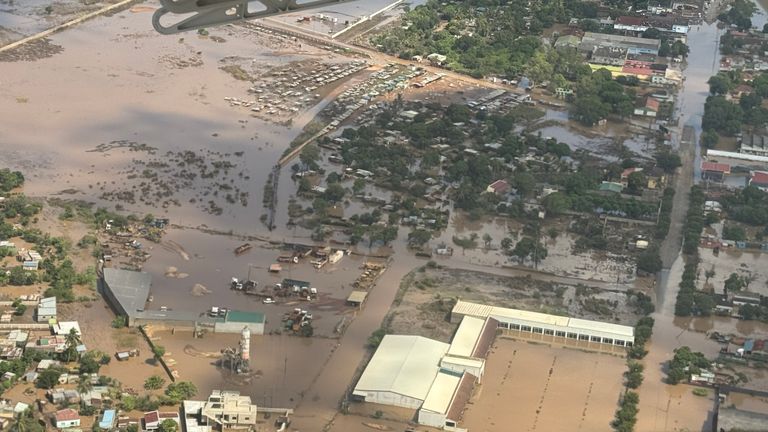
From the air, the devastation is staggering.

Entire neighborhoods are submerged, with only rooftops and treetops visible above the waterline.
Roads that once connected towns now resemble wide, fast-moving rivers, cutting off access to food, medical aid, and rescue teams.
In many areas, boats and helicopters have become the only lifelines for stranded residents.
Survivors describe terrifying scenes as floodwaters arrived suddenly and violently.
Homes built from mud brick and wood collapsed under the force of the current.
Livestock were swept away, crops destroyed, and clean water sources contaminated.
Parents carried children through chest-deep water, unsure where they were going, only knowing they could not stay.
Emergency shelters filled rapidly as displaced families poured in.
Schools, churches, and community centers were converted into temporary refuges, often overcrowded and undersupplied.
Aid workers struggled to distribute food, drinking water, and medical care as demand overwhelmed available resources.
Many families are now sleeping on bare floors, uncertain how long displacement will last or whether they will ever return home.
Health officials warned that the disaster extends far beyond physical destruction.
Standing water and poor sanitation have raised fears of disease outbreaks, including cholera and malaria.
Children and the elderly are particularly vulnerable, and medical teams are racing against time to prevent a secondary health crisis from compounding the tragedy.
The floods have also crippled Mozambique’s agriculture, striking at the heart of food security.
Vast areas of farmland were inundated just as crops were nearing harvest.

Farmers watched helplessly as fields disappeared underwater, wiping out months of labor in hours.
Experts warn that the loss could trigger food shortages and economic hardship long after the waters recede.
Infrastructure damage is severe.
Bridges have collapsed, power lines are down, and entire road networks have been destroyed.
In some provinces, communication has been cut off completely, leaving authorities struggling to ᴀssess conditions in remote areas.
Rescue teams report that some communities remain unreachable, raising fears that the true human toll may be higher than currently reported.
Government officials acknowledged that the disaster has stretched national resources to their limits.
International ᴀssistance has been requested as Mozambique faces the enormous task of responding to immediate needs while planning for long-term recovery.
Relief agencies have called the situation one of the most urgent humanitarian emergencies in the region, urging swift global support.
Meteorologists explain that the flooding was driven by intense and prolonged rainfall linked to powerful weather systems affecting southern Africa.
Saturated ground, swollen rivers, and aging drainage infrastructure combined to create a perfect storm.
Climate experts warn that such extreme events are becoming more frequent, placing vulnerable countries like Mozambique at growing risk.
For those on the ground, the statistics fade into personal loss.
Families mourn loved ones lost to the floodwaters.
Children stare silently at the remains of homes that once sheltered them.
Entire communities face an uncertain future, caught between the trauma of what has happened and the fear of what may still come.
As floodwaters slowly begin to recede in some areas, the scale of rebuilding ahead is daunting.
Homes must be reconstructed, farmland rehabilitated, and infrastructure restored almost from scratch.
Yet for many displaced families, the question remains whether they will have the means to rebuild at all.
Night falls across flooded plains where darkness brings new dangers.
Without electricity, communities rely on flashlights and fires, while the sound of rushing water continues to echo.
Rescue teams work through exhaustion, knowing that every hour could mean the difference between life and death for those still trapped.
Mozambique now stands at a critical moment.
The floods have exposed deep vulnerabilities but also moments of resilience, as neighbors help neighbors and volunteers risk their lives to save strangers.
Still, the crisis is far from over.
This disaster is not just a flood.
It is a national emergency unfolding in real time, a stark reminder of how quickly nature can overwhelm entire regions and how fragile life becomes when the waters rise.


