DNA From Ancient Bones Finally Reveals Where Blue Eyes Came From
For most of human history, brown eyes have dominated the planet. High concentrations of melanin in the iris create shades ranging from dark brown to hazel — a protective adaptation that helps shield the eyes from ultraviolet radiation. Blue eyes, by contrast, are rare and concentrated primarily among people of European ancestry.
For decades, scientists wondered: Did blue eyes evolve multiple times in different populations? Or did they originate from a single mutation in one individual whose descendants carried the trait forward?
Modern genetics has now provided a clear answer.

First, an important clarification: there is no blue pigment in blue eyes.
Brown eyes contain melanin, which absorbs light. Blue eyes occur when melanin levels in the iris are greatly reduced. When light enters the eye, it scatters in the stroma (a layer of connective tissue), reflecting shorter blue wavelengths back to the observer. This optical phenomenon is known as the Tyndall effect — the same reason the sky appears blue.
So the real mystery wasn’t physics. It was genetics. What biological mechanism reduces melanin in the iris just enough to create blue eyes?
The breakthrough came in the early 2000s when researchers focused on two genes located on chromosome 15: OCA2 and HERC2.
The OCA2 gene plays a central role in melanin production. Severe mutations in OCA2 can cause albinism, a condition characterized by very low pigment in skin, hair, and eyes.
:focal(847x637:848x638)/https://tf-cmsv2-smithsonianmag-media.s3.amazonaws.com/filer_public/49/a0/49a04cd4-ff2c-4863-abf0-ddab5e58b61d/screen_shot_2024-10-21_at_114341_am.jpeg)
At first, scientists suspected blue eyes might result from a minor defect in OCA2 — a small glitch that reduced melanin slightly. But genetic data didn’t support that theory. If blue eyes arose from random OCA2 mutations, there would be many different genetic variations producing similar eye colors.
Instead, researchers found something remarkable.
A team led by Professor Hans Eiberg at the University of Copenhagen analyzed DNA from hundreds of blue-eyed individuals across Europe and parts of the Middle East. They identified a single nucleotide polymorphism (SNP) — a tiny genetic change — not in OCA2 itself, but in a regulatory region of the neighboring HERC2 gene.
This mutation acts like a dimmer switch. It doesn’t turn off melanin production completely. It simply reduces OCA2 activity in the iris, lowering pigment levels just enough to create blue eyes.

Here’s the stunning part: every blue-eyed person tested carried the same mutation in the same exact spot.
In genetics, that level of uniformity strongly indicates a single origin.
If blue eyes had evolved multiple times independently, researchers would see different mutations in different populations. Instead, the shared HERC2 variant acts like a genetic fingerprint.
The conclusion: blue eyes originated once, in one individual, and spread through that person’s descendants.
But when did this happen?
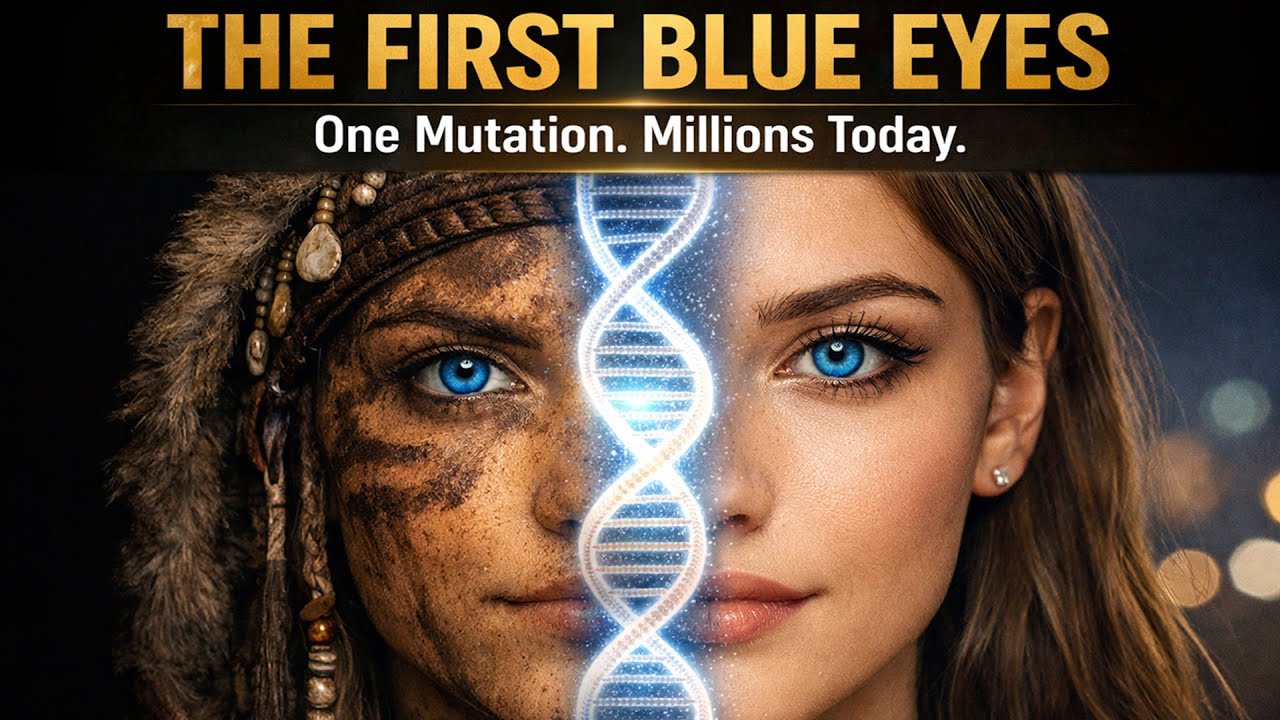
To answer that, scientists turned to paleogenomics — the study of ancient DNA extracted from human remains.
In 2014, researchers sequenced the genome of a 7,000-year-old hunter-gatherer from La Braña, Spain. His DNA revealed something unexpected: he likely had dark skin, dark hair — and blue eyes.
This discovery overturned long-held ᴀssumptions. Blue eyes did not evolve alongside light skin as an adaptation to low sunlight. Instead, they appeared earlier, in populations that still retained darker pigmentation.
Further back in time, remains from Villabruna, Italy, dating to about 14,000 years ago, also carried the blue-eye allele. This suggests the mutation arose roughly 10,000 to 15,000 years ago — likely somewhere in or near the Black Sea region during the late Ice Age.
As glaciers retreated and human populations began expanding and mixing across Europe, the mutation spread.

The transition from Mesolithic hunter-gatherers to Neolithic farmers brought dramatic demographic changes to Europe. Farmers migrating from the Near East introduced new genetic lineages, including lighter skin tones and predominantly brown eyes.
At one point, the blue-eye mutation could have disappeared.
Instead, genetic studies show that European populations became a blend of hunter-gatherers, early farmers, and later steppe herders. The blue-eye allele persisted and even increased in frequency in certain regions.
Today, around 8–10% of the global population has blue eyes, with much higher concentrations in Northern and Eastern Europe.
Why did the trait survive — and even thrive?
Scientists propose several possibilities:
-
Sєxual selection: Rare traits may have been perceived as attractive.
-
Founder effects: Small populations carrying the mutation expanded.
-
Genetic drift: Random shifts in gene frequency over generations.
No single explanation has been definitively proven, but the single-origin model is now widely accepted.
The most profound implication isn’t cosmetic — it’s historical.
Every blue-eyed person alive today shares a common ancestor who lived thousands of years ago. That ancestor likely had dark skin and lived during a time of dramatic climate change and human migration.
Blue eyes are not a marker of deep ancient separation. They are a relatively recent genetic variation — a small mutation that spread through interconnected populations.
In other words, blue-eyed individuals across continents are distant relatives, linked by one ancient genetic event.
The discovery underscores how small genetic changes can ripple across millennia. A single mutation in a regulatory gene altered melanin production in the iris — and became one of humanity’s most recognizable features.
Far from being an ancient, separate lineage, blue eyes are a reminder of how intertwined human history truly is.
Behind every pair of blue eyes lies the same story: one Ice Age individual, one tiny DNA change, and thousands of years of migration, mixing, and survival.


