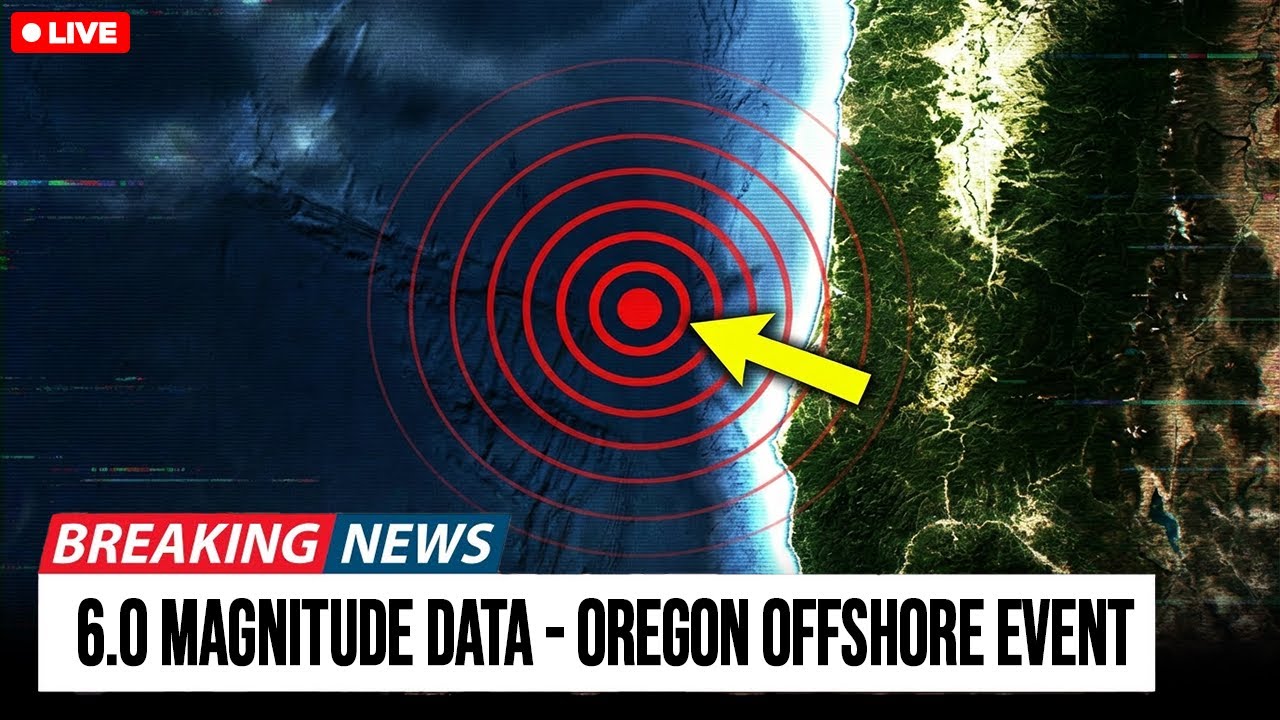
A magnitude 6.0 earthquake struck offshore of the Oregon coast within the past several hours, drawing immediate attention from scientists, emergency agencies, and coastal communities across the Pacific Northwest.
The earthquake was recorded approximately 180 miles west of Coos Bay at a depth of around 115 kilometers beneath the ocean floor.
While no injuries or structural damage have been reported, and officials confirmed the event was too small to generate a tsunami, the tremor renewed widespread awareness of the powerful geological forces operating just beyond the shoreline.
The earthquake was felt lightly in several coastal towns, with some residents reporting a gentle rolling sensation rather than sharp shaking.
In a few inland locations, individuals noted subtle movement, such as swaying lamps or vibrating windows.
Emergency notification systems were briefly activated in select areas, and the National Oceanic and Atmospheric Administration issued routine advisories to confirm that no tsunami threat existed for the West Coast.
Local media outlets rapidly disseminated updates, emphasizing calm while acknowledging the public concern that often follows offshore seismic activity.
For many residents, particularly those living near the coastline, the experience produced more unease than disruption.
The absence of visible damage did little to ease the lingering sense of vulnerability tied to the region’s seismic history.
Scientific attention quickly focused on the location of the earthquake within the broader Cascadia Subduction Zone, one of the most complex and closely monitored fault systems in North America.
Stretching roughly 600 miles from southern British Columbia through Washington and Oregon and into Northern California, this underwater boundary marks where the Juan de Fuca plate slowly descends beneath the North American continent.
The movement occurs at a rate of only a few centimeters per year, but the accumulated energy can be immense.
Although the magnitude 6.0 event was moderate by global standards, its offshore position and proximity to a major tectonic boundary prompted immediate analysis.
Researchers examined whether the rupture altered stress patterns along nearby segments of the fault.
Such changes do not guarantee additional earthquakes, but they can influence where and how seismic energy is released in the future.
Historical records and geological evidence show that the Cascadia Subduction Zone is capable of producing extremely powerful earthquakes, though such events occur infrequently.
The most recent major rupture is believed to have occurred in the year 1700, generating intense ground shaking and a tsunami that traveled across the Pacific Ocean.

Traces of that event remain visible today in coastal landforms, sediment layers, and submerged forests.
Modern monitoring systems now provide scientists with tools unavailable to earlier generations.
Networks of seismometers, ocean floor sensors, satellite measurements, and coastal gauges record even the smallest changes in the Earth’s crust.
Following the recent earthquake, data streams were reviewed continuously for signs of aftershocks, seismic clusters, or unusual patterns.
Emergency management agencies across Oregon responded according to established protocols.
Operations centers confirmed that evacuation routes, communication systems, and coastal signage remained functional.
While the absence of immediate danger allowed daily activities to continue, officials emphasized the importance of preparedness rather than complacency.
Residents along the coast are accustomed to earthquake drills, tsunami route markers, and emergency planning campaigns.
Still, each new tremor serves as a reminder that preparedness is an ongoing process.
Schools reviewed safety procedures, local governments revisited infrastructure ᴀssessments, and households were encouraged to check emergency supplies.
Scientists cautioned against interpreting the event as either a definitive warning or a harmless anomaly.
Earthquake behavior along subduction zones is inherently complex, and moderate offshore earthquakes can have different implications depending on location, depth, and surrounding conditions.
In some cases, such events are followed by periods of relative quiet.
In others, they precede additional seismic activity.
Throughout the day following the earthquake, researchers compared the event with similar offshore tremors recorded in past decades.
While patterns can sometimes be identified, no reliable method exists to predict when or where a larger earthquake might occur.
Instead, each event adds to a growing body of data that refines long term risk ᴀssessments.
Reports submitted through national observation platforms indicated that the earthquake’s energy traveled farther inland than some initial models anticipated.
Communities in central and southern Oregon described sensations ranging from barely noticeable movement to slow, rolling motion.

These reports help scientists better understand how seismic waves propagate through different geological structures.
The psychological impact of the earthquake was significant despite the lack of damage.
Many residents expressed concern about what the event might represent rather than what it caused.
This reaction reflects the unique relationship between the Pacific Northwest and its geological environment, where rare but severe events shape public awareness.
Infrastructure resilience remains a central focus of regional planning.
Bridges, ports, hospitals, and transportation corridors are continually evaluated for their ability to withstand strong shaking.
Coastal defenses and vertical evacuation structures are also part of long term strategies to reduce risk in low lying areas.
Beyond Oregon, seismic stations in Washington and Northern California recorded the event, underscoring the interconnected nature of the region’s fault systems.
Researchers across state and national boundaries shared data and observations, reinforcing a collaborative approach to seismic monitoring.
As the hours pᴀssed, attention turned to the possibility of aftershocks.
While smaller tremors are common following earthquakes, not all events produce noticeable sequences.
Scientists emphasized that the absence of aftershocks does not necessarily indicate reduced risk, just as their presence does not imply escalation.
Public officials continued to reiterate that no tsunami threat existed from this earthquake.
The depth and mechanism of the rupture limited its ability to displace large volumes of water.
Nevertheless, coastal residents were reminded that tsunami awareness remains essential due to the broader risks ᴀssociated with the region.
By the following morning, daily routines had largely resumed.
Fishing vessels returned to harbors, schools opened as scheduled, and businesses operated normally.
Yet conversations about emergency readiness persisted in homes, workplaces, and community spaces.
The event highlighted the value of early warning systems, public education, and transparent communication.
Emergency alerts functioned as designed, providing timely information without causing unnecessary alarm.
Scientists stressed that continued investment in monitoring technology and public outreach is vital for long term safety.
Ultimately, the offshore earthquake served as a quiet but powerful reminder of the forces shaping the Pacific Northwest.
Beneath calm waters and familiar landscapes, tectonic processes continue their slow, relentless movement.
While most days pᴀss without incident, each tremor reinforces the need for awareness and preparation.
The Cascadia Subduction Zone remains one of the most studied fault systems in the world precisely because of its potential impact.
Researchers will continue to analyze data from this event, integrating it into broader models of regional seismic behavior.
For the public, the lesson is neither fear nor dismissal, but readiness grounded in knowledge.
As Oregon’s coastline returns to its outward calm, the underlying reality remains unchanged.
The Earth continues to shift, often quietly, occasionally noticeably.
In this environment, preparedness is not a response to panic, but a steady commitment to resilience.
Every earthquake, no matter its size, contributes to understanding a system that shapes the past, present, and future of the Pacific Northwest.


