Listening to the Deep: How Artificial Intelligence Is Unlocking the Hidden Language of Whales
Far beneath the surface of the ocean, an ancient exchange unfolds every day, carried by rapid clicks and patterned sounds that echo through the dark water.
These signals belong to whales, some of the most intelligent beings on Earth, whose brains outweigh those of humans by several times.
For centuries, their voices were heard but never understood.
Today, a new generation of scientists armed with artificial intelligence is uncovering a form of communication far more complex than anyone imagined, reshaping humanity’s understanding of intelligence, language, and life itself.
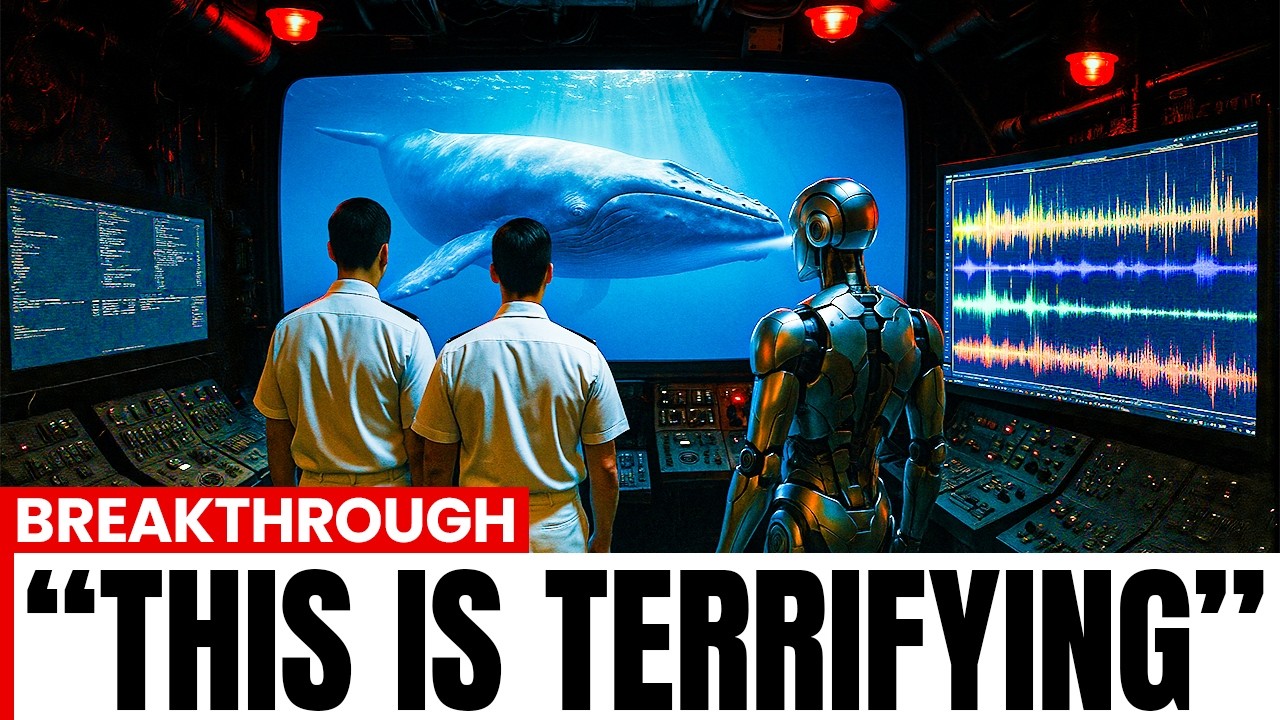
For most of human history, the ocean was viewed as an unknowable frontier.
Sailors returned from long voyages with tales of monstrous creatures and haunting underwater songs.
Whales inspired awe because of their immense size, yet they were largely treated as commodities rather than thinking beings.
Their bodies fueled lamps and fashion, while their voices were dismissed as instinctual noise.
That perception began to change in the late twentieth century, when environmental awareness and scientific curiosity converged in an unexpected way.
During the nineteen seventies, marine researchers studying humpback whales made a discovery that would alter public consciousness.
Using early recording equipment, scientists documented long, structured vocal sequences that lasted for hours and evolved gradually over time.
These recordings were later released as an album that reached a global audience and ignited widespread fascination.
For the first time, whales were not only seen as majestic animals but also as expressive creatures capable of complex acoustic behavior.
This shift played a significant role in the global movement that protected whales from extinction.
Despite this progress, understanding whale communication remained elusive.
Early bioacoustics research relied on limited tools and painstaking manual analysis.
Scientists debated whether whale sounds served simple functions such as mating calls or danger alerts, or whether they represented something more advanced.
The sheer volume of data and the limits of human perception made definitive answers impossible.
For decades, whale language remained an unsolved mystery.
That began to change with the arrival of Dr David Gruber, an American marine biologist and National Geographic explorer.
Gruber believed that traditional methods were insufficient for decoding whale communication.
Instead, he drew inspiration from an unlikely source: the scientific search for extraterrestrial intelligence.
Programs designed to detect alien signals from space focused on identifying patterns within vast streams of unfamiliar data.
Gruber proposed a radical idea.
If scientists were searching the cosmos for intelligent life, perhaps they should first learn to recognize intelligence on their own planet.
This idea became the foundation of the Cetacean Translation Initiative, known as Project CETI.
Its mission was not merely to record whale sounds but to understand them and eventually communicate back.
To achieve this, Gruber ᴀssembled an unprecedented team that included marine biologists, computer scientists, linguists, roboticists, and artificial intelligence specialists.
The goal was ambitious: to decode and translate the communication system of sperm whales.
One of the project’s central figures was marine biologist Shane Gero, who had spent more than a decade studying a single extended family of sperm whales near the Caribbean island of Dominica.
His work involved close, long term observation of individual whales across generations, allowing him to understand their social structures and behaviors in extraordinary detail.
This deep contextual knowledge became essential for interpreting vocalizations as meaningful communication rather than random noise.

Dominica was chosen as the operational center of Project CETI for strategic reasons.
Its volcanic seafloor drops steeply near the coast, allowing deep diving sperm whales to be studied close to land.
The region is home to stable whale populations that return year after year, making it ideal for long term research.
With major funding secured in twenty twenty, including tens of millions of dollars from international science initiatives, the project moved from concept to reality.
The first major task was the construction of a mᴀssive underwater listening system.
Researchers deployed large arrays of hydrophones across a defined section of ocean, creating a continuous acoustic monitoring network.
These underwater microphones recorded whale sounds around the clock and allowed scientists to identify which individual whale produced each vocalization.
This spatial precision marked a turning point in the study of marine communication.
To add further context, the team deployed advanced robotic systems capable of attaching non invasive sensor tags to whales using suction cups.
These tags recorded audio alongside movement, depth, and social interactions.
By combining acoustic data with behavioral information, researchers could determine not only what sounds were made, but also why and under what circumstances.
The scale of data collection far exceeded anything attempted before.
Instead of hours of recordings, Project CETI gathered millions of vocalizations over multiple years.
This enormous dataset was essential for artificial intelligence models, which rely on large volumes of information to detect patterns and structure.
Previous efforts had failed largely because the available data was too limited for meaningful analysis.
The real breakthrough occurred when this vast library of whale sounds was processed using machine learning.
Raw audio was converted into spectrograms, visual representations of sound that allowed AI systems to analyze patterns beyond human hearing.
The models were trained to identify codas, which are specific sequences of clicks used by sperm whales in social communication.
Rather than being programmed with predefined rules, the AI learned by exposure.
By analyzing millions of codas, the system began identifying recurring structures, rhythmic variations, and contextual patterns.
Over time, it detected distinctions in tempo, timing, and ornamentation that human listeners could not perceive.
These subtle variations proved to be critical components of whale communication.
The findings were astonishing.
Whale communication was not a simple set of signals but a combinatorial system resembling elements of human language.
Codas functioned like phonetic units, with rhythm and timing modifying meaning.
Small changes in sequence altered interpretation, allowing whales to convey a wide range of messages using a shared acoustic framework.
This discovery challenged long held ᴀssumptions about the uniqueness of human language.
Even more remarkable was the social dimension of this communication.

Analysis revealed that different whale families used distinct dialects, enabling identification through vocal patterns alone.
These dialects were culturally transmitted across generations, demonstrating that whale communication was not only biological but also cultural.
Meaning depended on context, relationship, and group idenтιтy, much like human speech.
The implications extended beyond pᴀssive understanding.
With knowledge of structural patterns, Project CETI began exploring the possibility of two way communication.
Using underwater speakers, researchers tested whether whales would respond to artificially generated codas.
In a landmark experiment conducted in twenty twenty three, a whale responded with a matching coda after hearing a synthesized signal.
This exchange represented the first intentional back and forth interaction between humans and whales using their own communication system.
Such progress raised ethical questions.
Scientists emphasized the importance of respecting whale autonomy and avoiding disruption of natural behaviors.
The goal was not to impose human concepts but to engage cautiously and responsibly, allowing whales to control the terms of interaction.
Ethical oversight became a core component of the project.
Beyond marine biology, the significance of Project CETI reached into broader scientific domains.
The methods developed for decoding whale communication offered new strategies for identifying intelligence in unfamiliar forms.
The same techniques could one day ᴀssist in the detection of extraterrestrial signals, providing a framework for interpreting non human communication across the universe.
Perhaps most profoundly, this research transformed humanity’s relationship with whales.
Understanding their communication revealed complex social lives, shared histories, and cultural idenтιтies.
Whales emerged not merely as animals to protect, but as intelligent beings with voices worthy of attention.
This realization strengthened arguments for ocean conservation and redefined humanity’s responsibility toward other life forms.
Project CETI continues to expand, with plans to study additional species and refine artificial intelligence models further.
As technology advances, the boundary between human and non human communication grows thinner.
The ocean, once silent and unknowable, is beginning to speak in ways science can finally hear.
In listening to whales, humanity is not only discovering another language but also learning how to listen more carefully to the world it shares.


