The Oseberg Ship: A Viking Burial That Revealed a Dark Ritual
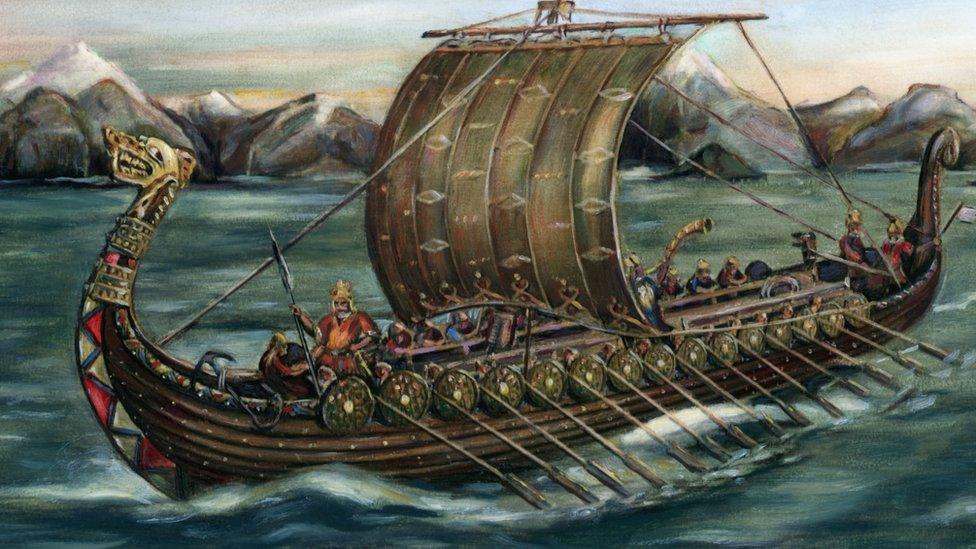
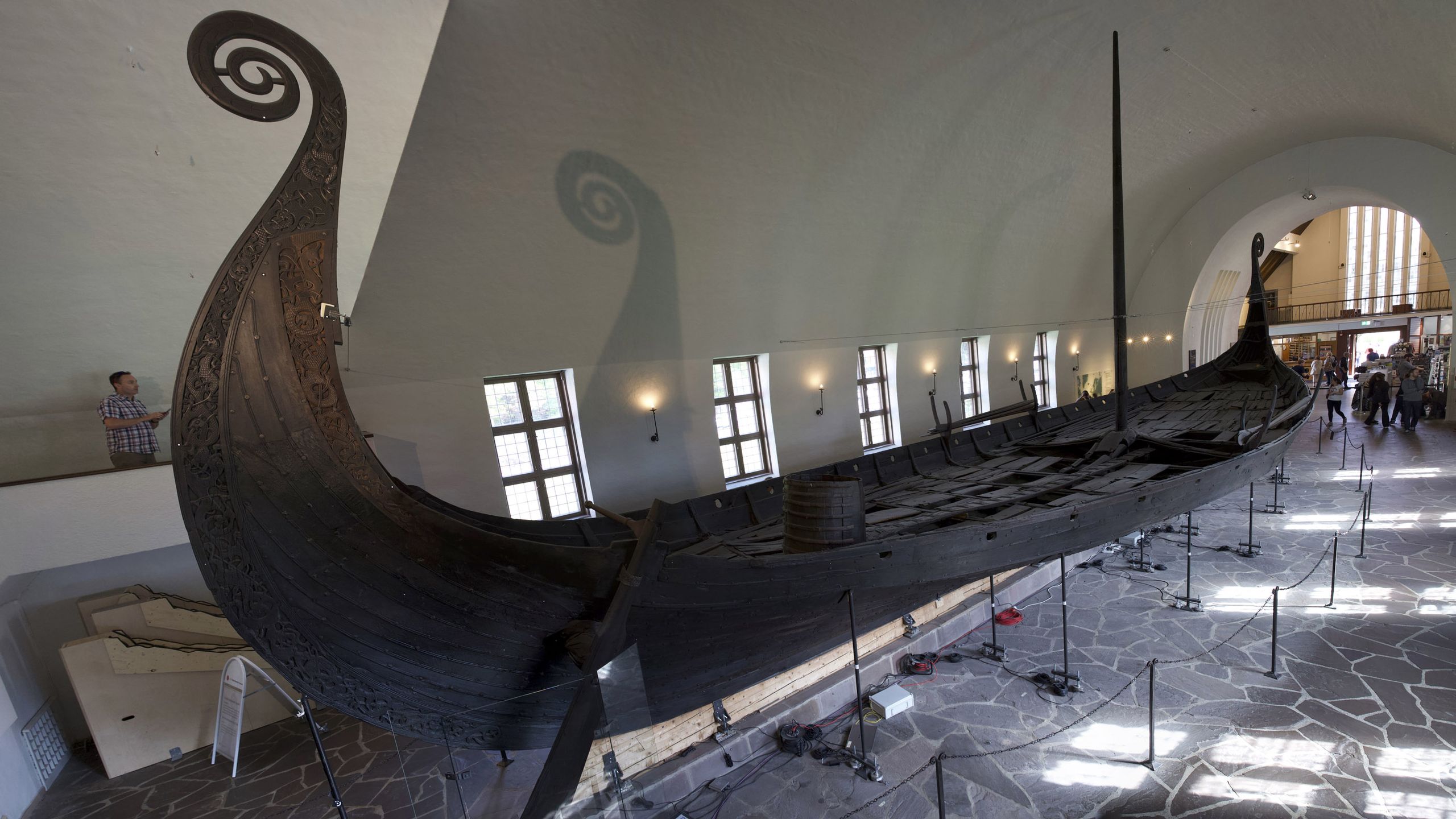
In the summer of 1904, a Norwegian farm became the site of one of the most extraordinary archaeological discoveries in history. Beneath a grᴀssy burial mound lay a 70-foot oak Viking ship, astonishingly intact after more than a millennium underground. Encased in dense blue clay that acted like a natural vacuum seal, the vessel had been preserved with breathtaking precision.
But this was no ordinary shipwreck. It had never sunk at sea. It had been deliberately dragged inland, lowered into a trench, and buried under layers of stone and turf. What archaeologists uncovered inside would challenge long-held ᴀssumptions about Viking society.
The Oseberg ship was not merely a royal burial. It was the stage for a meticulously orchestrated ritual.

Inside and around the vessel, researchers found the remains of at least fifteen horses, several oxen, and multiple dogs. Nearly all the animals had been decapitated. Their skulls were positioned deliberately, many facing the ship’s bow as if guiding it into the afterlife. In a society where livestock represented immense wealth, sacrificing so many animals was a staggering display of power and devotion.
Yet the animals were only part of the spectacle.
At the center of the ship stood a specially constructed timber burial chamber — a “house within a boat.” Inside lay the remains of two women. One was elderly, likely in her late 70s or early 80s — an exceptionally advanced age for the 9th century. The other was younger, perhaps in her early 50s.
For decades, historians ᴀssumed the pair represented a noblewoman and her loyal servant. But modern forensic science told a darker story.
Isotope analysis — which reveals diet and geographic origin through chemical signatures in bones and teeth — showed that the older woman had consumed a rich, protein-heavy diet consistent with high status. The younger woman’s isotopic signature suggested a poorer upbringing and possibly foreign origins. Evidence pointed to her being a thrall — a slave.
Further examination revealed trauma to the younger woman’s body, including a broken collarbone sustained near the time of death. The injury suggested violence rather than natural causes. Increasingly, scholars believe she was sacrificed to accompany the older woman into the afterlife.

This interpretation aligns with historical accounts. The 10th-century Arab traveler Ahmad Ibn Fadlan described witnessing a Viking funeral along the Volga River in which a slave girl was ritually killed to serve her master in death. While the Oseberg burial cannot be reconstructed with certainty, the parallels are chilling.
But who was the elderly woman?
The grave goods offer clues. The ship contained finely carved sledges, ornate furniture, elaborate tapestries, and a four-wheeled ceremonial cart decorated with mythological scenes. Most striking was an iron staff — believed to be ᴀssociated with seiðr, a form of Norse magic practiced primarily by women known as völur (seers).

Seiðr was a powerful and feared ritual tradition involving prophecy, trance states, and communication with the spirit world. The presence of the staff, along with ritual objects including hemp seeds and henbane (a hallucinogenic plant), suggests the older woman may have been a spiritual leader — perhaps a revered seer rather than merely a political queen.
If so, the burial takes on even greater meaning.
The Oseberg ship appears to have been constructed not just as transportation for the ᴅᴇᴀᴅ, but as a carefully engineered bridge between worlds. The tapestries found within depict scenes ᴀssociated with Norse mythology, including figures hanging from trees — possibly referencing Odin’s sacrificial ordeal on Yggdrasil, the world tree.
These images may have served as symbolic guides for the journey beyond.
Even the footwear buried with the older woman seems purposeful. Soft leather shoes, unworn and pristine, were likely intended for her pᴀssage into the afterlife — reflecting Norse beliefs that the ᴅᴇᴀᴅ faced a long and difficult journey.
Yet the story did not end with burial.
Sometime in the late 10th century, roughly a century after the funeral, someone broke into the mound. For years, archaeologists ᴀssumed grave robbers were responsible. But curiously, valuable objects remained untouched.
Instead, the intruders disturbed the skeletons, removing and scattering major bones — particularly skulls and long limbs.
This suggests a different motive.
In Norse belief, the ᴅᴇᴀᴅ could return as draugar — corporeal unᴅᴇᴀᴅ beings capable of harming the living. If a powerful seer had been improperly settled, descendants may have feared her return. The disturbance of the remains may have been a ritual act intended to neutralize her power — a second ceremony to ensure she stayed ᴅᴇᴀᴅ.

Modern scientific analysis continues to reveal new layers. Traces of vivid pigments show that the ship had once been painted in bright colors before burial. Protein and residue studies are uncovering more about the materials used in the ritual. The Oseberg site, once thought fully excavated, still yields secrets more than a century later.
Today, the restored ship stands in Oslo’s Viking Ship Museum — elegant, silent, and imposing. Visitors admire its craftsmanship, its graceful hull, and its intricate carvings. Yet beneath its beauty lies a narrative of sacrifice, hierarchy, and profound spiritual conviction.
The Oseberg burial reveals a Viking worldview where power extended beyond death, where ritual violence reinforced social order, and where faith demanded enormous cost.

It forces us to confront a civilization far more complex — and darker — than popular culture often portrays.
The ship was built to cross boundaries: between land and sea, life and death, fear and faith. For 1,200 years it lay sealed in clay, guarding the memory of a ritual that blended art with atrocity.
Now uncovered, it reminds us that history is not just about discovery. Sometimes, it is about confronting the unsettling truths left behind.


