Across Europe, mᴀssive concrete bunkers constructed by Nazi Germany during World War Two continue to emerge from forests, coastlines, mountains, and even beneath modern cities.
Many of these structures were deliberately concealed using terrain, camouflage, and underground engineering so effective that some remained undiscovered for decades after the war ended.
Together, they form a chilling record of Adolf Hitler military ambitions, the technological extremes of the Third Reich, and the immense human cost paid by forced laborers who built them.
These bunkers were not simply defensive shelters.

They were components of an unprecedented military infrastructure designed to support long range weapons, submarine fleets, aircraft production, and command operations.
Advances in archaeology, satellite imaging, and accidental natural erosion have allowed historians to rediscover and reᴀssess many of these sites in recent decades.
One of the most ambitious fortifications ever constructed was the Fortress of Mimoyecques in northern France.
Located near the English Channel, the underground complex was built to house the V Three supergun, a weapon designed to bombard London continuously.
Construction began in nineteen forty three under extreme secrecy.
Engineers excavated deep railway tunnels and angled shafts intended to support mᴀssive gun barrels.
More than five thousand workers, including enslaved Soviet prisoners, labored under brutal conditions.
Allied intelligence eventually identified the site, and sustained bombing raids culminated in a decisive attack using Tallboy bombs in July nineteen forty four.
The resulting underground collapses rendered the fortress unusable.
It was later demolished on orders from Winston Churchill.
Today, portions of the structure remain accessible as a museum commemorating both Allied airmen and forced laborers.
Another long forgotten installation was the Maisy Battery in Normandy.
Buried beneath farmland near the D Day landing beaches, the site remained undocumented for more than sixty years.
Its rediscovery began in two thousand four when a British historian uncovered hidden bunker entrances beneath dense vegetation.
Subsequent excavation revealed a sprawling complex with artillery positions, command centers, medical facilities, and extensive trench systems.

The battery remained operational during the Normandy landings and shelled Allied forces for several days due to intelligence oversights.
Artifacts recovered from the site included ammunition, uniforms, and signs of close quarters combat, reshaping historical understanding of coastal defenses in the region.
Along the western coast of Denmark, thousands of bunkers were built as part of the Atlantic Wall.
In two thousand eight, violent storms uncovered several fully preserved bunkers buried beneath sand dunes.
Inside, archaeologists found personal belongings left untouched since nineteen forty five, including uniforms, medical supplies, and communication equipment.
The discoveries sparked national debate over preservation versus destruction.
Ultimately, many bunkers were conserved and converted into museums, becoming educational sites that confront difficult aspects of occupation history.
Deep within the forests of northeastern Poland lies the Wolf Lair, Adolf Hitler primary headquarters on the Eastern Front.
Constructed beginning in nineteen forty, the compound covered hundreds of hectares and contained reinforced bunkers with walls several meters thick.
Hitler spent more than eight hundred days there directing military operations.

The site became infamous as the location of the failed ᴀssᴀssination attempt by Claus von Stauffenberg in July nineteen forty four.
Human remains discovered near the complex decades later confirmed the presence of forced laborers who built and maintained the facility.
Today, the ruins attract hundreds of thousands of visitors annually.
In Hamburg, the Elbe Two U boat bunker represents the extraordinary durability of German naval engineering.
Built to protect submarines from Allied bombing, the structure was partially demolished after the war using mᴀssive explosives.
Despite this, the bunker survived largely intact, sealing submarines inside for decades.
Rediscovered in the nineteen eighties, the site was later filled with concrete and converted into a port facility, leaving its contents permanently entombed beneath the city.
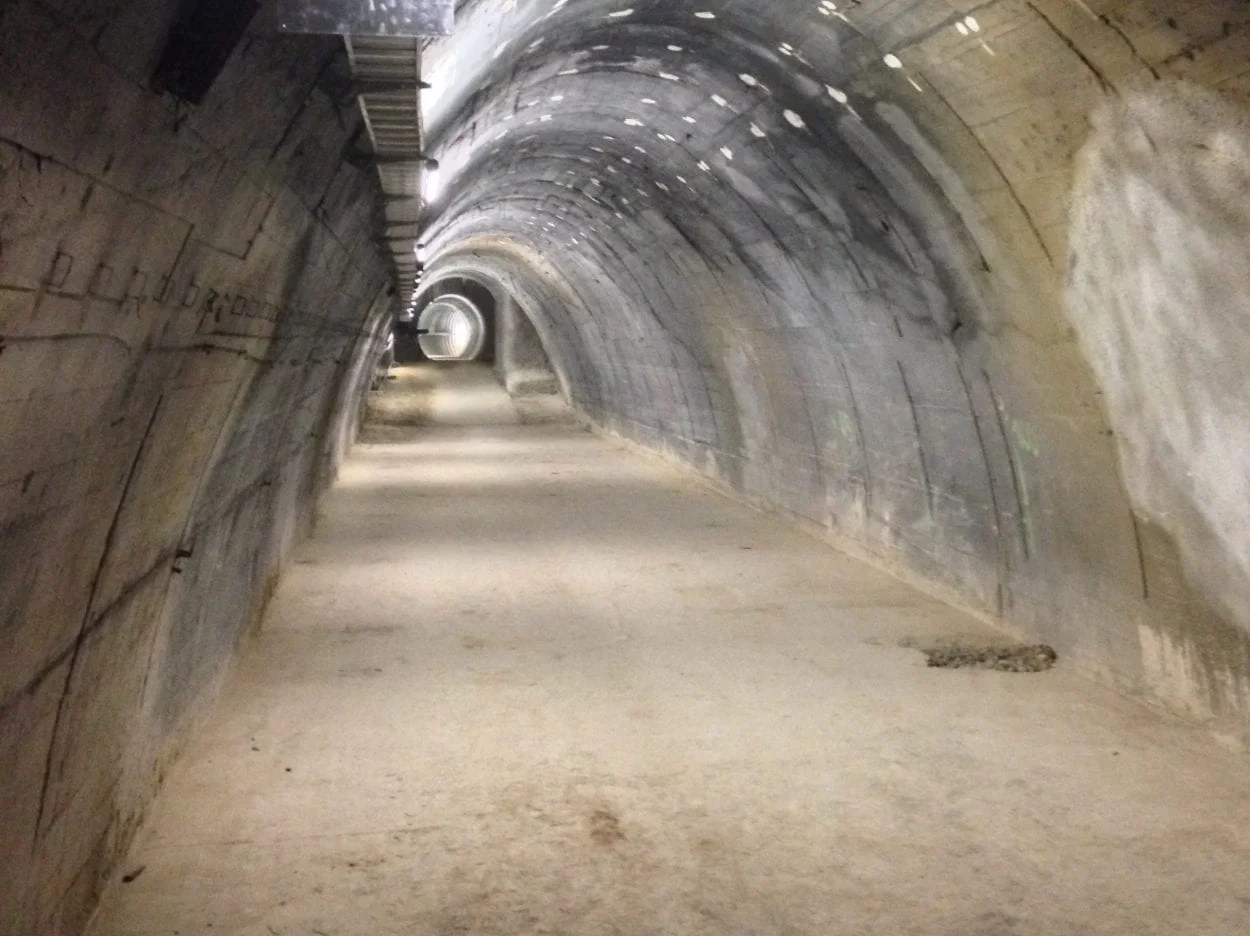
On the Channel Island of Jersey, extensive tunnel systems known as Hohlgangsanlage were excavated deep underground to shelter German troops.
Construction relied heavily on forced labor from across Europe, many of whom died from exhaustion and malnutrition.
After the war, the tunnels were opened to the public and later developed into a museum that documents daily life during occupation and the suffering endured by laborers.
In Bavaria, the partially completed Weingut One facility stands as a stark reminder of wartime desperation.
Designed as an underground factory for jet aircraft engines, the project relied on thousands of concentration camp prisoners.
More than three thousand workers died during construction, and the facility never became operational.
After the war, most of the structure was deliberately destroyed, leaving a single concrete arch as a memorial.
Another mᴀssive structure, Blockhaus d Eperlecques in northern France, was built to ᴀssemble and launch V Two rockets.
Allied bombing campaigns damaged the site beyond repair before it could be used.
Today, the preserved remains serve as a museum detailing the V weapon program and the forced labor system that sustained it.
In Austria, the Bergkristall facility beneath St Georgen an der Gusen became one of the most productive underground aircraft factories of the war.
Tens of thousands of prisoners worked in ᴅᴇᴀᴅly conditions ᴀssembling jet aircraft components.
Liberation forces found the complex nearly complete.
The tunnels were later destroyed to prevent technological exploitation.
The Mittelbau Dora complex in Germany represents one of the most lethal industrial sites of the Third Reich.
Prisoners lived and worked entirely underground while producing V Two rockets.
Of the approximately sixty thousand prisoners who pᴀssed through the camp, at least twenty thousand died.
The site now stands as a memorial to those victims.
Along the French coast, Battery Todt housed mᴀssive artillery guns capable of firing across the English Channel.
Although heavily fortified, the installation fell with minimal resistance in nineteen forty four.
It later became a museum showcasing Atlantic Wall defenses.
The Siracourt V One bunker in northern France was designed using innovative construction methods to protect it from bombing.
Despite heavy bombardment, the structure survived largely intact but was never completed.
It remains one of the most imposing abandoned V weapon sites.

La Coupole near Saint Omer featured a mᴀssive concrete dome sheltering underground rocket facilities.
Allied bombing prevented its use, and today it functions as a history center and planetarium.
In Poland, Project Riese remains one of the most mysterious underground construction efforts of the war.
The unfinished tunnel networks beneath the Owl Mountains have fueled decades of speculation about their intended purpose.
Documentation was deliberately destroyed, leaving historians divided between theories of headquarters construction and weapons production.
Finally, beneath Berlin, the Führerbunker marked the final days of the Third Reich.
Constructed in stages beneath the Reich Chancellery, the bunker became Adolf Hitler last refuge as Soviet forces advanced.
Within its confined rooms, the Nazi leadership witnessed the collapse of the regime.
After the war, the site was largely demolished and buried, with only minimal markers indicating its location.
Together, these bunkers reveal the immense scale of Nazi Germany underground ambitions.
They stand as enduring reminders of technological obsession, military overreach, and the human suffering inflicted in pursuit of total war.
Nearly a century later, their rediscovery continues to reshape understanding of World War Two history.
https://youtu.be/VehJ2IpLdKU?si=HVAOQL77DyZUPh6n


